
The Islamabad memorandum, signed on June 17 under Pakistani mediation, was meant to end the war within sixty days. It collapsed in July, and the American blockade returned. Today, the negotiations appear to be making no progress whatsoever.
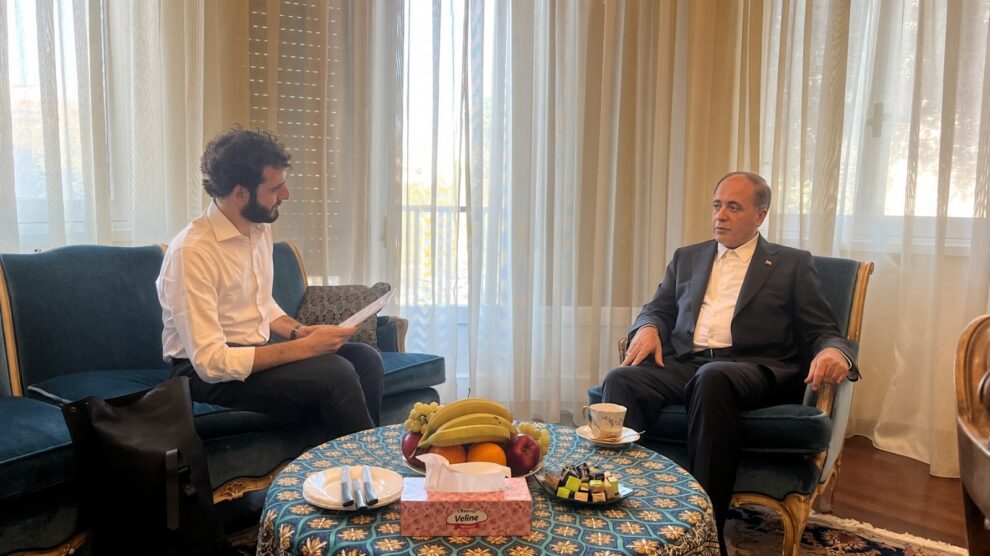
The situation has had repercussions on economies across the global system, including, of course, Iran’s own. Decode39 discussed precisely this with Tehran’s Minister of Agriculture, Gholamreza Nouri Ghezeljeh, before exploring other topics, from the growing weight of the Caspian routes to relations with Moscow and Beijing, to the prospects for negotiations with Washington and the possible role of Italy.
Q: What has been the impact of the war and the ensuing blockade on Iranian agriculture?
A: The war certainly has a cost, for our country too, especially when it comes to food. But it has had a cost for the whole world: energy and food prices have risen everywhere, not just here. We did not start this war; we have always stood for peace and dialogue. America and Israel attacked us, and we defended ourselves well, people and government together. When someone attacks your country, you factor in the cost of defence. Anyone with a bit of pride defends their country, and in Iran everyone thinks this way.
- And despite the war, we have also had some successes in the food sector. We have become self-sufficient in the production of certain goods we used to import. There has been no food shortage in Iran, even though, as in the rest of the world, prices have gone up. But rest assured that Iran will soon embark on a path of development at an extraordinary, almost miraculous pace, until it becomes a true paradise for investment.
Q: During the conflict, 3 million tonnes of inputs arrived through the northern ports. Has the Caspian, and therefore Russia, become a vital artery? Has a kind of dependence developed? How has the relationship with Moscow evolved?
A: The relationship with Russia is very important. Naturally, with the war our trade routes became more effective and helped the country a great deal. Our relationship with Russia is based on a bilateral agreement between friendly countries. Of course, every country also looks after its own interests, so it is a relationship based on mutual benefit.
- And it is not only Russia: we have also had good cooperation with other countries along our northern border. Iran is a large country, and all its neighbours need this relationship. It is a reciprocal relationship, one that looks at our needs as much as theirs.
Q: And what about China?
A: We also have a very good relationship with China. Like us, China opposes unilateralism and needs to develop relations with other countries. We have a good trade relationship and continue to have one. We cooperate with China, as with Russia, within the framework of the Shanghai Cooperation Organisation and BRICS. China is recognised by the whole world as a great economic power.
Q: Moscow has benefited from oil above 100 dollars. Do you have the sense that it suits Russia for the crisis to continue?
A: It is natural. Every country in the world pursues its own national interests and, when an opportunity arises, moves to seize it. Russia too follows its own interests, like everyone else. This situation has created good opportunities for Moscow, and it is natural that Russia benefits from it today.
- America has accepted this, with Trump acknowledging its role, and has then also opened up to deals with Russia. We hope the war ends, and that is an interest we all share. Today Russia is profiting from higher fuel prices. In the future, once the war is over, every country must be able to reap its own benefits.
Q: You said you are hopeful about the negotiations. What, in your view, is missing for a return to the June memorandum?
A: It was a logical agreement, and we hope the American side will go back to respecting it. No war lasts forever, and in the end peace always comes. This war has imposed heavy costs on the whole world. People everywhere are already paying a high price for Trump’s warmongering policies, above all because of rising energy and food prices, and that is why they are angry.
- So I think an agreement will be reached soon. The most far-sighted politicians are pressing Trump to end the war, and it is in everyone’s interest that it ends as soon as possible. We remain faithful to the June agreement; it was the United States that withdrew from it. We hope they will go back to respecting it.
- The Iranian people and the armed forces have shown that they do not yield to the enemy’s insistence. If Trump carries on, he will have problems at home as well. You can see in Italy too how much oil and petrol prices have risen. All reasonable people in the world would like this to end soon, and the position of His Holiness the Pope also points in this direction. I believe that in the end this will prevail. No war lasts forever.
Q: How is Rome seen from Tehran?
A: We look at Italy with the respect of one great civilisation towards another. Italy, like Iran, has a great culture: these are two civilisations that have done a great deal for the advancement of humanity. We have had diplomatic and trade relations with Italy for more than 150 years.
- Despite the distance, our two peoples have many things in common. We hope this closeness between the two peoples will also reach the level of governments. We want to develop relations between Italy and Iran, in agriculture too, but not only there.
Q: So do you think Italy could be a credible mediator?
A: In the past, Italy has shown a rational and reasonable attitude on these issues. That is perhaps why it can play a more important and more active role, and I think it will move in that direction in the future. Or at least, that is what we expect.