
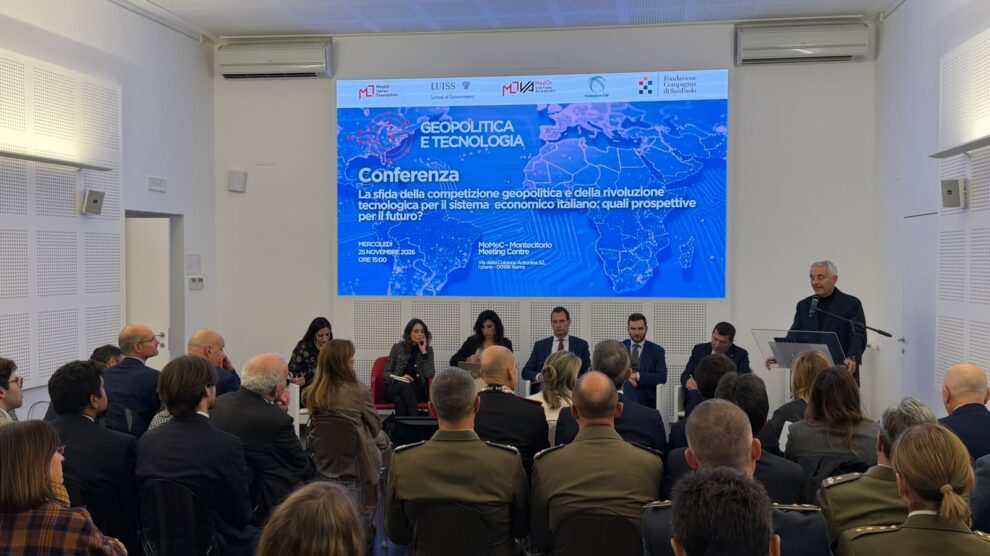
Med-Or Italian Foundation and the Luiss School of Government presented the volume “Geopolitics, Technologies and Security in the Mediterranean” on November 25 at the MoMeC – Montecitorio Meeting Centre in Rome.
The book: Published by Rubbettino, the book concludes the research project of the same name, coordinated by Med-Or Italian Foundation and developed in collaboration with the Luiss School of Government, as part of the “Geopolitics and Technology” call for proposals promoted by Fondazione Compagnia di San Paolo and Fondazione CSF.
- Edited by Enrico Casini, Federico Deiana and Giordana Terracina, the publication brings together six essays exploring transformations in Mediterranean connectivity, energy security and unconventional threats, with particular attention to their implications for Italy. The research project, launched in November 2025, included two major events: a workshop hosted by Luiss last March and an international conference held in Rome in July.
The November 25 event opened with institutional remarks by Gaetano Quagliariello, Dean of the Luiss School of Government, and Nicolò Russo Perez, Director of Fondazione CSF.
- The roundtable, introduced by Enrico Casini and moderated by Ginevra Leganza, featured Luiss professor Carolina De Stefano, Sapienza University professor Alessia Melcangi, Massimo Deandreis, Director General of Studi e Ricerche per il Mezzogiorno (SRM), Igor Malgieri, Head of International Affairs at Edison, and Enrico Savio, Managing Director of Leonardo International. Andrea Manciulli, Director of Institutional Relations at Med-Or Italian Foundation, delivered the closing remarks.
Why it matters. The transformation of the Mediterranean into an arena of growing international competition confronts Italy with an issue that concerns its very ability to exert geopolitical influence: technological autonomy.
- The protection of strategic infrastructure, the management of energy and information flows, and the development of advanced industrial capabilities are now integral components of national security policies.
The big picture. The research project starts from the premise that transformations in the international order, the return of great-power competition and accelerating technological change have given the Mediterranean renewed strategic importance.
- The region sits at the intersection of economic systems, infrastructure networks and strategic interests that extend well beyond its geographical boundaries. Understanding its dynamics therefore requires an approach that brings together foreign policy, security, innovation and industrial policy.
Technological autonomy and political sovereignty. One issue that emerged during the discussion concerns the relationship between technological autonomy and political sovereignty.
- Savio explained how reliance on technological capabilities developed by other actors can constrain independent national decision-making. Having systems of one’s own, particularly in sectors most exposed to hybrid warfare, therefore takes on direct political significance.
- This applies particularly to control over data, whose availability underpins decision-making processes in both civilian and military domains.
- The issue also concerns the future of European defence: investments mobilised through instruments such as SAFE should be matched by greater strategic convergence among member states. According to Savio, Europe must “identify at least a thin thread of common priorities or interests” to develop shared capabilities.
Below the surface. The technological dimension of Mediterranean security — where that thin thread could begin to unfold as a matter of priority — is equally evident beneath the surface of the sea.
- Telecommunications cables and energy transport infrastructure constitute the connective tissue underpinning economic relations between Europe, Africa and Asia. Their vulnerability exposes the countries that depend on them to forms of pressure potentially capable of producing systemic consequences.
- Reflecting on the prospects for consolidating a Western and European supply chain for subsea infrastructure, Deandreis examined how growing demand for security could become an opportunity for Italy to strengthen its industrial positioning, given the country’s expertise in shipbuilding, sensor systems and underwater technologies.
- Protecting Mediterranean connectivity thus becomes an area in which to develop exportable technological capabilities and new forms of international cooperation.
Energy and industrial competitiveness. Similar considerations apply to energy. As Malgieri highlighted, the challenge lies in reconciling security of supply with competitive energy costs, on which much of the resilience of Italy’s manufacturing sector depends.
- The energy transition is also generating new technological dependencies, as demonstrated by China’s weight in photovoltaic supply chains, while the spread of artificial intelligence raises further questions about the ability to meet electricity demand.
- The prospects associated with hydroelectric energy storage and next-generation nuclear power, discussed during the conference, illustrate the complexity of the choices facing Italy. Infrastructure development will therefore need to proceed in parallel with the development of the industrial expertise required to manage it.
The bottom line. This is one of the elements that make the multidisciplinary approach adopted by Med-Or and the Luiss School of Government particularly relevant.
- The Mediterranean’s growing strategic importance — examined during the discussion through Melcangi’s academic assessment of regional instability and De Stefano’s analysis of the significant role played by Russia — offers Italy opportunities to expand its international reach while simultaneously increasing its exposure to geopolitical tensions and technological vulnerabilities across the region.
- Geography represents a potential advantage. Its strategic value will ultimately be determined by the industrial, technological and diplomatic capabilities Italy can mobilise, including its ability to shape Europe’s policy choices.