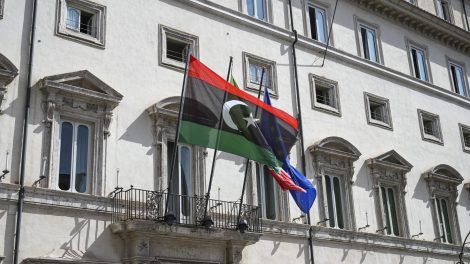

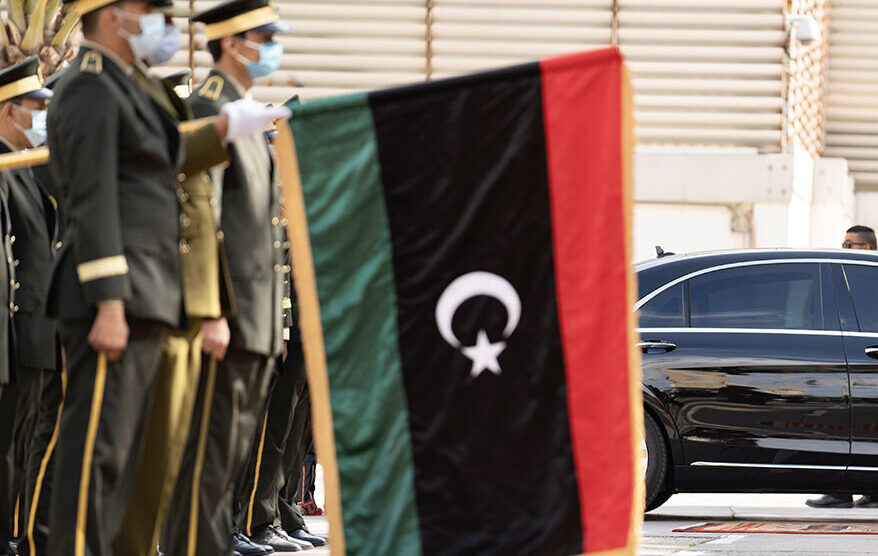
Renewed Ukrainian operations against Russian interests in Libya require Italy to reassess the security of its southern neighbourhood. Foreign Minister Antonio Tajani’s concerns over the risk of the Russian-Ukrainian war spreading to the Mediterranean reflect legitimate national security interests.
However, recent developments have also brought back to the centre of political attention a strategic issue that predates Kyiv’s military initiatives by almost a decade: Russia’s entrenched presence in the North African country.
Why it matters: Senator Marco Dreosto, Senate group leader of the League, identifies both dimensions of Italy’s strategic dilemma.
- “The Ukrainian attack against the Russian corvette moored in the port of Benghazi concerns us for two reasons. On the one hand, we cannot accept the war spreading to the Mediterranean, just a few hundred kilometres from our shores, where trade routes, energy routes and infrastructure vital to Italy are located. On the other hand, the episode confirms an already structured Russian military presence in Libya, with warships. This is a fact that can no longer be underestimated.”
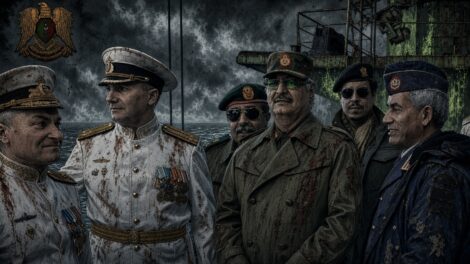
The big picture: The relationship between these two dimensions defines the complexity of Italy’s position. Over the years, Cyrenaica has become a platform through which Moscow supports its military and geoeconomic projection across Africa.
- The relationship established with Khalifa Haftar has allowed Russia to gain strategic depth in the central Mediterranean, sustain its activities in the Sahel and pursue ambitions extending towards Sudan and the Horn of Africa.
Zoom in: Haftar’s evolving relationships. Haftar, who travelled to Turkey on Wednesday to meet President Recep Tayyip Erdoğan, is now entering a different phase of his political engagement.
- Channels with Turkey have recently reopened despite Ankara having defeated Haftar militarily in 2020, when he attempted to seize Tripoli from the UN-recognised government, which Turkey defended.
- Relations with Moscow remain in place. However, according to some observers, Haftar’s renewed engagement with Erdoğan, the leader of a key NATO member, could also serve to weaken his ties with the Kremlin. Moscow, meanwhile, has accused Turkey of providing assistance to the Ukrainians.
- For Italian diplomacy, this opens a particularly relevant avenue for engagement with Turkey, which retains significant political and military influence in western Libya, and with the United States, which is developing relationships with both sides of the country.
- Offering Cyrenaica’s leadership credible political, economic and security alternatives to its relationship with Moscow could help address the structural conditions fuelling the current escalation.
The Indo-Mediterranean dimension. These developments have implications for a broader strategic geography, encompassing areas crossed by major commercial and energy connectivity routes between the eastern Mediterranean and the Gulf, and more broadly between Asia and Europe. They also intersect with Italy’s strategic projection towards Africa through the Mattei Plan.
- From this perspective, Ukraine’s decision to exert pressure on Russian military interests outside the Eastern European theatre follows an understandable logic of tactical and strategic asymmetry, notwithstanding questions concerning international law and Libyan sovereignty.
- It also illustrates the direct connections between different geostrategic theatres and the complexity of their interdependencies. The predictability of such developments, however, raises questions about the effectiveness of the Western response to Moscow’s progressive penetration of North Africa.
NATO’s southern flank. “For this reason, Italy must strongly demand, within NATO and at the European level, that strategic attention should not focus solely on the eastern flank. The Mediterranean must not become a sea of war; the security of the southern flank is crucial for us and for the entire Alliance,” Dreosto says.
- “Europe must understand this quickly: Italy must be present and focus its efforts where geography places it and where its strategic and national interests are at stake, which are also those of all its allies.”
- The issue raised by the senator concerns the need to overcome an excessively compartmentalised understanding of European security. Russia’s activities along the eastern flank and those conducted across the Mediterranean and Africa belong to the same overarching strategy of power projection, although they take different forms.
- “The new Ukrainian attack in Libya confirms a dangerous escalation that risks bringing the war into the heart of the Mediterranean. This is a development that must be firmly averted,” Dreosto reiterates.
- “It is necessary to prevent any expansion of the conflict and, at the same time, remain highly vigilant about the growing Russian military presence in the North African country, which directly threatens the Atlantic Alliance’s southern flank.”
Europe’s strategic response. The expansion of the mandate of the EU naval operation Irini to contribute to countering Russia’s shadow fleet reflects Brussels’ growing awareness of the connections between maritime security, illicit trafficking, sanctions evasion and hybrid activities.
- However, several policymakers argue that further efforts may be necessary.
- The situation in Libya is particularly delicate: the reported Ukrainian presence in Tripolitania, alongside Russia’s presence in Cyrenaica, risks exacerbating Libya’s territorial and political divisions, undermining international efforts towards the country’s reunification.
The bottom line: “For Italy, the strategic priority remains the full security of maritime routes, energy infrastructure and submarine cables crossing the Mediterranean. Defending Libya’s stability and supporting its path towards pacification is the only way to truly protect our national interests and strengthen the security of NATO’s southern flank, which must return to the centre of the European and Atlantic agenda,” Dreosto concludes.