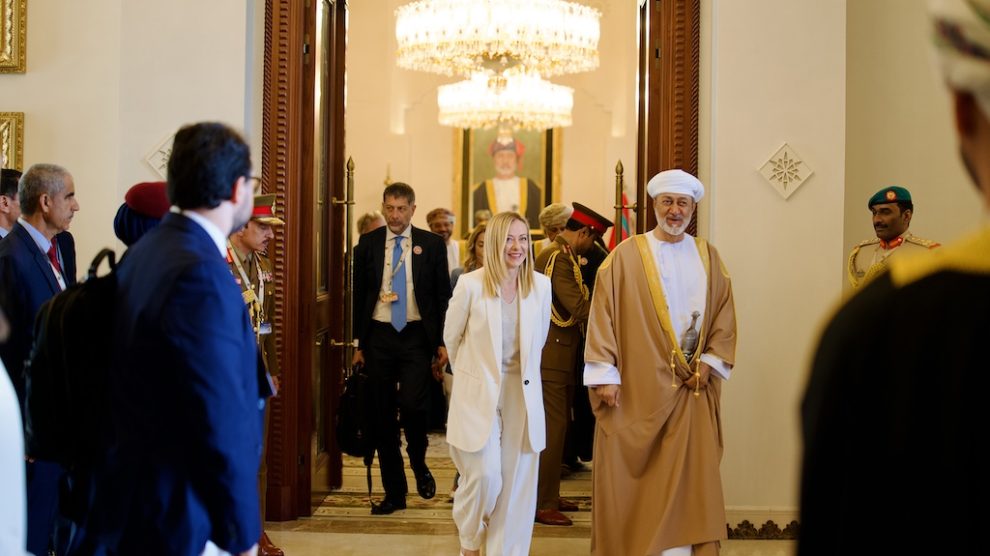
Decoding the news. Invited by Sultan Haitham bin Tariq Al Said, Meloni will be the first foreign leader to be received by the Omani monarch in 2026 — a highly symbolic gesture underscoring mutual trust and a shared vision on stability, dialogue, and economic diversification.
- According to Omani analysts speaking to Formiche.net, the visit reflects a broader alignment: Italy sees Oman as a strategic balancer in the Gulf, while Muscat views Rome as a pragmatic European partner, less ideological and more focused on long-term cooperation.
How we got here. The groundwork was laid at the EU–GCC summit on December 3, when — for the first time in 14 years — the Sultan of Oman personally attended. That summit provided the setting for a pivotal bilateral meeting with Meloni, during which the formal invitation to visit Muscat was extended.
- Diplomatic sources in the Gulf suggest the Sultan’s decision to attend the summit was driven in part by the opportunity to meet the Italian prime minister — a signal of Rome’s rising profile in Muscat’s strategic calculus.
Why Oman is looking at Italy. The answer lies in economics and industrial policy:
-
SME-driven growth: Italy’s small- and medium-sized enterprise model aligns closely with Oman’s diversification goals.
-
Trade leverage: Oman benefits from low U.S. tariffs (around 10%), enhancing its attractiveness as a manufacturing hub.
-
Green hydrogen: Muscat aims to become a leading supplier of green hydrogen to Europe, producing domestically and exporting north.
-
Industrial reshoring: Oman is encouraging European — including Italian — firms to produce steel and aluminium locally, powered by hydrogen, then ship finished goods to Europe.
- Healthcare is another priority. As Oman moves toward partial privatization, it is seeking foreign investment and expertise, with Italian healthcare know-how seen as a strong match.
Beyond protocol: a “silent alliance”. “This visit cannot be read as a ceremonial act,” says Mohammed al-Araimi, president of the Omani Journalists Association. “It is part of a broader Italian repositioning in the Gulf and the Middle East.”
- For Rome, Oman represents a strategic equilibrium platform – the only Gulf monarchy maintaining open, functional relations with Washington, Tehran, Riyadh, Abu Dhabi, and Europe.
- “Muscat has become indispensable for any power interested in regional stability,” al-Araimi notes. “Its non-aligned foreign policy and mediation role — from Iran’s nuclear file to the Red Sea crisis — make it a natural partner for Meloni’s Italy, which seeks strategic autonomy within Europe and the Middle East.”
A partnership growing off the radar. Ali al-Muqbali, Omani journalist and analyst, describes Italy–Oman ties as low-profile but resilient:
- “This is a partnership built on trust and institutions, not headlines. Strategic, silent, and durable.”
- From Muscat’s perspective, Italy is a pragmatic European power. From Rome’s, Oman offers predictability and diplomatic continuity, rare commodities in a volatile region.
Energy and infrastructure at the core. Economically, the visit revolves around Oman Vision 2040, Muscat’s blueprint to reduce hydrocarbon dependence and expand into advanced sectors:
-
Green energy and hydrogen (target: 1 million tons annually by 2030)
-
Logistics and ports
-
Industry and manufacturing
-
Tourism
- Italy, already a key technology and machinery partner in Oil & Gas, is looking to scale up cooperation on hydrogen and energy corridors linking Oman–Netherlands–Germany, alongside LNG and industrial efficiency projects.
- Ports such as Sohar, Duqm, and Salalah are also central strategic hubs on routes to the Indian Ocean and East Africa, regions of growing interest for Italian companies.
Shared instincts on regional stability. Geopolitically, Rome and Muscat converge on a core principle:
- dialogue over confrontation. Both Meloni and the Sultan emphasise state stability and mediation in dossiers ranging from Iran and Yemen to Gaza and the Red Sea.
- “In an increasingly polarized world,” al-Araimi observes, “Oman and Italy share a simple but powerful idea: talk to everyone, without blind alignment.”
What comes next? The Italy–Oman relationship is set to evolve along three axes:
-
Economic: Energy transition and industrial technologies.
-
Political: Deeper diplomatic coordination on regional crises.
-
Strategic: Oman as Italy’s hinge between the Gulf, the Indian Ocean, and Africa — key to Rome’s wider Mediterranean strategy.
- “Investing today in the Italy–Oman relationship means building capital in trust and stability,” al-Muqbali concludes. “Muscat and Rome are looking in the same direction: a regional order based on dialogue, predictability, and sustainable development.”
Local media watch:
- English-language Omani outlets have offered measured but positive coverage, highlighting Meloni as the first foreign leader hosted by the Sultan in 2026 and underscoring cooperation on political, economic, and strategic issues.
- Arabic-language media have framed the visit within Oman’s active global diplomacy and mediation role, maintaining an institutional, optimistic tone — with growing traction across digital platforms.
Bottom line: Meloni’s stop in Muscat is less about ceremony and more about strategy – a quiet but consequential step in Italy’s bid to anchor itself between the Mediterranean and the Gulf.