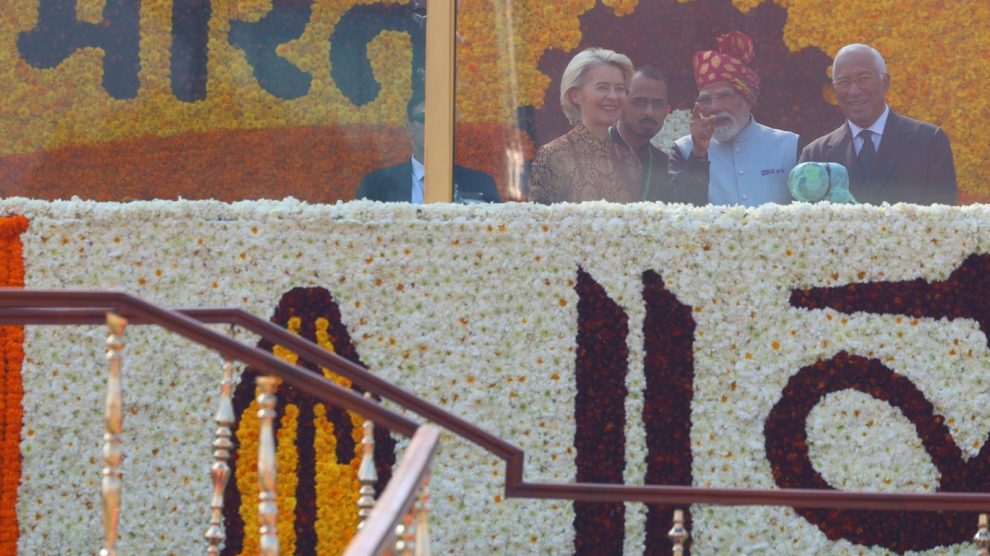
European Commission President Ursula von der Leyen called it the “mother of all deals,” while Indian Prime Minister Narendra Modi called it “historic.” If realized, the landmark EU–India trade agreement could impact nearly 2 billion people and economies accounting for roughly a quarter of global GDP and a third of world trade. Like most major trade pacts between diverse partners and competing interests, negotiations were lengthy and complex, stretching over two decades. This deal is expected to eliminate or cut tariffs on nearly 97% of goods. Beyond trade, it signals deeper economic cooperation and a strategic shift, as both sides seek to diversify partnerships amid rising global trade tensions and evolving relationships with other major powers.
From Stalled Talks to Economic-Security Logic. Historically, these talks first began in 2007 during a boom in free trade agreements but stalled in 2013 over disputes on market access and tariffs.
- They resumed in July 2022, against the backdrop of increasing tensions in EU-China relations, and Europe’s reassessment of economic security following Russia’s invasion of Ukraine.
- Over time, the strategic context of economic security has intensified: the EU now treats economic dependencies, especially in energy, critical minerals, semiconductors, pharmaceuticals, and clean tech, as strategic security risks.
- The EU is one of India’s largest trading partners, with bilateral goods trade surpassing €120 billion in 2024. EU exports to India, about €55 billion, remain near pre-pandemic levels, while Indian exports to the EU have surged, rising more than 70% between 2018 and 2023, reaching €71 billion in 2024 and the EU runs a goods trade deficit.
- India accounts for only about 2.5% of the EU’s trade, but for India the EU is its largest goods trading partner, more than with either the U.S. or China.
- The EU mainly sells machinery, transport equipment, and chemicals, while India exports chemicals, metals, minerals, and textiles. India is set to gain in exporting textiles, apparel, engineering goods, leather, footwear, handicrafts, and seafood, while the EU stands to benefit by exporting wine, cars, chemicals, and pharmaceuticals.
- Tariffs for European cars, now as high as 110%, would drop to 10% under a 250,000-vehicle quota, opening important market opportunities for the auto industry. Germany and France are projected to be among the biggest beneficiaries. Services trade has expanded sharply, with Indian exports to the EU doubling to $44B by 2024, while EU exports to India reached $34B, driven mainly by consulting and IT services.
Ratification Risks and the Strategic Endgame. However, it is not a done deal yet. Formal signing will come only after approval by the European Parliament and member states, and that could be rocky.
- Past deals show the risk: the EU-China CAI of December 2020 was frozen after political tensions, and EU-US TTIP of 2016 collapsed entirely. Even the EU-Mercosur agreement, signed in 2026 after decades of talks, now faces legal review that could delay ratification by months or years.
- The deal should be about investment as much as trade: the EU holds about €140 billion in FDI stock in India, while Indian investment in Europe—around €10 billion—is growing.
- By improving transparency, cutting arbitrary barriers, and clarifying dispute rules, an FTA would reduce policy risk, deepen supply chains, and support the long-term flow of technology, capital, and industrial capacity.
- The partnership should focus less on a single grand trade deal and more on core economic-security areas—critical minerals, clean tech, semiconductors, digital systems, and resilient supply chains—with the FTA serving as just one tool within a broader, modular framework of investment and industrial cooperation of likeminded partners.
From Trade Deal to Strategic Insurance. This may fall short of the once-imagined “maximally ambitious” deal, but it is increasingly viewed as a foundation rather than a final endpoint as the EU seeks deeper ties with a vast, fast-growing economy. Rising protectionism, supply-chain vulnerabilities, and trade tensions with the United States, overcapacity by China, are pushing both sides to see the FTA as an insurance policy towards long-term strategic stability, not just a vehicle for commercial gains.
- For Europe, India stands out as a rare partner combining scale, growth, and strategic autonomy in a way that is both economically meaningful and politically dependable. EU–India economic ties are part of wider connectivity efforts, such as the India–Middle East–Europe Economic Corridor, highlighting the need for more proactive European leadership on trade, standards, and infrastructure links.
- Despite internal and external obstacles, making progress on simpler trade and investment rules remains vital for global prosperity.
- Trade models like this may point to the future of trade negotiations: smaller groups of like-minded partners pursuing targeted gains in areas of comparative advantage within defined timelines—an approach that could also shape how international trade evolves.
(Photo: X, @narendramodi)