

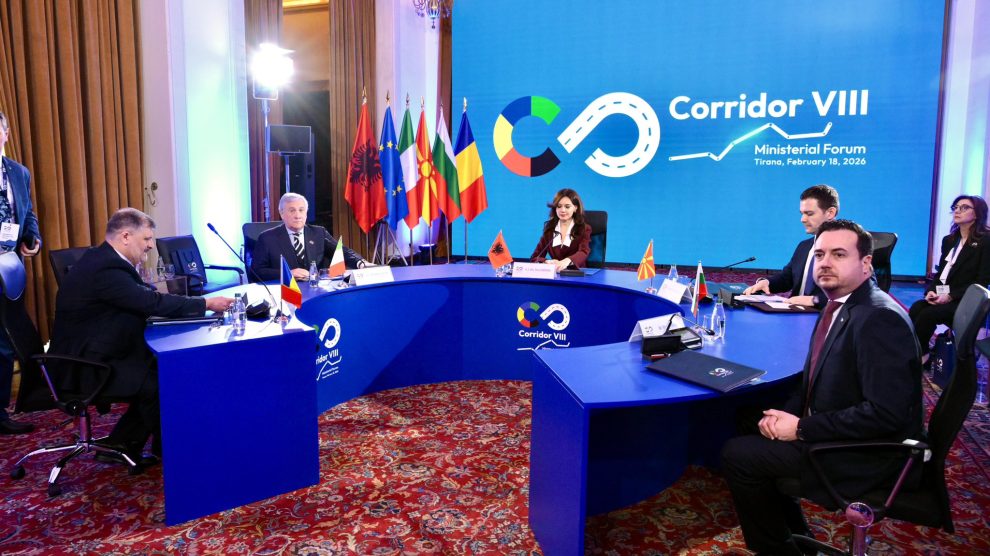
Why it matters: The Adriatic-to-Black Sea Corridor VIII is being recast not just as infrastructure, but as a geopolitical platform to anchor the Western Balkans to the EU, boost trade flows, and strengthen NATO mobility on Europe’s southeastern flank at a time of growing geopolitical competition over infrastructure routes.
What happened: Albania hosted the second ministerial meeting on the multimodal Corridor VIII, bringing together Italy, Albania, North Macedonia, Bulgaria, and Romania (as an associated participant on military mobility).
- The meeting ended with a joint declaration reaffirming commitment to the project, now framed as both an economic integration tool and a security asset.
- Officials stressed the corridor’s role in closing long-standing connectivity gaps in Southeast Europe and advancing EU enlargement.
The big picture: Corridor VIII — linking the Adriatic to the Black Sea — is increasingly viewed as a strategic east-west axis within the EU’s Ten-T network and as critical infrastructure for NATO logistics, energy resilience, and supply chains.
What Italy wants: Italian officials sketch Corridor VIII as a strategic tool to accelerate EU integration of the Western Balkans while expanding trade routes between the Mediterranean and the Black Sea.
- According to Italian sources, Rome sees the project as a driver of export growth, supply-chain diversification and industrial opportunities for Italian companies, particularly in sectors linked to infrastructure, logistics and critical minerals.
- Rome also views the corridor as a key component of military mobility planning, strengthening NATO logistics across Europe’s southeastern flank.
In Tajani’s words: Foreign Minister Antonio Tajani, who represented Italy at the Tirana meeting, described Corridor VIII as a strategic linchpin for Europe’s connectivity and enlargement agenda, linking infrastructure development with regional integration and broader geoeconomic initiatives.
- Tajani called it “a strategic infrastructure connecting the Black Sea to the Adriatic Sea, crossing the Balkans to our ports of Bari and Brindisi,” adding that it is “a political and economic priority for Italy and Europe” and “a platform in synergy with the IMEC corridor.”
What others are saying:
- Albanian Foreign Minister Elisa Spiropali described the corridor as “possibility, resilience and security,” emphasising faster movement of allied forces and equipment.
- North Macedonia highlighted its role for NATO mobility, energy links, and market integration.
- Romania joined the initiative specifically on the military mobility dimension.
By the numbers:
- Planned route: Durres–Tirana–Skopje–Sofia to Bulgarian ports Burgas and Varna, with maritime links to Bari and Brindisi.
- Infrastructure: ~1,300 km of rail and 960 km of roads across five countries and six key ports.
- Financing: EIB, EBRD, EU Western Balkans Investment Framework, and Connecting Europe Facility.
Security angle: The project has been designated critical infrastructure by NATO, reflecting growing emphasis on military mobility and protection of strategic corridors after Russia’s war in Ukraine.
Economic stakes: Italy’s trade with Western Balkan countries exceeded €9 billion in the first ten months of 2025, reinforcing the corridor’s appeal as a trade and investment multiplier.
Between the lines: a geopolitical signal behind the declaration. Beyond infrastructure, the joint declaration signed today in Tirana signals a coordinated EU-NATO effort to anchor Southeast Europe firmly within the Western strategic space at a time of heightened tension with Russia and growing concern over Chinese influence in regional connectivity projects.
- By framing Corridor VIII as critical for military mobility, supply-chain resilience and protection against hybrid threats, the five countries are positioning it as a geopolitical counterweight to competing east-west routes shaped by non-Western actors.
- The message is clear: integrating the Western Balkans through hard infrastructure is no longer just about development — it is about security, alignment and long-term strategic orientation.
What’s next: Italy will host a meeting of the “Friends of the Western Balkans” group in Rome on March 3 to coordinate EU support for enlargement and regional integration — signalling continued political momentum behind Corridor VIII.
(Photo: X, @antonio_tajani)


