
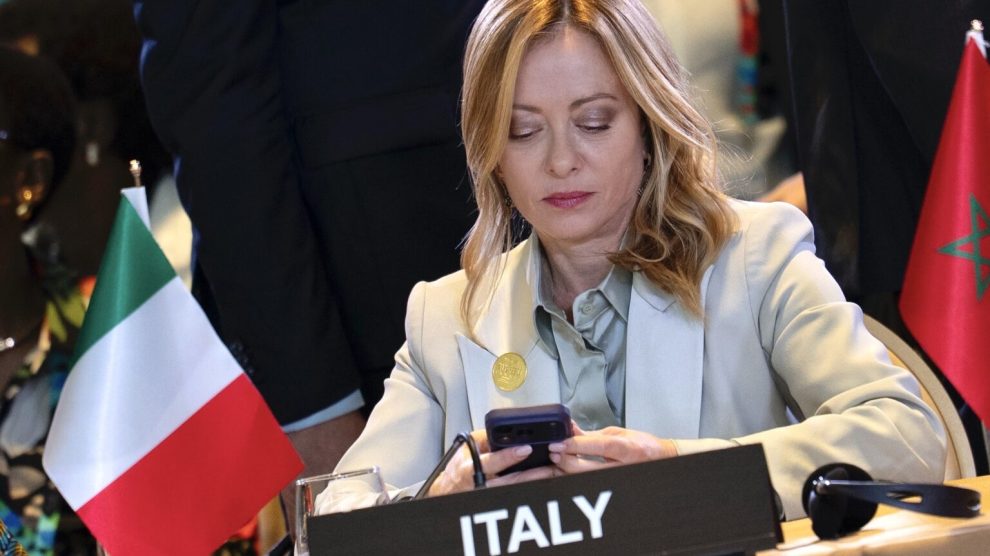
Prime Minister Giorgia Meloni said Italy does not intend to enter the Middle East war, while indicating that Rome is preparing to provide defensive assistance — including air defence support — to Gulf partners facing Iranian strikes.
The latest: Speaking to Italian radio RTL 102.5, Meloni said the planned assistance reflects both Italy’s political ties with Gulf countries and the need to protect Italian nationals and military personnel deployed across the region.
- “This is not only because they are friendly nations, but above all because tens of thousands of Italians live in the region and around 2,000 Italian troops are deployed there — people we want, and must, protect,” she added.
Support for the partners. Wednesday evening, Prime Minister Meloni and Defense Minister Guido Crosetto visited the Quirinale following a restricted meeting of the executive with Italy’s national intelligence services “to analyze the developments of the crisis in the Middle East,” according to a statement from Palazzo Chigi.
- Defense Minister Crosetto said that the United States has so far not requested the use of operational military bases in Italy — a move that would require authorization from the Italian Parliament.
- The issue has already been a source of sharp tensions between President Donald Trump and both Spain and the United Kingdom, and is therefore being watched very closely.
- In parallel, French President Emmanuel Macron spoke with Prime Minister Meloni and Greek Prime Minister Kyriakos Mitsotakis.
- The three leaders were reportedly coordinating the deployment of military assets to Cyprus and the eastern Mediterranean and cooperating in safeguarding freedom of navigation in the Red Sea, a person close to the French president told Politico.
The context: Gulf states have been using expensive Patriot missiles to defend themselves from Iranian Shahed drones. But their stocks are declining, and they are looking to Kyiv’s experience for cheaper defence: the Pentagon and at least one Gulf government are reportedly in talks to buy Ukrainian-made interceptors to fend off Iranian drone attacks, according to industry figures in Ukraine, quoted by the Financial Times.
-
Iran may have stockpiled tens of thousands of Shahed drones and missiles, meaning Italy’s regional partners are now seeking rapid defensive assistance.
From Parliament: “Despite its complexity, we remain convinced that the diplomatic path is the only one capable of producing lasting results, even when it appears fragile and distant. We will make every possible effort to help achieve peace in the Middle East,” Foreign Minister Antonio Tajani told Italy’s Chamber of Deputies during a parliamentary briefing on the conflict involving Iran and requests for support from Gulf countries.
- “I want to reiterate in this Chamber that Italy is not at war with anyone and will not be at war with anyone. This is the essence of our foreign policy: speaking with everyone without ever renouncing our values.”
Yes, but… “Iran cannot be allowed to acquire nuclear weapons or possess missile systems capable of representing an existential threat to Israel, to the region and to Europe. The choice by extremists to attack countries such as Cyprus, Turkey, the Gulf states and now also Azerbaijan — states that had never conducted operations against Tehran — is unacceptable,” Tajani said.
- “These are senseless actions that the Italian government has condemned without hesitation.”
- In the face of what he described as indiscriminate Iranian attacks against neighbouring countries, Tajani confirmed that several strategic Gulf partners have formally asked Italy to help strengthen their air defence capabilities.
- “These are nations where tens of thousands of Italians, civilians and military personnel, are present, and whom we have a duty to protect. This is why the government considered it necessary to respond positively to these requests.”
D.C. calling. On Wednesday, Foreign Minister Antonio Tajani spoke by phone with U.S. Secretary of State Marco Rubio to discuss the war involving Iran and the surge in energy prices.
- Tajani warned that Iran appears intent on expanding the conflict by striking Gulf countries and said a prolonged closure of the Strait of Hormuz could severely damage the global economy.
- He reiterated that Iran must not acquire nuclear capabilities and reaffirmed Italy’s support for its Gulf partners.
From the Gulf: Undersecretary of State for Foreign Affairs Maria Tripodi, representing Italian Foreign Ministry, took part in an extraordinary EU meeting with the countries of the Gulf Cooperation Council (GCC) to discuss the regional escalation.
- In her remarks, Tripodi expressed Italy’s solidarity with Gulf partners targeted by Iranian attacks and thanked local authorities for their support in assisting Italian nationals during evacuation operations.
- Italy also backed a joint EU‑GCC statement calling for rapid de‑escalation and renewed diplomatic efforts to stabilize the region.
Evacuations underway. In the meantime, Italian authorities are prioritising the evacuation of citizens from areas affected by the crisis, including Iran, with assistance from regional partners such as the United Arab Emirates and Oman.
- “Some convoys are moving toward neighbouring countries, and we are beginning to arrange departures from safer airports. For this, we must also thank the United Arab Emirates and Oman, which are friendly countries and are helping us,” Meloni announced.
- The repatriation of Italian nationals is one of the government’s ”Task Force Golfo” top priorities, as it maintains constant diplomatic and political contacts with Gulf leaders — a region with which Italy has strengthened ties in recent years.
Domestic security posture. The government has raised its alert level over possible terrorist threats linked to regional instability.
- Interior Minister Matteo Piantedosi has convened Italy’s national security committee to assess risks and coordinate preventive measures.
Economic concerns. The Italian government is also monitoring the economic security implications of the crisis, particularly energy prices. Italy’s energy regulator is preparing a task force to monitor developments in the oil & gas market and potential speculative pressures.
- On Thursday, Iran’s Revolutionary Guards announced that the Strait of Hormuz, a crucial maritime chokepoint where traffic has already dropped since the start of hostilities, is currently restricted to vessels originating from the United States, Israel, Europe, and other Western nations.
- During today’s EU-GCC, Undersecretary Tripodi noted that the global energy system appears better prepared than in previous crises thanks to higher stock levels and greater production resilience.
- For Italy — which benefits from diversified oil imports and relies largely on pipeline gas — the main risk lies in price volatility rather than in the physical availability of supplies.