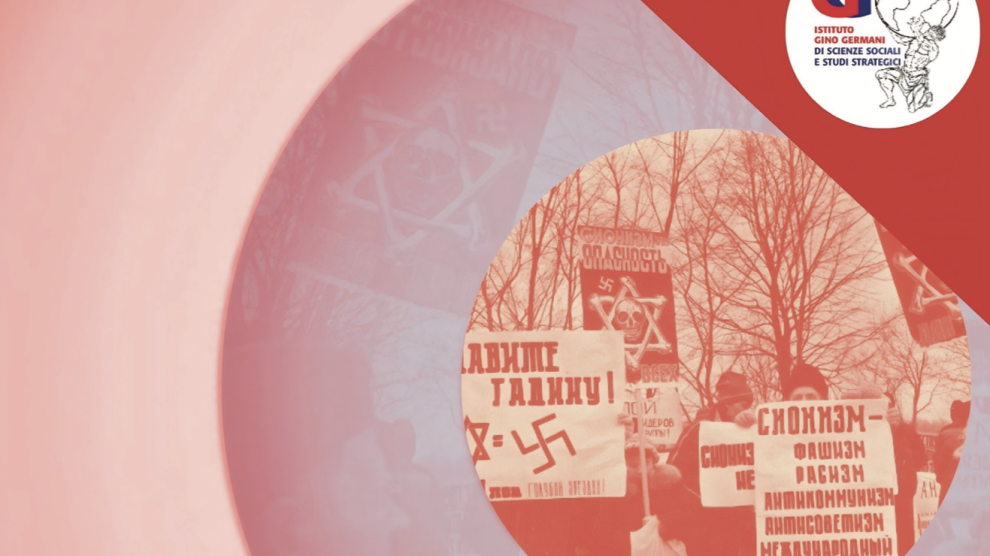
Why it matters: Antisemitism is not just a historical prejudice in Russia. According to a new report by researcher Massimiliano Di Pasquale, it has repeatedly been used as a strategic instrument of influence operations — from Tsarist secret police to Soviet intelligence and, today, the Kremlin’s information ecosystem.
- The study argues that anti-Jewish conspiracy theories have become part of Moscow’s broader effort to fragment Western societies and undermine trust in democratic institutions.
The report: The Gino Germani Institute published the study, a think tank focused on defending liberal democracy and analysing threats to Western security.
- Its author, Massimiliano Di Pasquale, is an associate researcher at the institute and director of the Ukraine Observatory. His work focuses on disinformation, hybrid warfare and political dynamics in the post-Soviet space.
- The report examines how antisemitic narratives have been integrated into Russia’s long tradition of “active measures” — influence operations designed to manipulate public opinion and destabilise adversaries.
The concept: cognitive warfare: The study places Russian antisemitic propaganda within the broader framework of aktivnye meropriyatiya — covert techniques developed by Soviet intelligence that combine disinformation, propaganda, support for extremist movements and the recruitment of agents of influence.
- In today’s environment, these tactics operate within a multilayered disinformation ecosystem that includes:
- official Kremlin messaging
- state-funded media outlets such as RT and Sputnik
- seemingly independent websites and commentators
- local influencers who amplify narratives within Western societies.
- The goal, the report argues, is not simply to persuade audiences but to destabilise societies from within, eroding trust and amplifying polarisation.
Antisemitism in Putin’s Russia: Di Pasquale describes the ideological environment of the current regime using the term “rashism” — a blend of Russian nationalism, Soviet nostalgia, imperial identity and Orthodox messianism.
- Within this narrative, antisemitic tropes continue to play a role.
- One example is the Kremlin’s justification for the invasion of Ukraine through the narrative of “denazification.” The report notes the paradox of accusing Ukraine of Nazism despite the country’s president, Volodymyr Zelensky, being Jewish.
- Russian propaganda has also promoted narratives that distort the history of the Holocaust, including claims that Jews themselves were responsible for Nazi crimes — a form of antisemitism disguised as historical revisionism.
A long historical pattern: The report traces the roots of these narratives across more than a century of Russian political history.
- In the Tsarist era, the secret police known as the Okhrana produced the notorious Protocols of the Elders of Zion. This fabricated document claimed to reveal a global Jewish conspiracy.
- During Stalin’s rule, antisemitism resurfaced in campaigns against so-called “rootless cosmopolitans” and in the fabricated Doctors’ Plot, which accused Jewish doctors of conspiring against Soviet leaders.
- The Soviet Union also used antisemitic narratives in foreign influence operations. One example cited in the report is Operation Zarathustra in 1959, when Soviet intelligence orchestrated antisemitic vandalism in Western countries to portray West Germany as a neo-Nazi state and generate political turmoil.
- Later, under Yuri Andropov, the KGB promoted a global campaign equating Zionism with racism and Nazism, influencing political discourse in parts of the Western left and in the Middle East.
Modern case studies: The report also analyses how these narratives have adapted to the digital age.
- Among the most frequent targets is George Soros, portrayed in Russian disinformation campaigns as the symbol of a global Jewish elite allegedly orchestrating “colour revolutions” or demographic change in Europe.
- During the COVID-19 pandemic, conspiracy theories circulated through Russian media ecosystems linking the virus to laboratories funded by Soros or Bill Gates as part of a supposed depopulation plan.
- After the Hamas attack on Israel on October 7, 2023, the Kremlin exploited the conflict to deepen divisions within Western societies and shift attention away from the war in Ukraine.
Italy in the crosshairs: The report also highlights the circulation of similar narratives in Italy, where figures such as Moni Ovadia, Sandro Teti, Elio Lannutti, and Maurizio Blondet have been cited in discussions around the spread of pro-Kremlin conspiracy theories.
The bottom line: The report concludes that countering these operations requires stronger societal resilience.
- Among the recommendations:
- expanding media literacy and critical-thinking programs
- condemning antisemitic rhetoric clearly and consistently
- creating dedicated government structures to counter cognitive warfare.
- Countries such as the United Kingdom and France, the study notes, have already elevated hybrid threats and information warfare to the level of national security priorities.