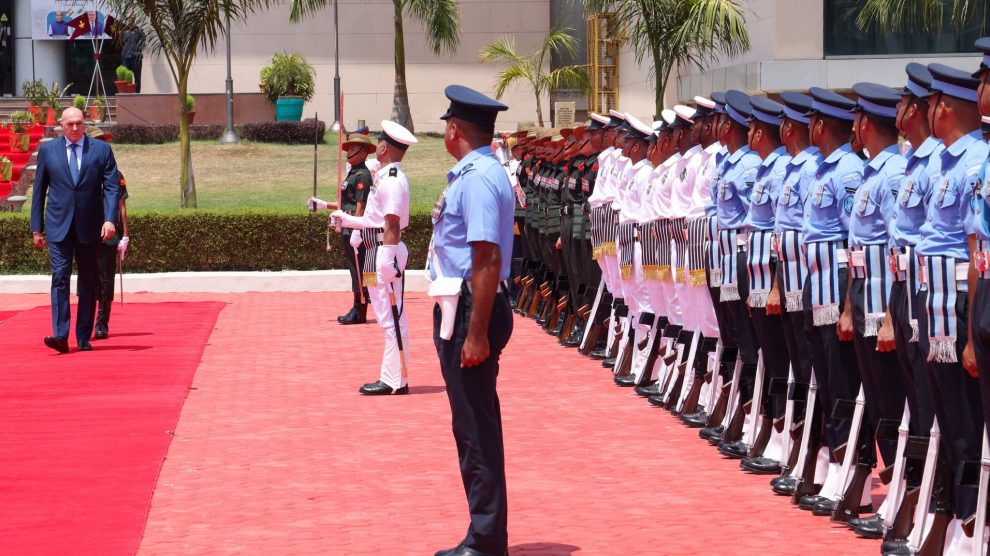
“We are entering a new phase in Italy–India relations.” Vincenzo De Luca, former Italian ambassador to New Delhi, frames it this way as he reflects on Defence Minister Guido Crosetto’s visit to India and the signing of the 2026–2027 military cooperation plan—steps that signal a more structured and strategically grounded partnership between Rome and New Delhi.
Italian Defence Minister Guido Crosetto’s visit to India and the signing of the 2026–2027 military cooperation plan mark a further step in the consolidation of relations between Rome and New Delhi. Following years of renewed political engagement and stronger dialogue involving Italy, India and the European Union, cooperation is now expanding into strategic sectors such as defence, aerospace and maritime security.
Q: Italy and India have built a relationship of growing trust in recent years, also strengthened by dialogue between Giorgia Meloni and Narendra Modi. What is the significance of Minister Crosetto’s visit and the signing of the 2026–2027 bilateral defence plan in this context?
A: It is true — we are looking at a new phase. After a period of difficulty in Italy–India relations, linked in part to the marines case and the issues involving Leonardo, the situation began to shift around 2021–2022. In 2023, the two countries signed a strategic partnership, which helped relaunch cooperation, including in key sectors.
- We are no longer speaking only about trade relations, but about industrial cooperation in areas such as defence and aerospace. The 2026–2027 military cooperation plan signed by Minister Crosetto fits squarely within this framework. Italy and India now recognise each other as strategic partners, also in light of shared concerns over security spanning the Mediterranean and the Indian Ocean.
- In 2023, during the G20 summit in New Delhi, the IMEC project — the India–Middle East–Europe Corridor — was also launched, aimed at diversifying routes in the Indo-Pacific. This has increased both countries’ focus on connectivity, maritime cooperation and security.
- At the same time, important industrial initiatives have developed, involving major Italian companies such as Leonardo, Fincantieri and Elettronica, as well as small and medium-sized enterprises in the aerospace sector. I am thinking, for instance, of Leonardo’s agreement with Adani for helicopter production, supplies to the Indian Navy, and cooperation programmes in defence electronics. This is a broad framework, which India views with great interest, also within the “Make in India” programme, as New Delhi seeks to diversify procurement and strengthen its strategic autonomy in defence and security.
Q: You mentioned the “Make in India” programme. How can Italy position itself within this strategy, particularly in defence and aerospace?
A: Italy already starts from a solid base. Around 800 Italian companies operate in India, many of them investing and producing in manufacturing sectors such as machinery, mechanical engineering, automotive, food processing and textiles. Cooperation in defence and security therefore builds on an already established industrial fabric and long-integrated production platforms.
- The free trade agreement between the European Union and India — which should be followed by an investment protection agreement — could further boost this development. At the same time, we are seeing growing Indian investment in Italy, as illustrated recently by Tata’s significant investment in Iveco.
- We are therefore looking at a substantial cross-border investment framework, within which a qualitative leap is now taking place in terms of partnerships in defence and security.
Q: Maritime security, trade routes and the Indo-Pacific are now central to cooperation between Rome and New Delhi, as Minister Crosetto has noted. What role can Italy carve out in such a decisive region for global balances?
A: We can see this clearly in recent days with the very serious crisis in the Strait of Hormuz, which confirms how critical freedom of navigation and the security of transport flows are across the Indian Ocean, the Persian Gulf, the Middle East and the Mediterranean.
- The IMEC corridor was conceived precisely to make transport mechanisms more efficient. To this we should add a digital dimension, represented by the first project presented under the corridor when I was still ambassador to India: a very high-capacity cable between Europe and India, originating in Italy, developed by TIM Sparkle in partnership with Google and a telecommunications company.
- On the maritime side, Italy is already participating in Operation Aspides, aimed at safeguarding freedom of navigation in the Suez Canal area. It remains to be seen how the situation in the Strait of Hormuz will evolve, as it remains unpredictable. The key point is that both Italy and India are interested in further expanding trade, which could be supported by the EU–India free trade agreement.
- These are two countries that are integral to a growing integration between the European continent and the Indian subcontinent. In this context, maritime security, physical connectivity and digital connectivity become central pillars of the relationship.
Q: In light of strengthening bilateral ties and the prospective EU–India free trade agreement, can Italy help build a stronger bridge between India and the EU, including in defence?
A: We may be moving slightly ahead of the current framework. It should be remembered that some European countries established strategic partnerships with India before Italy did — France, for instance — and Germany is also moving in this direction.
- That said, high-level technological cooperation, including in defence and security, is envisaged in recent EU–India agreements. The European Union has established a Trade and Technology Council with India — a format that previously existed only with the United States — to share cutting-edge and disruptive technologies.
- The framework is very broad and offers Europe and India the opportunity to work together on artificial intelligence, green technologies, renewable energy, storage systems and many other innovative sectors. While we are discussing defence and security cooperation between Italy and India, this must be seen within a much wider framework. The free trade agreement will be historic, as it will connect a market of around two billion people across Europe and India.
(Photo: X, @guido_crosetto)