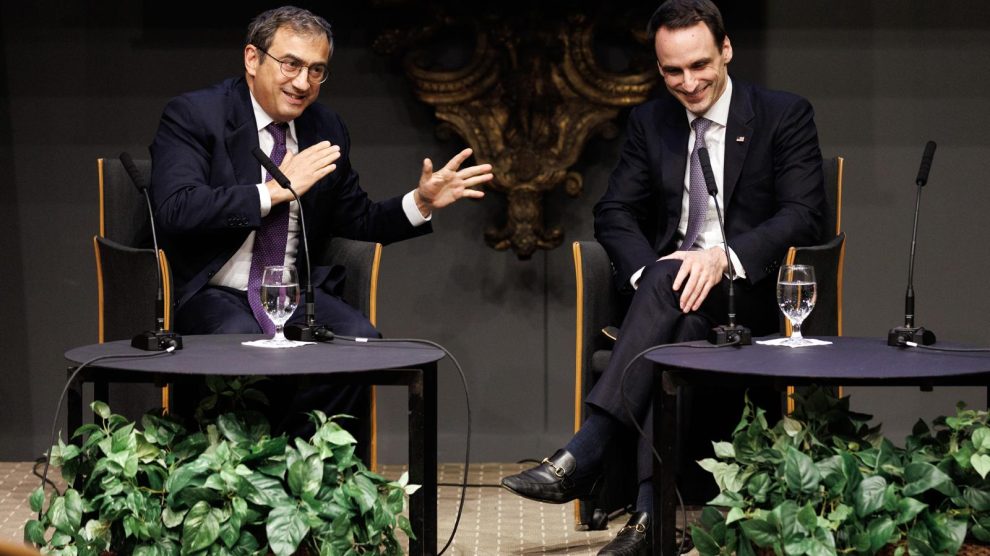
Technology is no longer a neutral domain of economic exchange but a central arena of geopolitical alignment. That was the underlying message of a fireside conversation between Michael Kratsios, director of the White House Office of Science and Technology Policy, and Italy’s ambassador to the United States, Marco Peronaci, held at the Italian Embassy as part of the U.S.–Italy Trusted Tech Dialogue.
Framed around “allied leadership in the age of strategic technology”, the discussion reflected a growing convergence between Washington and its European partners: the future of technological development — particularly in artificial intelligence — will hinge on the ability of like-minded countries to build interoperable, secure and commercially viable systems.
From telecom to AI: the evolution of trust. At the centre of the exchange was a concept that has come to define Western policy thinking: trust.
- Kratsios traced its origins to earlier debates over telecom infrastructure, when governments were first forced to confront the strategic implications of embedding foreign technologies into critical systems. “You were installing infrastructure… that was carrying data that was very important and personal to your citizens and to your national security,” he noted.
- That logic has since expanded. Artificial intelligence now represents the next frontier, requiring what Kratsios described as a “trusted AI stack” — spanning semiconductors, models and applications. Trust, in this context, must be embedded across the full system, particularly where technologies intersect with sensitive data and national security.
- For Washington, the answer lies in coordination among allies. “We as the West should come together and be able to have a trusted stack that we can deploy,” Kratsios said.
Adoption and the widening gap. Peronaci pointed to the societal dimension of trust, stressing the role of public perception in shaping AI adoption.
- Kratsios linked that directly to economic outcomes. “The more trust that you can make into the system, the broader it helps adoption,” he said.
- Emerging data from US businesses suggest a widening divide: companies investing in AI are seeing “tremendous, almost double-digit growth”, while others risk stagnation. The result is an increasingly “K-shaped” trajectory, with early adopters pulling ahead.
- “The ones that aren’t adopting AI now are already falling behind,” Kratsios warned.
Trust, cost and the limits of principle. The conversation also underscored a more practical constraint: trust is insufficient without competitiveness.
- Reflecting on the global expansion of Chinese telecom providers, Kratsios noted that “the commercial realities of a highly subsidised stack… still trumped the more expensive Western alternative.”
- This has informed a shift in US strategy. Through initiatives such as the American AI Export Program, Washington is seeking to deploy a full-stack technological offering — from chips to applications — supported by public financing tools.
- At the same time, the US has moved to ease access among partners. Kratsios pointed to the decision to roll back earlier restrictions on advanced chip diffusion, with the aim of enabling allies to “build data centres with American chips and run American models.”
AI sovereignty: integration over autonomy. Debates over cooperation increasingly turn on the meaning of sovereignty.
- While some European approaches emphasise full technological self-sufficiency, Washington is advancing a more networked model. “Our fundamental belief is that a Western stack that includes American components and those of our allies is how you can achieve your sovereignty,” Kratsios said.
- In this view, sovereignty is secured through participation in a trusted ecosystem rather than independence from it.
- Delaying adoption in pursuit of autonomy, he suggested, risks leaving countries behind. “The opportunities of AI are starting today… we must move as expeditiously as possible.”
China and the structure of competition. The geopolitical dimension surfaced most clearly in the discussion of China.
- Kratsios characterised the global AI landscape as effectively a “two-man game”, dominated by the United States and China. He warned that Chinese entities are working to replicate US advances, including through large-scale model distillation techniques.
- While expressing confidence in American innovation, the implication was clear: competition will intensify, and alignment among allies will matter more.
Regulation and divergence. Differences between the US and Europe remain most visible in the regulatory domain.
- Kratsios referred to what he described as an ongoing “A-B test” between competing approaches to AI governance, suggesting that regulatory design directly shapes innovation outcomes.
- Peronaci, for his part, pointed to the need for continued dialogue on principles, governance and control, indicating that transatlantic and broader allied frameworks could serve as venues for alignment.
AI and the next frontier of power. Beyond economics and security, Kratsios framed AI as a driver of scientific transformation. He described it as “one of the most powerful unlocks for scientific discovery in the history of humanity”, with implications ranging from material science to space exploration.
- Referencing the US Artemis programme, he pointed to an agenda that ties technological leadership to long-term scientific ambition.
A choice of systems. Taken together, the exchange points to an emerging architecture in which alliances are increasingly defined by shared technological systems.
- In this context, “allied leadership” is less about hierarchy than about coordination — and about choices. As technological ecosystems consolidate, the question is no longer whether to adopt advanced technologies, but within which system to do so.
- Between a fragmented landscape and competing models, the contours of alignment are becoming harder to avoid.
(Photo: X, @MPeronaci)