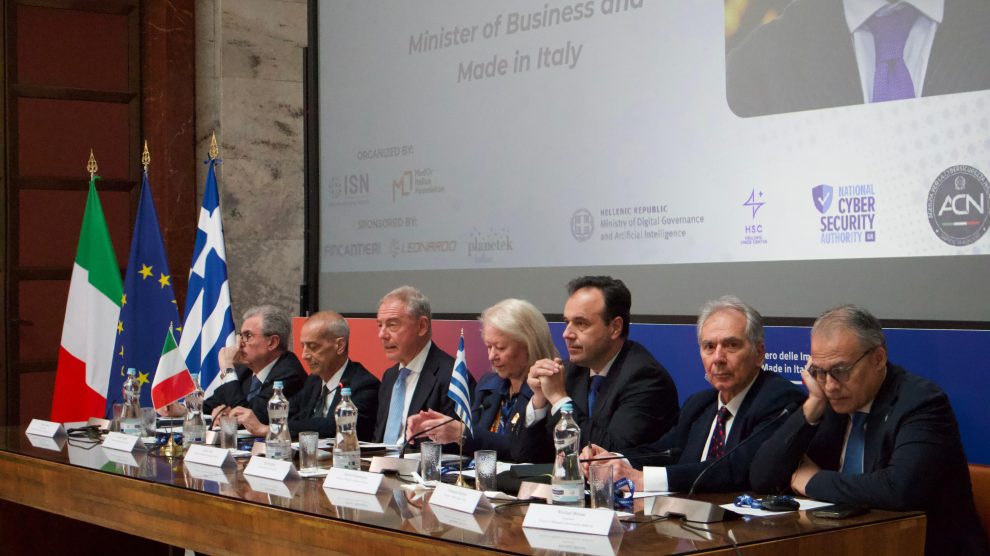
The meeting between Italy’s Industry and Made in Italy Minister Adolfo Urso and Greece’s Minister of Digital Governance and Artificial Intelligence Dimitris Papastergiou focused on cybersecurity, undersea infrastructure and technological sovereignty, against the backdrop of rising concern in Europe over hybrid threats and critical infrastructure protection.
Why it matters:
- Submarine cables carry roughly 97% of global internet traffic.
- Italy and Greece see the Mediterranean as a key corridor for global digital connectivity.
- The talks align with broader EU efforts on economic security, digital sovereignty and strategic autonomy.
- Rome and Athens are increasingly framing digital infrastructure as a geopolitical and security issue, not just an industrial one.
The big picture: The discussions took place during the “Greece–Italy Bilateral Dialogue” initiative organized by the Greek Embassy in Rome, bringing together government, industry and research representatives from both countries.
- The initiative reflects growing coordination between two southern European countries that share concerns over technological resilience, infrastructure security and Europe’s dependence on external digital capabilities.
- Italian and Greek officials presented closer bilateral cooperation as part of a broader European framework focused on secure, resilient and autonomous digital and space capacities.
Zoom in: the Mediterranean digital corridor. Urso and Papastergiou stressed the strategic role of submarine telecommunications infrastructure for European connectivity, economic security and digital sovereignty.
- Both ministers highlighted the Mediterranean basin as a central crossroads for maritime and digital connectivity, at a time when European governments are paying increasing attention to the vulnerability of critical infrastructure.
- The two sides agreed to intensify cooperation on the protection, monitoring and development of submarine and digital infrastructure, while also improving interoperability between technological systems.
Undersea infrastructure first. Italy and Greece also expressed their intention to promote a coordinated framework for surveillance and risk mitigation related to submarine infrastructure in the Mediterranean.
- The effort is aimed at strengthening operational resilience and industrial development within a broader European cooperation framework.
- The emphasis on monitoring and protection comes as European governments have raised alarms over hybrid threats targeting strategic infrastructure, including cables and energy networks.
Space and satellite push. The talks also covered satellite connectivity, Earth observation systems and broader space technologies.
- Both governments pointed to the future EU sovereign satellite constellation IRIS² as a strategic asset for ensuring continuity, security and autonomy in digital services and data-based applications.
- Officials also stressed the importance of closer cooperation among national authorities, research institutes and space agencies, alongside alignment with upcoming EU initiatives such as the EU Space Act.
AI and compute. Rome and Athens agreed to explore cooperation opportunities linked to the future European AI Gigafactories initiative.
- The discussions focused on computing infrastructure, data ecosystems and advanced AI applications, as European governments seek to expand sovereign technological capabilities in artificial intelligence.
The bottom line: Italy and Greece are positioning their digital partnership as part of a wider European effort to secure critical infrastructure, strengthen technological sovereignty and expand the EU’s role in strategic sectors spanning connectivity, space and AI.
(Photo: Industry and Made in Italy Ministry)