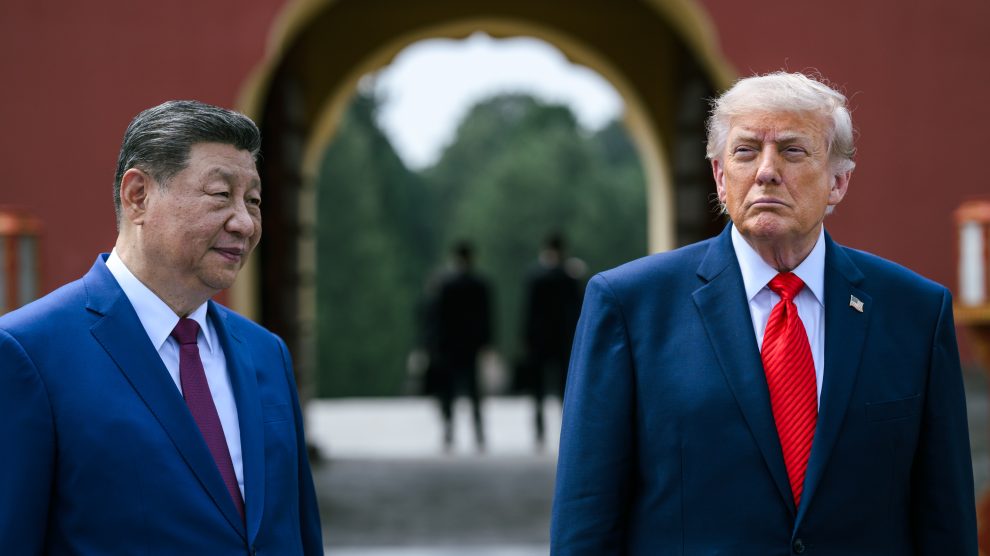
Decoding the news. The summit between Donald Trump and Xi Jinping in Beijing confirmed that the heart of global competition now runs through AI chips, rare earths and industrial capacity. Against this backdrop, Europe has remained on the sidelines, caught between ambitions of technological sovereignty and the need to cooperate with Washington. What are the right steps for Europe to take in the technological domain?
- Formiche.net spoke with Ronan Murphy, director of the Tech Policy programme at the Center for European Policy Analysis (CEPA).
Q. At the Beijing summit this week, the world’s two major technological powers bilaterally defined the agenda on AI chips and rare earths. Europe was absent. What does that mean?
A: It was a bilateral summit between the leaders of the United States and China, so Europe was never going to be a central topic, let alone an active player, and one should not overread that aspect. Certainly, some things were hopefully discussed, such as Russia’s war against Ukraine. But beyond that, one should not misread the context.
Q: What can Europe do in the post-summit landscape to strengthen the transatlantic relationship in the technological domain?
A: Several steps are needed simultaneously:
- Continue to identify areas of cooperation and adopt a realistic vision of “sovereignty”
- Make the planned EU regulatory simplification meaningful. The US administration has openly expressed its frustrations regarding European regulation and what it perceives as an offensive against American companies — but some positive signals do exist: Pax Silica already includes several European countries, and others, along with the EU itself, could soon join
- Give substance to the new US-EU “technology dialogue,” which is still thin but represents a starting point
- Use the planned “technological sovereignty package” as an opportunity to demonstrate that American companies will not be excluded or penalised in Europe
- Both sides benefit from a competitive European technology ecosystem, but that will not be achieved by imposing rigid “European production” rules. And in Brussels, the simplification agenda has only just begun – we are roughly 18 months into the Commission’s mandate – and it could and should move much faster.
Q: Reuters reported, hours before the Trump-Xi summit, that Washington had authorised the sale of Nvidia H200s to Chinese giants such as Alibaba, Tencent, ByteDance and JD.com. What impact will this move have? And what does it mean for European hyperscalers and AI labs that have been operating on the assumption that Chinese firms would remain short of computing capacity?
A: It appears that China, at least officially, does not feel the need to purchase H200S at scale and prefers to focus on developing domestic chips and processors.
- This is the recurring challenge of export controls: they can push others to innovate more rapidly. For Europe, it may be good news that Nvidia has more chips to sell — but it is still too early to draw firm conclusions.
Q: One of the few concrete outcomes expected from Beijing is a thin bilateral AI governance channel. Should Europe push to be included in this dialogue, build its own parallel track, or accept that frontier AI governance is now a G2 affair?
A: What is certain is that Europe will not be able to dictate the rules. That said, while American and Chinese companies are currently leading AI development, I do not see AI governance as an exclusively US-China scenario.
- The companies involved operate globally. Europe can and must work with the United States and like-minded allies on AI governance — and do so with urgency.
Q: The summit confirmed rare earths as Beijing’s primary lever over Washington. If even the United States, with all the tools at its disposal, struggles to reduce this dependency, what realistic options does Europe have — and over what timeframe?
A: The only realistic option for Europe is cooperation with the United States and other partners, and this is recognised within Europe itself. It is a long-term project for all actors involved, with timelines of 5, 10, 15, and 20 years for different parts of the supply chain.
- China holds the upper hand, so there is no time to waste. Europe can contribute meaningfully, given that it holds deposits of critical minerals and some refining capacity. Pax Silica is a US-led multilateral solution aimed at ending long-term dependence on China. US investments in the critical minerals supply chain in Europe already exist, from France to Ukraine.
- And the Lobito Corridor is a good example of what large-scale, long-term international cooperation can look like — one that includes, but is not limited to, the United States and Europe.