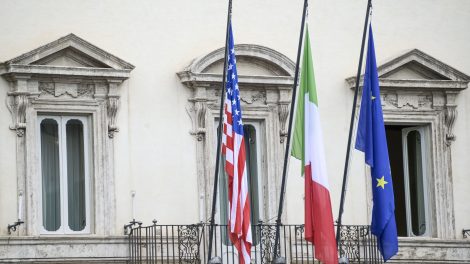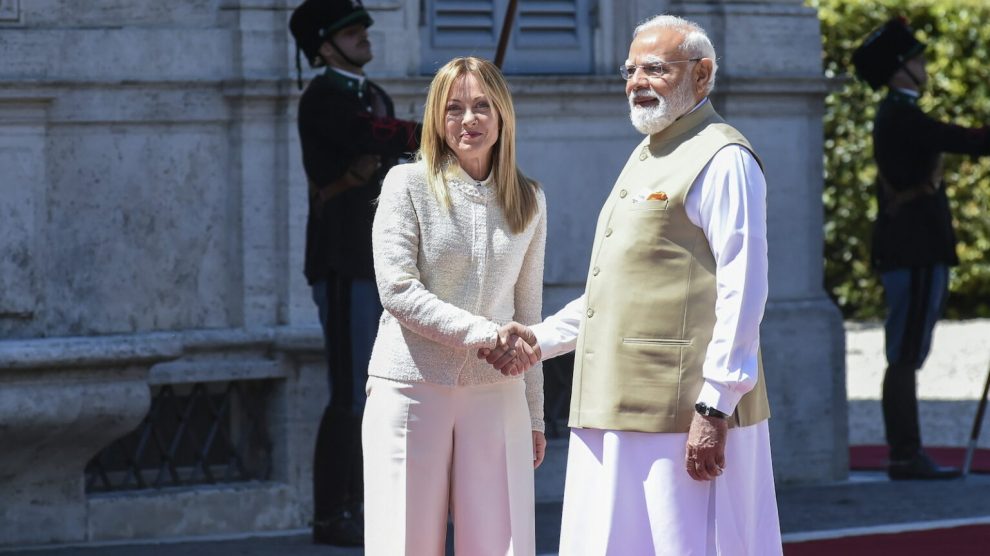
Narendra Modi’s visit to Italy was not just another bilateral stop on a European tour. It reflected a deeper shift underway in Indian foreign policy.
Europe moves to the center. “There is a perceptible shift in Indian foreign policy, with Europe receiving increased attention,” Sanjay Pulipaka, chairperson of the Politeia Research Foundation, told Decode39.
- The Rome visit came at the end of Modi’s four-country European tour, which included the Netherlands, Sweden and Norway.
- For Pulipaka, the sequence itself matters: “It appears India has adopted a four-pronged approach in its interactions with Europe,” he said.
The first pillar is institutional. India, Pulipaka argued, is simultaneously strengthening ties with the European Union and with Europe’s regional blocs.
- He pointed to the recently concluded India-EU Free Trade Agreement and to the Trade and Economic Partnership Agreement (TEPA) signed with Iceland, Liechtenstein, Norway and Switzerland.
- Industry, technology and strategic ecosystems
The second pillar of India’s European strategy is industrial cooperation. “The idea is to encourage industry-to-industry partnerships between European and Indian firms,” Pulipaka said.
- That logic was visible across Modi’s entire European tour.
In the Netherlands, India and Dutch partners signed an agreement to facilitate semiconductor cooperation between ASML and Tata Electronics — a move Pulipaka described as strategically important for India’s technological ambitions. - In Sweden, New Delhi and Stockholm upgraded bilateral ties to a strategic partnership while expanding cooperation in defense and launching the India-Sweden Joint Innovation Partnership 2.0.
- In Norway, meanwhile, the two countries established a Green Strategic Partnership, signed agreements in the space and health sectors and launched a digital development partnership. Oslo also joined the Indo-Pacific Oceans Initiative.
For Pulipaka, these developments point to an Indian strategy focused simultaneously on technological cooperation, supply-chain resilience and geopolitical coordination.
The third pillar of India’s European approach is geopolitical and geographic. “India is trying to develop a common vision for large regional spaces such as the Indo-Mediterranean,” Pulipaka said.
- That is where Italy becomes particularly important: “Given Italy’s central location in the Mediterranean and its economic strength, it is a key partner for India in advancing the Indo-Mediterranean vision,” he argued.
- According to Pulipaka, Italy’s geography, industrial base and political positioning make Rome increasingly relevant in India’s connectivity calculations.
- Both countries, he noted, played a role in conceptualising the India-Middle East-Europe Economic Corridor, or IMEC.
- “Recent security developments in the Middle East have underscored the need to develop multiple connectivity networks between India and Italy,” he said.
The fourth pillar of India’s European strategy is the consolidation of bilateral relations with major European powers. “It is important to consolidate bilateral relationships with countries such as Italy,” Pulipaka said.
- That logic, he argued, is driven by both geopolitics and economics.
“Many middle and emerging powers had to contend with unpredictability and coercive tactics in their interactions with major powers,” he said. - Against that backdrop, India and Italy increasingly see each other as complementary industrial and economic partners.
Beyond bilateralism. “As India seeks to further strengthen its ‘Make in India’ initiative, Italy, with its manufacturing prowess and design competencies, becomes a critical partner,” Pulipaka argued.
- “For Italy, India offers an opportunity to access the fastest-growing large economy and a massive market.”
- According to Pulipaka, Modi’s Rome visit should therefore not be interpreted simply as a bilateral diplomatic engagement.
- Instead, it reflects India’s broader attempt to build a denser network of strategic relationships across Europe.
- During the visit, Italy and India upgraded relations to a Special Strategic Partnership and signed agreements spanning defense, critical minerals, maritime transport, agriculture and labor mobility.
Per Pulipaka, however, the broader objective goes beyond bilateral cooperation itself. “The objective of these agreements will be to not only spur bilateral cooperation but also to collectively respond to regional and global challenges,” he said.
The bottom line: Modi’s Rome visit highlighted how India increasingly sees Europe not as a secondary theater, but as a central pillar of its economic, technological and geopolitical strategy — with Italy emerging as one of New Delhi’s key Indo-Mediterranean partners.