An op-ed signed by Giorgia Meloni and Narendra Modi and published simultaneously in Corriere della Sera and The Times of India marks the definitive entry of the “Indo-Mediterranean” concept into institutional strategic language.
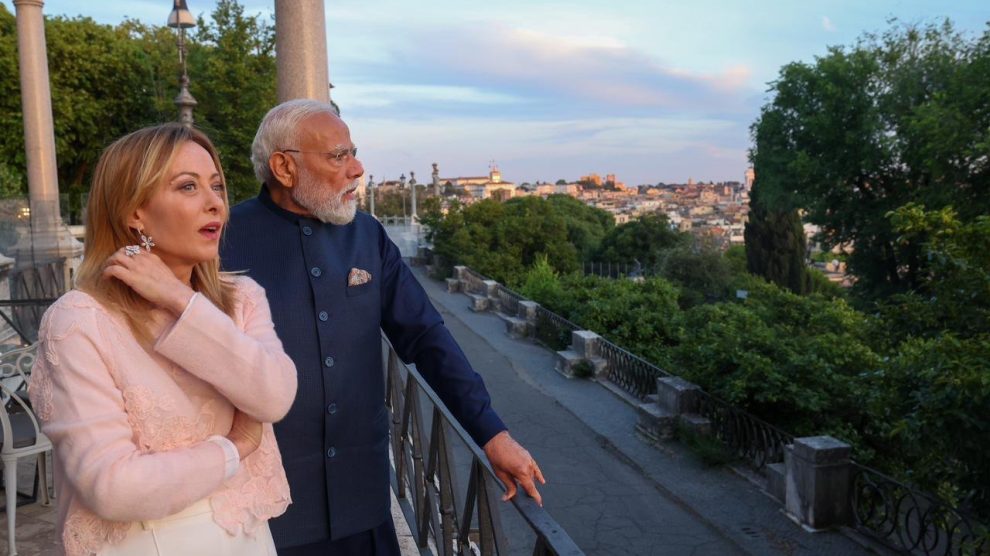
The meeting between the prime ministers of Italy and India in Rome represents a significant moment for a region whose geostrategic continuity is geographical, historical and increasingly political.
From bilateral partnership to strategic geography. The most relevant element is not merely the reference to the India-Middle East-Europe Economic Corridor (IMEC), now consolidated as a Eurasian connectivity platform and a potential alternative to China’s Belt and Road Initiative at a time of supply chain diversification.
- What matters is that Rome and New Delhi implicitly describe the Wider Mediterranean and the Indian Ocean as a single geopolitical space, shaped by the same interests, vulnerabilities, strategic responsibilities and opportunities.
- They state it explicitly when writing that “the Mediterranean and the Indian Ocean can no longer be considered separate spheres.”
The continuity of crises and vulnerabilities. This passage encapsulates the geopolitical evolution of recent years.
- Russia’s full-scale invasion of Ukraine exposed the fragility of Europe’s energy and logistical dependencies.
- The crisis in the Red Sea following Hamas’ October 7 attack — and Israel’s subsequent, strong military response — highlighted the vulnerability of maritime connections between Europe and Asia.
- Tensions in the Gulf and around the Strait of Hormuz, intensified by recent U.S.-Iran escalation dynamics, further demonstrated how the security of this geostrategic space directly affects both European and Asian economic security and stability.
- Within this framework, Eastern Africa also becomes part of the same logic. It belongs to the “Wider Mediterranean,” where Italy has historically projected its geopolitical interests, while simultaneously representing a natural geographical extension of the Indian Ocean.
Regional dynamics now increasingly bind together the Mediterranean, Africa, the Gulf and the Indo-Pacific into a single strategic continuum.
Beyond theory: the Indo-Mediterranean as strategic reality. At the same time, competition over supply chains — primarily technological, but also infrastructural, energy-related and industrial — has accelerated the search for alternatives, diversification and redundancy within global networks of production and connectivity.
- In this context, the Indo-Mediterranean moves beyond the dimension of theoretical construction and emerges as a strategic reality defined by the continuity of crises and interdependence.
- For Italy and India, IMEC becomes one component of a broader vision. The op-ed emphasizes maritime security, infrastructure, energy, artificial intelligence, space, digital resilience and industrial cooperation — all elements of a genuine shared strategic agenda, reflected in the decision by Meloni and Modi to elevate bilateral ties to a “Special Strategic Partnership.”
A shared strategic space. The Rome meeting therefore formalizes something that had already become evident geopolitically: the Indo-Mediterranean is now a shared and increasingly institutionalized strategic space for two powers seeking to contribute to the stability of global connectivity, the reshaping of Eurasian balances and, more broadly, to the governance of the international order.
(Photo: X, @narendramodi)