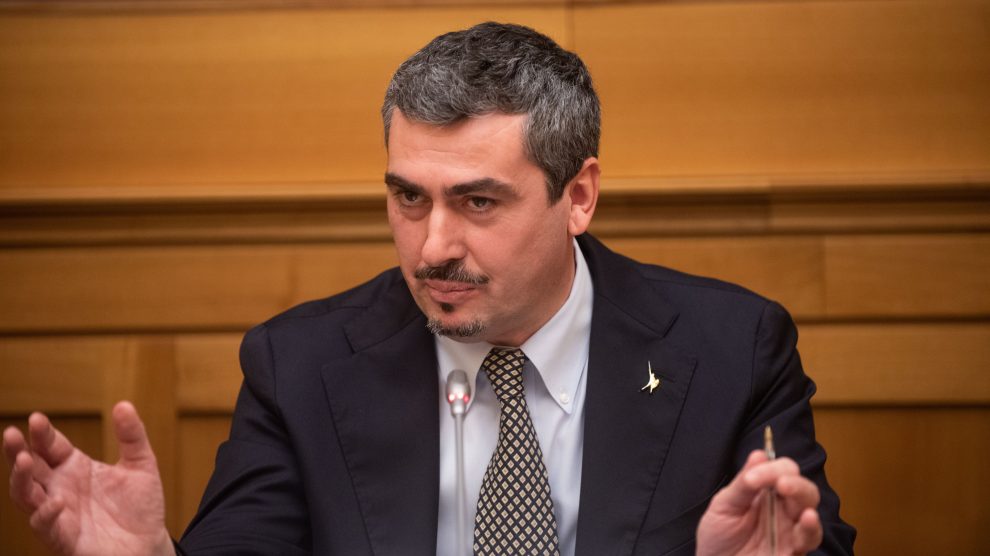
Decoding the news. Two seas, two peninsulas and the geopolitical hinge of a Mediterranean looking toward the Indo-Pacific. For Paolo Formentini, League MP and deputy chair of the Chamber’s Foreign Affairs Committee, the Meloni-Modi summit confirms two things:
- First, the need to give substance to the Imec project, moving from ministerial meetings to the answers that ports such as Trieste have been waiting for, as shown by the agreements signed yesterday, including on port cooperation;
- Second, the fact that the Italian government has become a visible international player and “a real model admired by many.”
Q: Prime Minister Giorgia Meloni highlighted two concepts in her remarks to Narendra Modi: reciprocity and complementarity. They may sound obvious, but…
A: Absolutely. That is why I think it is useful to shed light on a number of elements that are not sufficiently taken into account, starting with the fact that India is a democracy.
- In Italy, this is often overlooked. I have always believed that the major work carried out by the government in recent years to build a solid relationship with India is something that starts from the Abraham Accords and becomes what has rightly been called the “Indo-Abrahamic construct.”
- It is therefore right for Italy to diversify and to understand how many and which synergies can be developed with India. In my view, the main one remains Imec.
Q: Where does the project stand?
A: After a phase marked by meetings between prime ministers and foreign ministers, yesterday at Villa Pamphilj we moved to concrete steps. Deputy Minister Rixi signed a dedicated memorandum during the Meloni-Modi summit to strengthen cooperation in the port, logistics and infrastructure sectors.
- In this way, Italy confirms itself as the natural terminal of the Imec corridor, as the deputy minister himself reiterated, thanks to a logistics system that is unique in Europe: the western Genoa-Rhine route and the eastern route from Trieste toward Central and Eastern Europe, integrated with an advanced network of ports, interports and infrastructure.
- This is what our shipowners at the port of Trieste expect from us: to move toward an increasingly operational phase. Acceleration was essential because Italy could look at the new concept of the Indo-Mediterranean with confidence as an enlarged Mediterranean.
- It is no coincidence that we speak of two seas, both central because they are connected to maritime security and to the need to contain the actions of hostile actors. On these foundations, Italy and India can absolutely cooperate.
Q: Two other key elements are defence and international stability. How should they be framed in light of current events, from wars to the Hormuz crisis?
A: On security and defence, Italy today is certainly second to none in the world. International stability is also shaped by the global agenda. It is in the national interest of both India and Italy for the seas to remain navigable, especially in this case, the Strait, and it is a particular interest of an exporting power such as Italy.
- I would like to recall the enormous figures reached by Italian exports. We have an interest in Hormuz remaining open and in the Red Sea remaining navigable.
Q: How does the China factor fit into this context?
A: Beijing’s role so far has been at the very least ambiguous, if not contrary to our national interests. I am referring to the fact that the security of the Indian Ocean is being challenged by the continued presence of Chinese submarines, or to the fact that along the corridor from Myanmar to the Bay of Bengal, or in the Cocos Islands, there are Chinese listening stations pointed at Indian affairs.
- India has clearly understood all this very well. We Italians must also keep it in mind, because we would not want the Mediterranean to become like the Indian Ocean.
Q: How far has the process come since the G7 in Borgo Egnazia?
A: A long way, also thanks to key figures such as Ambassador Talò, who was among the first to imagine the Imec path and who is now our special envoy. In this sense, I would like to bring back a concept that I consider fundamental: the Abraham Accords, when thinking of India, find their basis also in a convergence rooted in the common origins of the three religions.
- And here, both about Israel and India, there is one real critical issue, namely, respect for Christianity. The members of this great agreement, which will shape our future and India’s future, will have to respect this element, because otherwise a fundamental part of the construct underlying this relationship would be missing.
Q: Has Italy’s international weight changed significantly over these three and a half years, as today’s summit shows?
The Italian government has become a well-established international player and is representing a real model that many admire.
- It is no coincidence that it engages with all the major players both in the region in question and in other highly strategic areas. This also connects to the role of the Emirates, whose position cannot go unnoticed: that country will be fundamental to the future of both India and Italy.