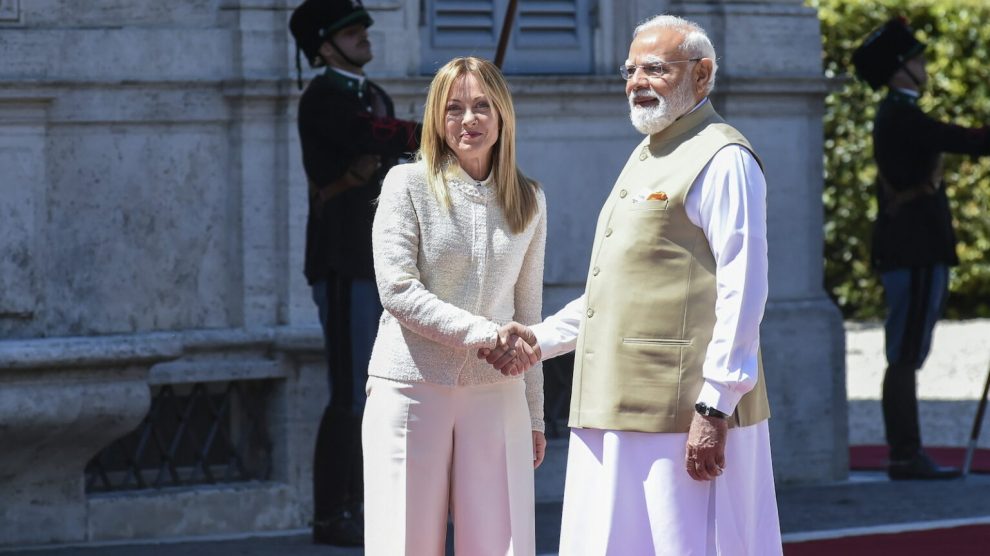
Decoding the news. The Rome-New Delhi axis is entering a new phase. Indian Prime Minister Narendra Modi’s visit to Italy confirms a trajectory that Giorgia Meloni’s government now considers strategic: strengthening the partnership with India on the economic, infrastructural, geopolitical and security fronts.
- From Imec, the India-Middle East-Europe Economic Corridor, to maritime cooperation, through innovation, Africa and industrial supply chains, Rome and New Delhi are seeking a convergence that goes beyond the purely commercial dimension and takes on systemic relevance.
- In this framework, the words of the two leaders marked a clear political point. Meloni insisted on the need to address together increasingly interconnected security challenges, while Modi evoked the link between “ancient civilisations” looking toward innovation and shared development.
- To understand the strategic significance of the visit, Formiche.net spoke with Ambassador Francesco Maria Talò, Italy’s Special Envoy for the India-Middle East-Europe Economic Corridor, former diplomatic adviser to Palazzo Chigi, permanent representative to NATO, and ambassador to Israel.
Q: Ambassador, Meloni spoke of the need to face together security challenges that are now intertwined. Is this the sign of a political leap in relations with India?
A: Yes, and I believe it is a very important step. President Meloni’s emphasis concerns precisely the complexity of today’s challenges.
- There are no longer separate dossiers: security, economy, infrastructure, energy and maritime connections are constantly intertwined. That is why we need to work together with reliable and strategic partners. It is a vision directly connected to the concept of the Indo-Mediterranean: a geopolitical reading based on seas and connections, with the Mediterranean at the centre but linked to the global context.
- Vision, however, is not enough. What is needed is concrete implementation and daily work. Hence, the very welcome emphasis on “hard work.”
Q: Modi also insisted on a specific point: the relationship between ancient civilisations that are nevertheless looking together toward innovation. How much does this element matter?
A: It matters a great deal because it captures the evolution of the bilateral relationship. Modi certainly recalled the historical and cultural dimension, but he immediately connected it to innovation, new technologies and shared growth.
- This is a relationship that is no longer confined to traditional diplomacy. When the Indian prime minister also speaks of cooperation in Africa, for example, what emerges is a much broader partnership, one that connects directly to the Mattei Plan and to a common vision of economic and strategic connections.
Q: The visit comes within a broader Italian strategy. How should it be read?
A: The keyword is diversification. We live in a context dominated by uncertainty, and we need to broaden our horizons. This means acting along three lines: the European dimension, in which we assert our national interests while strengthening European unity; the determined effort to preserve Western cohesion; and then the need to look beyond, precisely so as not to be at the mercy of external pressures.
- India is the number one partner in this strategy, but diversification does not mean monopolising attention around a single interlocutor. It means strengthening relationships that were underdeveloped compared with their potential.
Q: Why is India so central to Italy’s projection, according to this logic?
A: Because it is the most populous country in the world, one of the fastest-growing major economic players and a very young society demographically. For Italy, this is an extraordinary prospect.
- We have a highly diversified economy, with a fabric of small and medium-sized enterprises that is both a strength and a complex factor. India can be very interested in what comes from our SMEs and, above all, in the possibility of producing together.
- It is also a very strong country in terms of innovation and technical training: it produces huge numbers of engineers and advanced skills.
Q: You identify 2023 as a turning point in relations between Rome and New Delhi. Why?
A: Because in the first year of the Meloni government, it became clear that a qualitative leap was needed. I accompanied the prime minister to India twice during 2023, and there a strategic but also personal relationship with Modi was consolidated.
- There is good chemistry between the two leaders, and this matters in international relations. From that moment, several lines of work opened up: direct dialogue between businesses, also encouraged by the action of Foreign Minister Antonio Tajani through business forums; cooperation on infrastructure connections; the relaunch of Imec. All of this stems from that phase.
Q: Imec seems to have returned to the centre after difficult months linked to the war in the Middle East. Where do things stand?
A: It is resuming with great force. Imec is a strategic project because it connects India, the Middle East and Europe through infrastructure, ports, energy, data and logistics.
- It is the concrete translation of the idea of connection between different but complementary geopolitical areas. After a slowdown caused by the war, the project is now returning to the centre of the international agenda.
Q: How much does the security dimension matter?
A: A great deal. Defense Minister Crosetto’s recent visit was important precisely in this direction. There is major work underway on maritime security, ports and infrastructure cooperation.
- Deputy Minister Rixi is also closely following these dossiers. The maritime dimension is fundamental because global trade and security pass through the seas.
Q: You have long spoken of the Indo-Mediterranean. Today, this definition seems to have taken root in the Italian strategic debate as well.
A: For me it is a personal satisfaction, because just a couple of years ago very little was said about it. For a long time, we used the definition of the enlarged Mediterranean, which was certainly useful, especially for strengthening the Navy. But abroad, that concept was not widely received.
- The Indo-Mediterranean, instead, works because it immediately recalls the idea of the Indo-Pacific, which today is on everyone’s lips but was itself a political and strategic construction, originally conceived by Shinzo Abe.
- We too must assert a vision based on global maritime connections, with the Mediterranean at the centre. The Indians like this idea very much. The Indo-Mediterranean vision framed the conference dedicated to Imec held in March in Trieste.
- That initiative, promoted by Minister Tajani, was the most important organised so far on this issue, also because it involved many companies. It followed three bilateral forums chaired by Tajani himself over a few months in 2025 between India and Italy. Each time, there was strong interest from entrepreneurs.
- This means moving from vision to action, and it is consistent with Giorgia Meloni’s remarks, in which she placed great emphasis on the word work.