The mission of Deputy Industry Minister Valentino Valentini combined a political and industrial message: closer coordination between two advanced manufacturing economies facing growing pressure from geopolitical tensions, technological competition and fragile global supply chains.
Why it matters: Italian officials increasingly view the Indo-Pacific as central to global economic and geopolitical dynamics, with Japan emerging as one of Rome’s key partners in the region. The relationship is also increasingly reciprocal: while Italy sees Tokyo as a gateway into the Indo-Pacific, Japan views Rome as a strategic interlocutor in Europe and the Mediterranean.
- Italy and Japan are trying to move beyond traditional trade ties toward deeper industrial coordination.
- Economic security is becoming a central pillar of industrial policy among advanced economies.
- Semiconductors, critical technologies and strategic supply chains are emerging as key areas of cooperation.
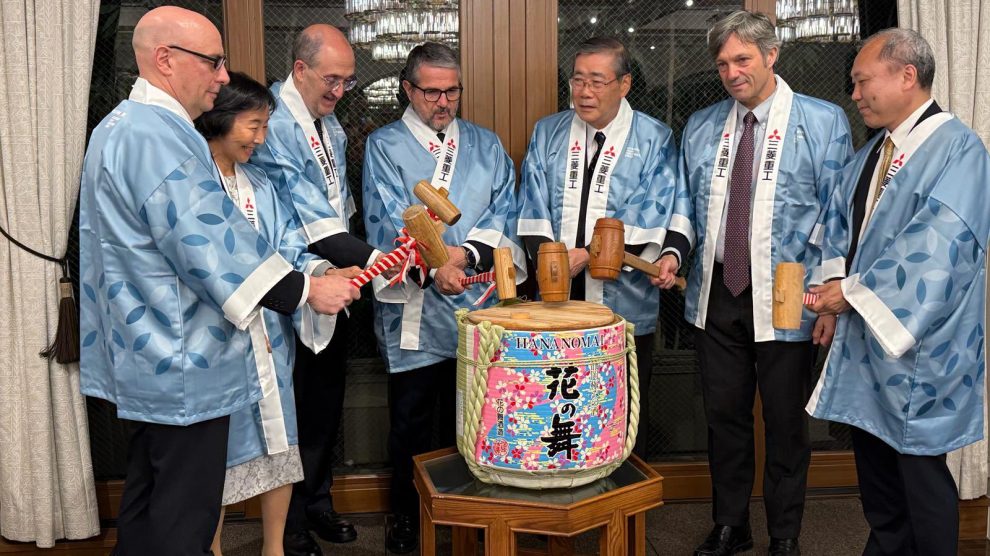
Zoom in: Valentini’s Japan mission. The Italian delegation in Tokyo was led by Valentini alongside Foreign Ministry deputy secretary general Carlo Lo Cascio, with Italy’s ambassador to Japan Mario Vattani also taking part. Japanese officials included Vice Foreign Minister Takeshi Akahori and METI Vice Minister Takehiko Matsuo.
- The centerpiece of the visit was the official launch of the Italy-Japan Economic Security Table, a new bilateral mechanism designed to coordinate policies on strategic supply chains, industrial resilience, technological cooperation and critical sectors.
- According to the official framework, the initiative aims to strengthen “the competitiveness of the economic system through the reinforcement of supply security and strategic value chains.”
- The mechanism will include plenary meetings and technical-level working groups intended to create more stable coordination between industrial policy and strategic security priorities.
Tokyo: economic security takes center stage. The launch reflects how economic security has moved to the core of relations among industrial economies.
- Italian officials see recent crises — from the pandemic and U.S.-China trade tensions to the wars in Ukraine and the Middle East — as evidence of the vulnerabilities tied to global supply chains for semiconductors, critical raw materials, energy and advanced technologies.
- Rome and Tokyo are now trying to reduce those vulnerabilities while preserving open trade channels and protecting strategically sensitive sectors.
- The initiative also signals Italy’s growing focus on the Indo-Pacific through industrial and technological partnerships rather than purely diplomatic engagement.
Nagoya: from trade ties to industrial partnership. Speaking at the Italy–Japan Business Group meeting in Nagoya, Valentini argued that the bilateral relationship should evolve from a “predominantly commercial” one into a “strategic industrial partnership” focused on sectors critical to the future of both economies.
- “There are relationships between countries measured in trade volumes. And there are relationships measured by something harder to quantify: trust, shared values and the ability to build together over the long term,” Valentini said.
- He described Italian and Japanese industrial systems as “different in form, but deeply convergent in substance,” arguing that both countries share a manufacturing culture centered on long-term knowledge, quality production and strong industrial ecosystems.
- Valentini also pointed to what he described as an “still largely unexplored” potential for cooperation between Japanese corporations and Italy’s manufacturing sector.
Between the lines: One of the most significant elements of the new framework is the planned integration of the private sector into future discussions.
- That suggests Rome and Tokyo are trying to build not only a diplomatic dialogue, but also a more operational platform linking governments and companies on industrial resilience and strategic technologies.
What we’re watching: The next test will be whether the new mechanism produces concrete industrial projects, investment coordination and technology partnerships in sectors such as semiconductors, digital infrastructure and advanced manufacturing.
The bottom line: Valentini’s Japan mission showed how Italy and Japan are increasingly framing their relationship as a long-term strategic industrial partnership shaped as much by geopolitical risk and technological competition as by trade.
(Photo: X, @vale_valentini)