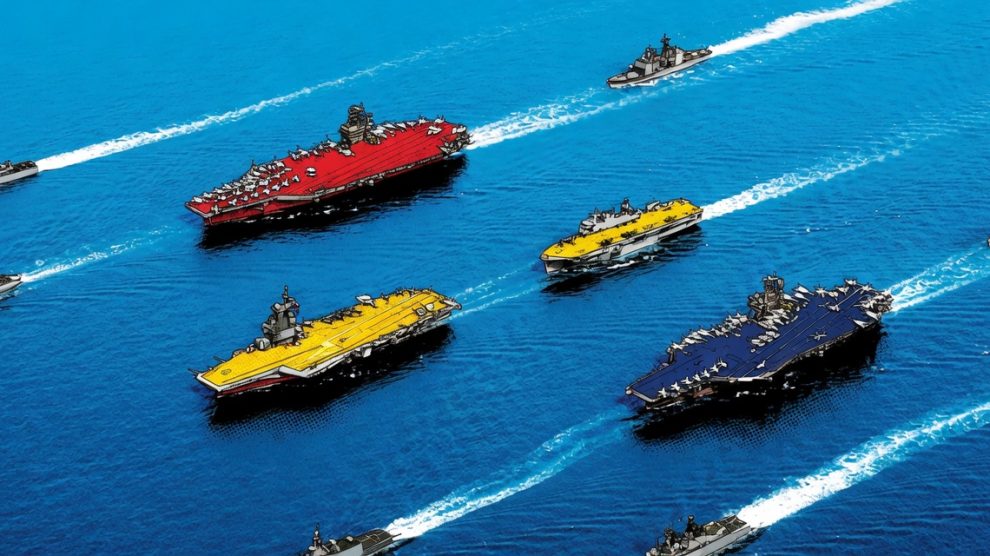
Over the past days, the Indo-Pacific has simultaneously displayed nearly all of its complexities — dynamics that have not gone unnoticed in Rome, where growing attention is being paid to the region’s direct impact on Italian strategic interests.
From G2 momentum to Rome. Within the span of a few days, the leaders of the United States and China met in Beijing attempting to shape a new form of strategic dialogue within what Donald Trump still implicitly imagines as a kind of “G2”: a pragmatic, transactional and potentially cooperative relationship between equals, capable of managing global competition through direct engagement between Washington and Beijing.
- For Xi Jinping, however, this framework is less convenient than it may appear. China’s leadership has never particularly appreciated the idea of a G2. Beijing sees “G-style” systems as structurally exclusionary and incompatible with the narrative through which China seeks to present itself as the inclusive leader of an alternative international order — formally multipolar, though increasingly centered around Chinese strategic interests.
- Relations between Trump and China will certainly form part of the backdrop to Italian Prime Minister Giorgia Meloni’s upcoming visit to China, which is expected to take place by October — or possibly even earlier.
Taiwan’s signal. And yet, the Trump-Xi summit ended up accelerating nearly every other regional dynamic. Starting with Taiwan, which openly became part of transactional strategic language.
- Taiwan itself is no longer merely an Asian security issue. It is a central node in the technological and industrial supply chains upon which European competitiveness increasingly depends.
Tokyo’s shift. Additionally, Japan is now entering a new strategic phase and reportedly criticized by Xi Jinping himself during discussions with Donald Trump.
China and Russia. Furthermore, Russia is also a significant player in this context. Shortly after Trump departed Beijing, Vladimir Putin arrived in the Chinese capital.
- The sequence was highly symbolic. Xi simultaneously demonstrated willingness to engage Washington while avoiding the appearance of being trapped inside a bipolar management structure of the international system.
- The partnership with Moscow therefore continues to serve an important political and narrative function: it signals that China possesses strategic alternatives to the West and, perhaps more importantly, that Beijing can manage from a position of strength a Russia that is becoming increasingly dependent on China economically and politically.
The Quad reload. At the same time, in New Delhi, the foreign ministers of India, Japan, Australia and the United States met to relaunch the Quad through operational initiatives focused on infrastructure, maritime security, energy and critical minerals.
- This marked an important step for a format that experienced strong institutionalization during Trump’s first term and is now trying to redefine its role amid the strategic ambiguities of the second.
- The Indo-Pacific increasingly revolves around the control of connections: ports, shipping lanes, supply chains, semiconductors, critical minerals, energy corridors and technological infrastructure are becoming part of the same strategic architecture.
Enter IndoMed. India also played a central role in another major development — geographically more distant, yet fully integrated into the broader Indo-Pacific strategic discussion.
- During Narendra Modi’s visit to Rome, Italy and India officially introduced the concept of the “Indo-Mediterranean” into their institutional strategic vocabulary.
- This means openly recognizing that the Mediterranean, the Gulf, the Indian Ocean and the Indo-Pacific now belong to the same continuous strategic space.
- The Indo-Mediterranean does not emerge as an abstract diplomatic formula, but as a direct consequence of the continuity of recent crises: the war in Ukraine, instability in the Red Sea, tensions around Hormuz, energy insecurity, logistical disruptions and the global competition over supply chains.
Why it matters for Italy: In other words, Italy is already inside Indo-Pacific geopolitics. Geography made that inevitable. Strategic language is now formalizing it.
- For Italy, understanding the Indo-Pacific no longer means expanding its geopolitical horizon outward. It means understanding where the economic, technological and strategic balances increasingly shaping Europe’s own future are being redefined.