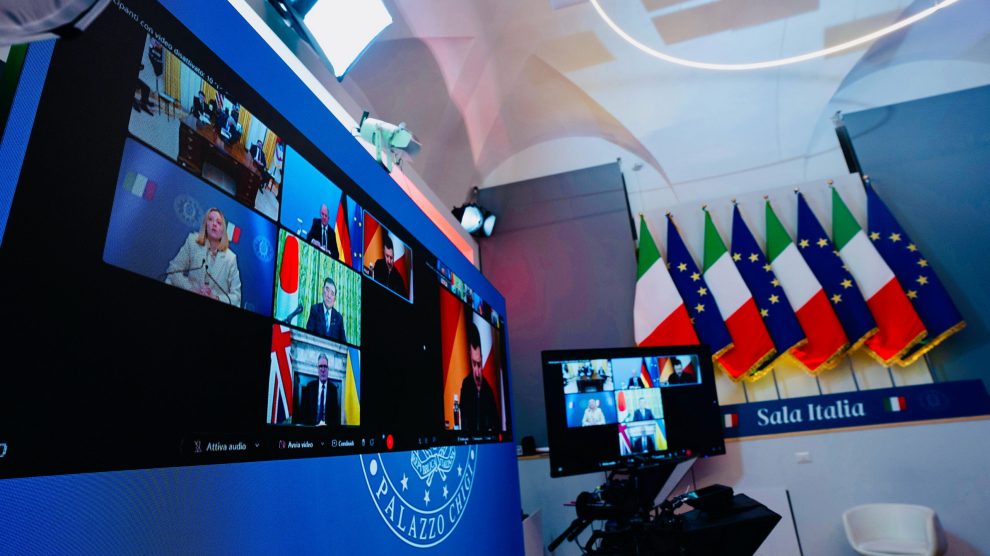
The sequence of meetings — Meloni-Trump, Crosetto-Hegseth and Tajani-Rubio — comes as Europe and the United States navigate overlapping disputes on security, trade, technology and supply chains.
Why it matters:
- Italy is positioning itself as a central interlocutor between Europe and the Trump administration.
- Defense, trade and critical technologies are increasingly intertwined across the transatlantic agenda.
- Rome is pushing for a stronger European defense role while insisting that it should reinforce, not replace, NATO.
- The meetings come ahead of two major tests for Western coordination: the G7 in France and the NATO summit in Ankara next month.
The big picture: The diplomatic calendar highlights a broader Italian effort to manage several strategic priorities simultaneously.
- The Meloni government is seeking to deepen ties with Washington while advancing European initiatives on defense, preserving economic cooperation with the U.S., and responding to growing concerns over global supply chains and geopolitical instability.
- The message from Rome is that a stronger European contribution to security should coexist with a robust transatlantic partnership.
Zoom out: Meloni and Trump head to the G7. Prime Minister Meloni will join leaders at the G7 summit in Évian-les-Bains, France, from June 15 to 17, alongside the heads of government of Canada, France, Germany, Italy, Japan, the United Kingdom and the United States.
- President Donald Trump has confirmed his participation. French President Emmanuel Macron is reportedly considering a bilateral engagement with Trump before the summit, with discussions ranging from a dinner in Versailles to a golf outing.
- Several sensitive dossiers are expected to dominate the agenda:
- the ongoing stalemate in the war in Iran;
- U.S. criticism of NATO allies over the Middle East;
- the war in Ukraine;
- relations with Canada and Japan;
- tariffs and trade disputes;
- artificial intelligence governance;
- critical mineral supply chains.
Yes but… A further point of uncertainty concerns Ukrainian President Volodymyr Zelensky, who has been invited by France but whose attendance remains unclear.
- Technology and industrial security are also likely to feature prominently. Trump recently suggested that the U.S. government could acquire small ownership stakes in major AI companies so that “the American people can benefit” from their future growth.
- At the same time, Western governments are increasingly focused on their dependence on China for critical minerals used in defense manufacturing and advanced industrial production. The issue has gained additional visibility following the launch of a Global Critical Minerals Supply Chain Observatory by India and the United Kingdom.
Zoom in: Crosetto’s Washington mission. On June 15, Defense Minister Guido Crosetto will hold a bilateral meeting in Washington with U.S. Defense Secretary Pete Hegseth.
- The discussions are expected to focus on:
- defense spending;
- the war in Ukraine;
- the use of U.S. military bases in Italy;
- the future structure of transatlantic security cooperation.
- The meeting comes after Crosetto publicly argued for the need to build a “continental European defense” alongside NATO.
- Italian officials frame this approach as an effort to strengthen the European pillar of the alliance without weakening ties with the United States. The Washington talks are also likely to serve as an early step toward the NATO summit scheduled for July in Ankara.
Follow the money: Tajani and Rubio in Miami. Crosetto’s trip will be followed by Foreign Minister Antonio Tajani’s participation in the Italy-U.S. Business, Investment, Science and Innovation Forum in Miami on June 22.
- U.S. Secretary of State Marco Rubio is also expected to attend, with the event designed to showcase the strength of bilateral economic ties.
- The forum will focus on four main sectors:
- frontier technologies, including AI, quantum computing, cybersecurity, energy and space;
- advanced manufacturing, robotics, agritech, medical technologies and biotechnology;
- resilient infrastructure and transportation systems;
- food, design, fashion, culture and sports.
- The economic backdrop remains favorable. Italian exports outside the EU rose 11.3% year-on-year in April 2026, according to the figures provided, while exports to the United States increased 12.1%. The U.S. remains Italy’s largest source of trade surplus, with a positive balance of €2.832 billion in April.
- The American market is also a key pillar of Italy’s export action plan, reflecting what Rome sees as deep commercial, industrial and technological integration between the two countries.
What we’re watching:
- Whether Meloni secures a substantive bilateral exchange with Trump on the sidelines of the G7.
- How discussions on Ukraine evolve if Zelensky attends the summit.
- Whether Crosetto’s proposal for a stronger European defense role finds traction in Washington.
- How trade, AI and critical minerals become linked within the broader transatlantic agenda.
The bottom line: The three Italy-U.S. meetings are unfolding across different policy areas, but they point in the same direction: Rome is seeking to reinforce its political, security and economic ties with Washington at a moment when the transatlantic relationship is being tested by wars, technology competition and strategic supply chain vulnerabilities.