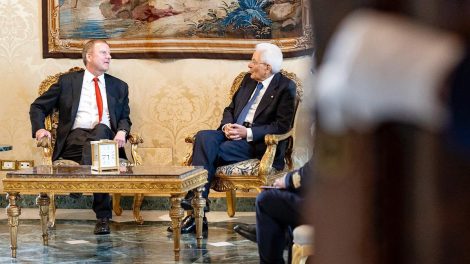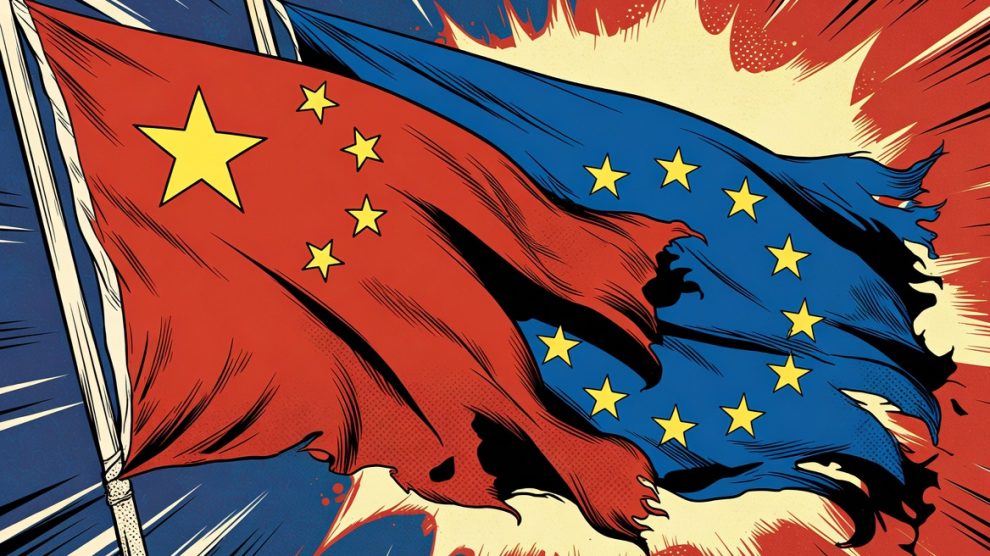
Brussels and Beijing are trying to stabilize one of the world’s most consequential trade relationships. But the meeting between EU Trade Commissioner Maroš Šefčovič and Chinese Commerce Minister Wang Wentao is less a sign of rapprochement than an acknowledgment that the current trajectory is becoming unsustainable.
Why it matters: The two sides agreed to issue their first joint statement since 2019, establish a joint trade-monitoring mechanism, and work toward “tangible results” by October – with a new ministerial meeting already scheduled, in Beijing. The real question, however, is whether Europe can translate its de-risking strategy into concrete policy before China’s structural economic pressures — and growing coercive toolkit — deepen the imbalance even further.
Driving the news: Šefčovič and Wang agreed to relaunch structured trade talks around four priorities:
- rebalancing trade and investment;
- export controls;
- intellectual property protection;
- WTO reform.
The most significant outcome was the creation of a joint monitoring mechanism that would trigger political consultations if trade imbalances exceed agreed thresholds. Brussels also welcomed China’s commitment to avoid disrupting exports of rare earths to Europe — a growing strategic concern for European industry.
The bigger picture: The diplomatic thaw comes against a deteriorating economic backdrop.
- In 2025, the EU recorded a €359.8 billion trade deficit with China.
- European exports to China fell by 6.5%, while Chinese exports to Europe rose by 6.4%. The trend has continued into 2026, with the deficit reaching its highest level since late 2022 during the first quarter.
- For the first time, every EU member state now runs a bilateral trade deficit with China.
- The imbalance is no longer viewed in Brussels as a temporary distortion. It is increasingly seen as a structural consequence of China’s economic model.
What’s driving China’s export surge. China’s domestic economy remains unable to absorb its own industrial output.
- The prolonged property crisis, weak household consumption and persistent deflationary pressures continue to constrain domestic demand. While Beijing has tried to stimulate consumption through subsidies under its 15th Five-Year Plan, these measures have so far failed to generate a lasting shift away from export-led growth.
- External factors reinforce this trend. As the United States has progressively raised tariffs and other trade barriers against Chinese goods, access to the American market has become more difficult across several sectors. That does not mean China is simply “redirecting” exports to Europe.
- Rather, weaker domestic demand combined with a more restricted U.S. market increases the incentive for Chinese firms to expand sales wherever market access remains comparatively open.
- Europe has increasingly become one of those destinations.
Europe agrees on the diagnosis. Not on the cure. Three years after launching its de-risking strategy, the EU still lacks a common operational approach toward China.
- Most member states now accept that reducing strategic dependencies is necessary. The disagreement concerns how far — and how fast — Europe should go.
- France has increasingly framed the relationship through the lens of economic security. Germany remains constrained by its deep industrial exposure to China and remains cautious about measures that could provoke retaliation. Italy and Spain broadly support the Commission’s de-risking agenda but favour targeted interventions over broad restrictions that could escalate into a wider trade conflict.
- This is why last month’s European Council deliberately avoided engaging China directly while mandating the Commission to develop new economic security instruments over the coming months.
What’s next: Brussels is quietly preparing a second generation of trade defence tools. Among the proposals under discussion are:
- an Overcapacity Instrument targeting sectors distorted by state-backed Chinese overproduction;
- new supply-chain diversification requirements that would oblige companies in critical sectors to source key inputs from multiple suppliers rather than relying on a single country;
- broader measures linking industrial resilience with economic security.
- Whether these proposals survive negotiations among member states remains uncertain.
Some of that shift is already underway. On 1 July, the EU abolished the de minimis exemption that had allowed parcels worth less than €150 to enter the bloc duty-free.
- The new flat customs charge — introduced mainly to target the surge of low-value imports from platforms such as Temu and Shein — is designed not only to restore a level playing field for European retailers, but also to strengthen customs authorities’ ability to inspect unsafe products.
- More than 5.9 billion low-value items entered the EU in 2025, over 90% from China, underscoring how economic security concerns now extend beyond strategic industries to everyday e-commerce.
But China isn’t waiting. While Europe debates new instruments, Beijing is already deploying its own.
- Since 2025, China has expanded export controls on rare earths, tightened licensing requirements and introduced new supply-chain security rules that allow authorities to prohibit Chinese companies from complying with certain foreign regulations.
- Chinese authorities have also restricted exports to several European defence companies over alleged links to Taiwan.
- The result is that economic interdependence is increasingly becoming an instrument of statecraft rather than simply a feature of globalization.
The overlooked risk: policy paralysis. Some analysts argue that China’s greatest leverage does not come from the sanctions it imposes, but from the sanctions Europe fears.
- Tobias Gehrke of the European Council on Foreign Relations describes this as a “chilling effect.” The possibility of Chinese retaliation may discourage European policymakers from adopting stronger trade or industrial measures before Beijing even needs to respond. Under this logic, economic coercion succeeds not only when sanctions are applied, but when they narrow the political space for action.
Between dialogue and deterrence. Several trade analysts note that Beijing continues to argue Europe’s growing trade deficit reflects declining European competitiveness — particularly higher energy costs — rather than unfair Chinese industrial policies. China also omitted any reference to the EU’s October timeline in its own official readout, suggesting it may not share Brussels’ sense of urgency.
- Meanwhile, Beijing remains deeply critical of forthcoming EU legislation, including the proposed Industrial Accelerator Act and new cybersecurity rules, both of which could further restrict Chinese firms’ access to the European market.
The bottom line: The Šefčovič-Wang meeting marks something nuanced: both sides are trying to prevent economic competition from escalating into outright confrontation while preparing for a relationship that will become increasingly defined by industrial policy, supply-chain resilience and economic security.
- Europe’s challenge is no longer identifying the risks posed by dependence on China. It is deciding how much economic and political cost it is willing to bear to reduce them before Beijing gains even greater leverage.