Eni’s deal flow since the start of 2025 — a lithium stake in Chile, a new Asian gas major built with Petronas, an entry into Argentina’s LNG frontier, a trading joint venture with Mercuria, a cluster of satellite companies opened to outside capital — is not a scattered list of opportunistic transactions.
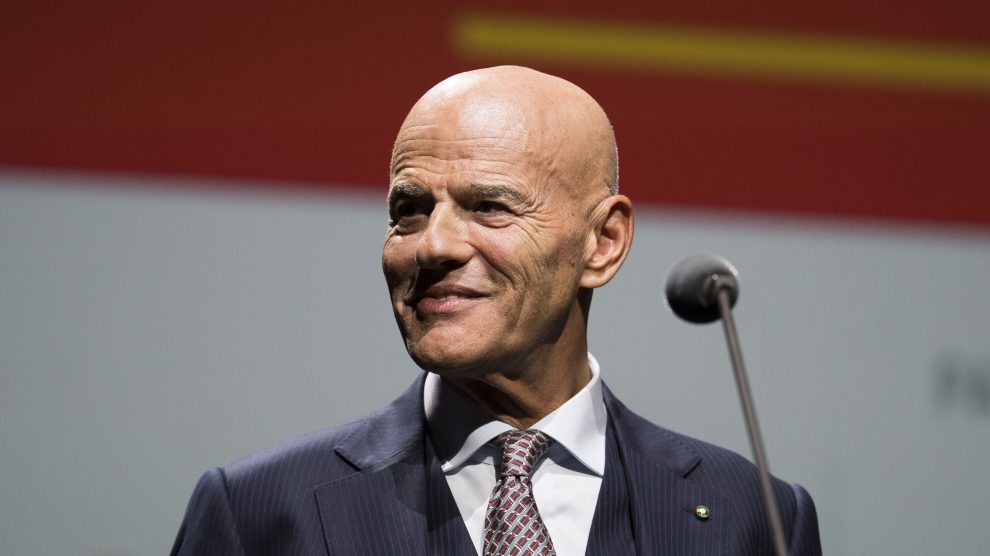
Read against the framework the Eni CEO Claudio Descalzi laid out in his recent interview with Il Sole 24 Ore, it looks like the deliberate execution of a stated thesis: that the world has entered a permanent regime of supply fragility, and that survival depends on diversifying sources, routes and partners faster than rivals.
A shock that will not reverse. The immediate news peg is stark enough on its own. Since fighting around Iran began in March, transit through the Strait of Hormuz has collapsed by 95 per cent, and daily shipping through the waterway has more than halved again since early July.
- In his interview, similar to a geopolitical manifesto, Descalzi puts the cumulative drawdown in global oil stocks, mostly OECD government reserves and seaborne cargo, at 350 million barrels between the start of the bombing campaign in March and the end of May, with the daily rate of depletion in May running ahead of anything recorded during the pandemic.
- He is explicit that this is not a transient shock but the third in a five-year sequence, following Covid and the war in Ukraine, whose effects on supply, freight and insurance costs have compounded rather than reset.
- His warning is precise: without a change of trajectory, the market hits a breaking point in the first quarter of 2027, and Europe — which he argues spent the post-Covid years indulging a narrative that treated the retreat of hydrocarbons as structurally assured — is the most exposed actor in the system.
From diagnosis to prescription. The prescription that follows is where the interview stops being commentary and starts reading as strategy.
- Descalzi calls for a “geoeconomics of energy” built on diversifying both sources and geography, integrating across the value chain, and treating Africa, South America and South-east Asia as the decisive new terrain, alongside a reinforced relationship with US gas.
- That reading is not only Descalzi’s personal diagnosis. Eni’s World Energy Review 2026 points to the same structural backdrop: in 2025, global energy demand continued to rise while the world’s energy mix remained broadly stable, with oil and gas retaining a central role even as renewables and critical minerals gained strategic weight. The transition is advancing, in other words, but it has not displaced the problem of supply security; it has made that problem more complex.
Diversification, deal by deal. Eni’s recent transactions map onto that prescription with unusual fidelity.
- The SEARAH venture with Petronas, cleared by Jakarta and Kuala Lumpur in May, folds 19 upstream assets across Indonesia and Malaysia into a jointly owned company producing over 300,000 barrels of oil equivalent a day, with a medium-term target above 500,000 — less an acquisition than the construction of a new regional gas major in the exact South-east Asian market Descalzi identifies as underexploited.
- The late-June entry into Vaca Muerta, acquiring a 32 per cent stake in three upstream blocks feeding the Argentina LNG project with YPF, extends the same logic to South America, targeting 12 million tonnes of annual LNG capacity.
- The Mercuria trading joint venture, announced in early July, rebuilds Eni’s presence in global commodity flows at precisely the moment those flows have become the contested resource Descalzi describes.
- And the $225mn investment in EnergyX’s Black Giant project in Chile, securing a quarter of future lithium carbonate output, pushes Eni into the critical-minerals supply chains that underpin the transition away from oil it says it cannot abandon in the short term.
A different way of paying for it. A parallel pattern is visible in how Eni is financing all of this. Rather than carrying capital-intensive assets on its own balance sheet, it is building standalone “satellite” companies and inviting outside investors in:
- KKR’s stake in Enilive, now 30 per cent at an implied €11.75bn valuation;
- Global Infrastructure Partners’ co-control of the new CCUS holdingspanning UK, Dutch and Italian carbon-storage assets; and Plenitude’s acquisitions of Acea Energia and Umbria Energy, which let the retail and renewables arm reach its 11 million-customer target three years ahead of the original 2028 schedule.
- Plenitude has been building on the international side too, absorbing a portfolio of renewable assets from the French developer Neoen during 2025, and in February the European Commission cleared a joint venture with Société Générale’s Vulturno Investments to acquire and manage solar, wind and battery-storage projects — a template for pairing Eni’s origination with a bank’s balance sheet rather than its own.
- Trimming a 10 per cent stake in the Baleine project to SOCAR, Azerbaijan’s state oil company, meanwhile, shows the same portfolio discipline applied in reverse — what Eni calls dual exploration, recycling capital out of mature assets to fund the next frontier.
Reaching into the fuels of the transition. The same satellite logic extends into Asia’s biofuels supply chain.
- A joint venture with South Korea’s LG is advancing a biorefinery expected to start operations in 2027, with capacity to process roughly 400,000 tonnes a year — a deal that combines Enilive’s push to internationalise, the group’s growing biofuels business, and an industrial partnership with one of the few Asian conglomerates able to match Eni’s scale in refining and chemicals.
- It reinforces the point made by SEARAH: Eni’s Asian strategy is not confined to upstream gas but reaches into the fuels of the energy transition as well.
The bottom line: What stands out is the sequencing. Eni was buying into Indonesian gas, Argentine LNG and Chilean lithium before Hormuz became the story dominating trading desks, which suggests a strategy already in motion rather than one improvised for the cameras.
- Descalzi naturally has an interest in framing his company’s transactions as foresight rather than routine portfolio churn, and volatile prices flatter that framing. But a European major that has spent two years diversifying suppliers, geographies and financing partners simultaneously is better placed than most to absorb the shock it now says is coming.