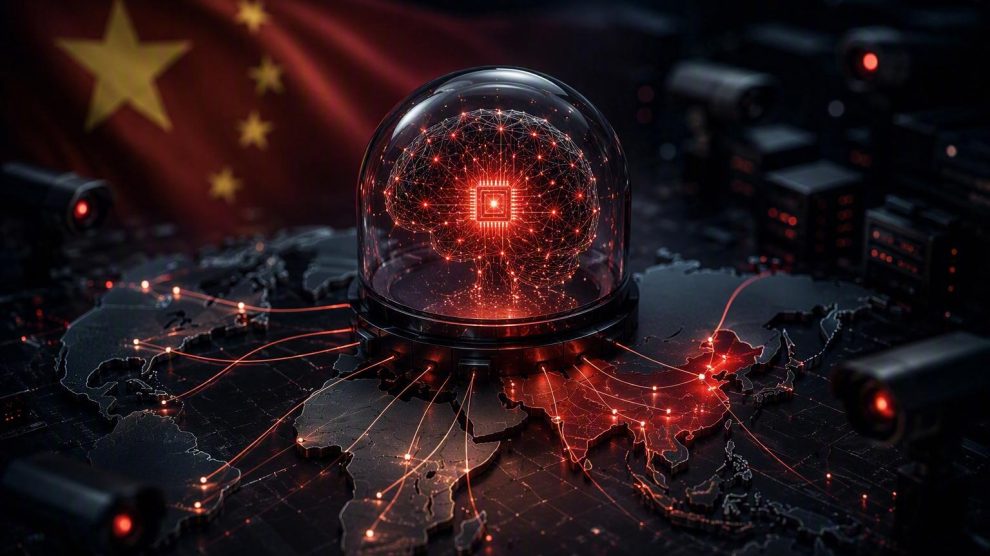
The participation of the Director General of AgID in the World Artificial Intelligence Conference in Shanghai is, in itself, a minor episode. Yet it highlights the gap between Italy’s declared international alignment and the day-to-day conduct of public administrations, companies and research centres. The government has made the country’s Euro-Atlantic orientation clear; the broader system continues to behave as though technological decisions belonged to a domain separate from national security. They no longer do.
The 2019 Memorandum had at least one defining characteristic: it was visible. It was a political act, with signatures and clearly identifiable responsibilities—debatable and, ultimately, reversible.
- Today, Chinese influence enters through far less visible side doors: an industrial partnership, a university agreement, a cloud service, an artificial intelligence model that is inexpensive and easily integrated into existing processes. None of these steps requires a high-level political decision. Each of them, over time, creates dependency.
The greatest risk therefore remains fragmentation. Beijing does not need a single major strategic realignment in its favour. It can achieve much the same result by accumulating smaller decisions: software adopted because it is cheaper, a scientific partnership assessed solely on academic merit, infrastructure selected without considering future dependence on the supplier. By the time policymakers recognise the problem, the cost of exiting has already become substantial.
- There is, however, another reason why artificial intelligence cannot be treated like the infrastructures we already monitor. It is not merely an enabling technology; it is becoming the channel through which an ever-growing share of society acquires information, interprets reality and forms its judgments.
We have learned to be wary of social media platforms, where every piece of content is ultimately the message of an identifiable actor. Faced with the response of an artificial intelligence system, users instead tend to attribute a different kind of authority to it: they assume they are receiving a neutral synthesis, rather than someone’s opinion. This perception may transform AI into an unprecedented intermediary of information, precisely because it is not perceived as an intermediary.
Absolute neutrality in an AI model does not exist. Every system depends on the data on which it has been trained, the sources that have been selected, the instructions it has received and the filters that have been applied. There is no need to imagine explicit propaganda. It is enough for certain information to be downplayed, other information to be emphasised, and some sources to be made marginal. Those who control models, data and response criteria do not directly govern public opinion, but they possess an unprecedented instrument for shaping how opinions are formed. This is the risk of a cognitive backdoor.
It would be intellectually dishonest to argue that this applies only to Chinese models. It applies to all of them, and particularly to American models, on which Europe depends to a far greater extent. The difference does not lie in neutrality, which no system possesses, but in the legal framework within which these choices are made.
- A model developed within a democracy operates under a legal order that allows litigation, parliamentary scrutiny, a free press and corporate accountability. An ecosystem embedded within an authoritarian system offers none of these mechanisms of verification, and never will, because verifiability is precisely what such a system is designed to exclude. The real distinction is contestability, not purity.
This does not, however, exhaust Europe’s challenge vis-à-vis the United States, which is different in nature but by no means negligible. Depending on an ally for computing power, cloud infrastructure and AI models is still a form of dependency. It means being exposed to regulatory or extraterritorial decisions taken elsewhere and for purposes that may not be Europe’s own, as recent experience with tariffs and semiconductors has demonstrated.
- An alliance does not automatically imply a coincidence of interests. The answer is not equidistance between Washington and Beijing, which would be a strategic mistake, but the development of an autonomous European capability that makes transatlantic cooperation a matter of choice rather than necessity.
Two forms of action are therefore required. The first concerns procedures. The international activities of public administrations in strategic sectors require clearer rules on who takes decisions and how those decisions are coordinated with national security authorities. Companies need technological risk assessment tools that go beyond a purely formal compliance exercise. Universities and research centres require proportionate rules capable of distinguishing legitimate cooperation from the transfer of sensitive knowledge.
- The second concerns capabilities. Risk cannot be reduced through prohibitions alone. One cannot ask a company to forgo the most competitive technology without offering a competitive alternative. Europe must invest in computing capacity, cloud infrastructure, semiconductors, large language models, cybersecurity and dual-use applications, bringing together research, industry, defence and space into what is today a fragmented industrial ecosystem. Not unrealistic self-sufficiency, but the autonomous capacity to choose.
Relations with China will remain necessary, and complete decoupling is unrealistic. But cooperation does not mean abandoning the ability to distinguish between normal economic exchange and activities that generate strategic dependency or informational influence.
- The real question is not how effectively China can still exploit Italian and European vulnerabilities. It is whether we are capable of recognising those vulnerabilities before they become dependencies. In the age of artificial intelligence, sovereignty is no longer only about ports, networks and critical infrastructure. It is also about the freedom with which a society forms its own convictions.
Why the author matters: Raffaele Volpi served as Undersecretary of State for Defense from June 13, 2018, to September 5, 2019.
- He was also the President of COPASIR (the Parliamentary Committee for the Security of the Republic) from October 2019 until his resignation in May 2021.
- Throughout his career, he has been a long-serving lawmaker, operating as a Member of the Italian Chamber of Deputies from 2008 to 2013 and again from 2018 to 2022, alongside a tenure as an Italian Senator from 2013 to 2018.