Decoding the situation: Libya’s political paralysis is entering a new phase. As the United Nations struggles to revive a stalled transition, Washington is backing a new political initiative that has attracted growing international attention.
- Yet, according to Karim Mezran, Director of the North Africa Initiative at the Atlantic Council and one of the world’s leading Libya experts, the proposal risks deepening internal divisions rather than resolving them.
A crisis of legitimacy. Libya’s political deadlock has evolved into what Mezran describes as a profound crisis of legitimacy.
- Public frustration is increasingly directed at both competing centers of power: in the east, where Khalifa Haftar and his family continue to dominate from Benghazi through what Mezran describes as a system of coercion and repression; and in the west, where the Government of National Unity (GNU), led by Prime Minister Abdulhamid Dabaiba, remains in office despite the expiration of its original UN-backed transitional mandate.
- “The current situation is clearly unsustainable,” Mezran says. “Everyone recognizes it. The real question is whether anyone is genuinely willing to change it.”
- According to Mezran, widespread political and economic frustration stems from both domestic failures and shifting regional dynamics.
Regional powers are changing the equation. Among the external factors, Mezran highlights Russia’s continued backing of Haftar and Turkey’s gradual rapprochement with eastern Libya, largely driven by economic considerations.
- That shift, he argues, has created growing confusion among ordinary Libyans. “Many people no longer understand the position of those who helped defend Tripoli in 2019 and are now moving closer to Haftar,” he says.
- Egypt represents another important variable. Despite maintaining significant political, military and economic interests in eastern Libya—and despite having long supported Haftar—Cairo has adopted what Mezran calls “a deafening silence.”
- For the Libya expert, that silence reflects broader regional calculations as well as domestic considerations.
The UN searches for relevance. Mezran also argues that the United Nations has paid a heavy price for years of unsuccessful mediation.
- Since the 2011 revolution, Libya has seen eleven successive UN special envoys, yet political reconciliation and institutional reconstruction remain elusive. “Years of costly mediation have passed without any meaningful democratic reconstruction of the Libyan state,” he says, arguing that this has significantly weakened the organization’s credibility.
- The latest effort comes from UN Special Representative Hanna Tetteh, whose roadmap proposes appointing a temporary prime minister and a limited cabinet tasked exclusively with organizing nationwide elections by 2027.
- According to Mezran, however, rival Libyan institutions have already begun advancing alternative political arrangements of their own, with little public backing.
Washington’s new initiative. Against this backdrop, a separate U.S.-backed initiative has emerged.
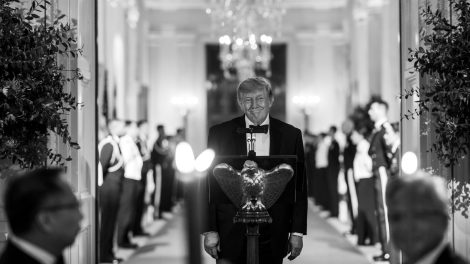
- According to Mezran, the renewed American engagement reflects not only strategic considerations but also President Donald Trump’s interest in achieving a diplomatic breakthrough.
- The initiative has been promoted by Trump’s envoy Mossad Boulos, who, Mezran argues, has sought to broker a direct political agreement between Libya’s competing ruling families.
- In Mezran’s assessment, the proposal marks a significant departure from previous Western approaches centered on institution-building. Instead, he says, it risks replacing democratic transition with what he describes as a more transactional political settlement.
The Boulos Plan. Only limited details of the proposal have become public.
- According to Mezran, the framework would elevate Saddam Haftar to the presidency of Libya’s Presidential Council — the country’s highest institutional office under the current UN-sponsored framework — while allowing Prime Minister Dabaiba to remain in office with expanded executive powers.
- Even these preliminary elements have generated strong reactions inside Libya. “Very little is known about the American plan,” Mezran says. “But even that has already generated widespread public discontent and rejection among several components of Libya’s current political elite.”
- Washington has pointed to developments such as the reunification of Libya’s state budget as early signs of progress. Mezran, however, argues that many Libyans interpret those steps differently, viewing them primarily as transactional arrangements that strengthen rather than reform the existing political system.
A fragile consensus. Recent diplomatic contacts underline the attention Washington is devoting to the initiative.
- In late June, Saddam Haftar was received in Washington by Secretary of State Marco Rubio, while Abdulsalam Zoubi, a senior representative of the Dabaiba government, met Deputy Secretary of State Christopher Landau.
- For many observers, those meetings signaled growing U.S. engagement with the initiative. According to Mezran, however, the proposal continues to face significant skepticism inside Libya because many perceive it as externally driven rather than domestically negotiated.
- He argues that both the Haftar and Dabaiba families suffer from limited popular legitimacy and warns that any agreement lacking broad domestic consensus could remain politically fragile.
- His concern is that sustained external pressure to institutionalize such an arrangement could ultimately produce “structural fragilities,” generating renewed instability instead of lasting political reconciliation.
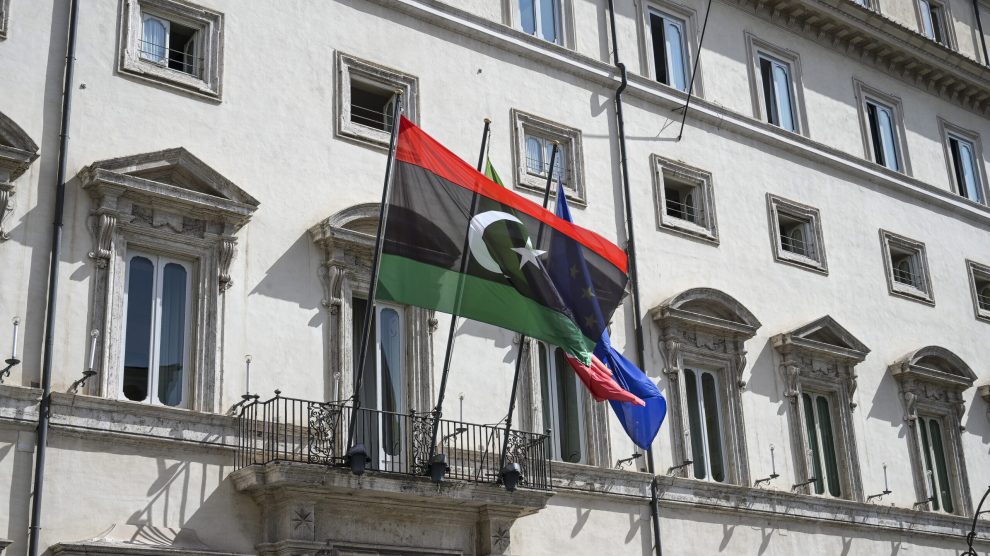
Italy’s position. Mezran also points to what he sees as an evolution in Italy’s Libya policy.
- He recalls that Prime Minister Giorgia Meloni initially presented the Mattei Plan as a framework aimed at supporting a more stable and institutionally resilient Libya.
- Against that backdrop, he argues, Rome’s subsequent alignment with the Boulos initiative could be interpreted by some international observers as a significant policy shift.
- According to Mezran, that repositioning has generated criticism in some diplomatic and political circles, particularly given the controversial figures involved and the opposition expressed by segments of Libyan society.
What comes next. Despite the deteriorating political environment, Mezran sees few immediate alternatives.
- He recalls that a diplomatic opening briefly emerged last year following meetings involving Italy, Turkey and Libya, with the possibility of eventually bringing Egypt and Algeria into a broader regional framework under U.S. sponsorship. That window, he says, has now largely closed.
- Turkey has expanded its engagement in eastern Libya, while Egypt has shown little appetite for assuming a more active political role.
The bottom line: As a result, Mezran believes that any sustainable solution will ultimately have to emerge from within Libya itself.
- “The only remaining hope is that Libyan society and the country’s traditional local elites eventually find both the opportunity and the political will to build a credible internal path forward”.
- “Today, however, that prospect still appears very distant,” he concludes.