ROME — Italy and Saudi Arabia used a meeting of the Global Alliance for the Implementation of the Two-State Solution in Rome on Wednesday to reaffirm support for UN-backed efforts on Gaza and the two-state solution, concluding the talks with a joint declaration on regional security, reconstruction and bilateral cooperation.
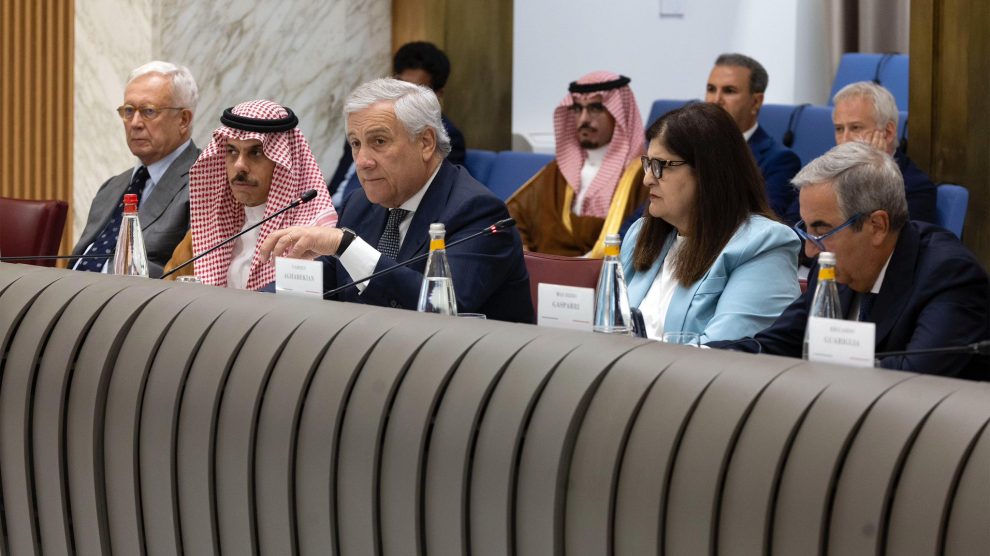
Foreign Minister Antonio Tajani and his Saudi counterpart, Faisal bin Farhan Al Saud, co-chaired the ministerial session, which brought together international partners to review progress on implementing the New York Declaration and discuss the next steps for Gaza’s governance and the broader peace process.
Why it matters: The meeting underscored Italy’s effort to position itself as a diplomatic convening power on the Middle East.
- It reinforced coordination between Rome and Riyadh on implementing the two-state framework endorsed at last year’s New York conference.
- The joint declaration broadened the agenda beyond Gaza to include regional security and freedom of navigation in the Red Sea and the Strait of Hormuz.
Zoom in: In Tajani’s words. The Italian Minister portrayed the meeting as evidence of Italy’s growing diplomatic role, saying that “Rome is increasingly becoming the capital of peace.”
- According to Tajani, participants worked to advance implementation of UN commitments on Gaza and the prospect of “two peoples and two states, Palestinian and Israeli, coexisting in peace and security.”
- The meeting also included Palestinian Foreign Minister Varsen Aghabekian and representatives of the three monotheistic religions in a session on interfaith dialogue, which Tajani described as “an essential instrument for a just and lasting peace in the Middle East.”
The bilateral dimension. At the conclusion of the meeting, Tajani and Faisal bin Farhan adopted a joint declaration reaffirming their commitment to Gaza’s stability and reconstruction.
- According to Tajani, the declaration also condemns violence in the West Bank, supports freedom of navigation in the Strait of Hormuz and the Red Sea, and seeks to strengthen the bilateral partnership between Italy and Saudi Arabia.
The big picture: The Global Alliance for the Implementation of the Two-State Solution was established in 2024 at the initiative of Saudi Arabia, Norway and the European Union.
- Its work fed into the New York Declaration, the outcome document of the Conference on the Peaceful Settlement of the Question of Palestine and the Implementation of the Two-State Solution, co-chaired by France and Saudi Arabia in July 2025.
- According to the Italian Foreign Ministry, Italy played a leading role during that conference as co-chair, together with Indonesia, of the working group on security.
The Rome meeting reviewed progress on implementing the New York Declaration, explored new synergies in support of the peace process and focused on advancing work related to UN Security Council Resolution 2803 and the Peace Council.
- Around 30 delegations took part in the technical session. UN High Representative for Gaza Nickolay Mladenov addressed participants remotely in his role coordinating transitional governance, reconstruction and implementation of the 20-point Gaza Peace Plan. The two-day meeting concluded with a closed-door session on interfaith dialogue.
What we’re watching: The next test will be whether the commitments reaffirmed in Rome translate into concrete progress on Gaza’s governance, reconstruction and implementation of the two-state framework backed by the alliance.
The bottom line: Rather than launching a new diplomatic initiative, the Rome meeting sought to keep momentum behind existing international commitments, with Italy presenting itself as an active facilitator alongside Saudi Arabia in the next phase of implementation.