America’s trade war with China is moving beyond tariffs and towards a more contentious question: where goods really come from. In the process, some of Washington’s closest allies are finding themselves in the line of fire.
The White House has accused more than 40 countries, including Canada, Mexico and Japan, as well as the European Union, of enabling Chinese exporters to circumvent US tariffs by routing goods through jurisdictions facing lower duties.
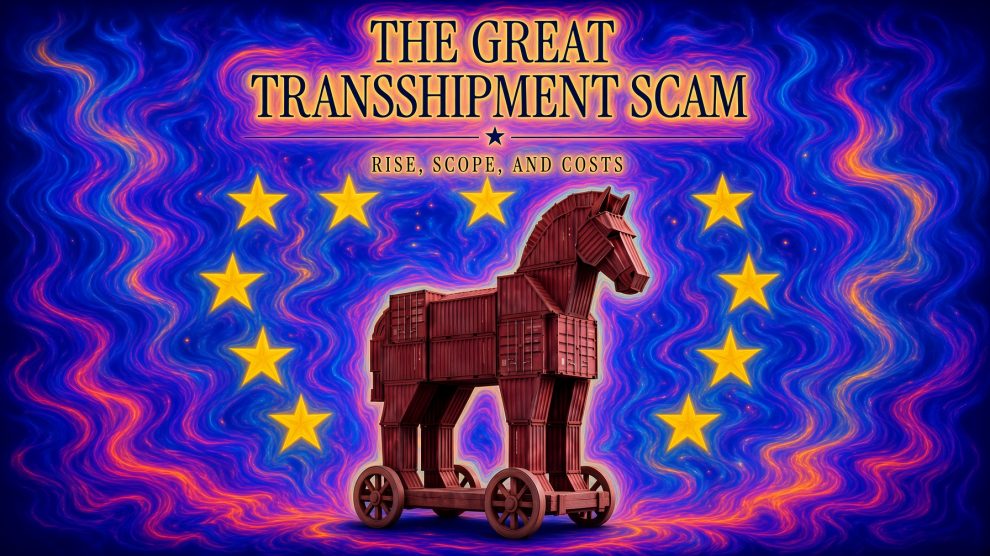
According to a White House report, “The Great Transshipment Scam”, the practice involves about $60bn in trade under its central estimate, although assessments cited by the administration range from $40bn to $303bn.
- The accusation comes six weeks before Xi Jinping is expected to visit Washington, following Donald Trump’s trip to Beijing in May, as the US and China seek to keep channels of communication open even as their competition becomes broader and more intense.
- The trade truce agreed by the two leaders in Busan remains in place. But tensions persist. Washington has questioned whether Beijing is honouring commitments over rare-earth exports, while China has objected to new US national security restrictions, including export controls on technologies underpinning the artificial intelligence ecosystem.
The White House report, presented on Thursday by Peter Navarro, the president’s trade and manufacturing adviser and one of the administration’s most prominent China hawks, suggests that the commercial confrontation is entering a wider phase.
- For Washington, restricting Chinese access to the US market increasingly means scrutinising the supply chains of the countries through which Chinese components, investment and finished goods move.
Europe enters Washington’s transshipment map. The White House classifies the EU as a “Tier 1 Diversified Scale Leader” in what it calls China’s “Shadow Transshipment Network”, alongside Canada, India, Israel, Japan, Mexico, South Korea and Taiwan.
- The category covers economies with large volumes of China-linked goods, diversified industrial bases and significant export platforms serving the US. In such markets, according to the report, transshipment risk can be embedded within otherwise legitimate trade.
That distinction matters. The administration is not portraying Europe simply as a conduit for illicit commerce. Washington’s concern is precisely the sophistication and depth of European industrial supply chains.
- Chinese components can enter complex manufacturing processes, undergo assembly, finishing, testing or repackaging, and subsequently reach the US under a different declared origin — without, in Washington’s view, necessarily undergoing sufficient transformation to justify that origin under American customs rules.
The report also maps different functions within Europe. Poland, the Czech Republic, Hungary and Romania are described as a “Central and Eastern European Processing Belt”, associated with finishing, contract manufacturing, bonded warehousing and regional relabelling.
- Belgium and the Netherlands, alongside non-EU Switzerland, are placed among “Developed Logistics Platforms”: economies with advanced ports, trading houses, bonded warehouses and global re-export systems.
- The result is an unusually granular American depiction of how European industrial and logistics infrastructure can intersect with Chinese supply chains.
A wider transatlantic disagreement. Behind the technical dispute over rules of origin lies a larger political divergence.
- Washington increasingly views competition with Beijing as a system in which the economic policies of allies can either reinforce or undermine US measures against China
- That assessment extends beyond the differences within the current administration over how aggressively to confront Beijing and beyond the partisan divide between Republicans and Democrats.
Electric vehicles illustrate the asymmetry. The report notes that Chinese products subject to high US tariffs — including EVs, where restrictions were already tightened under the Biden administration — enter the American market in much smaller quantities than the EU.
- But the wider the tariff gap between China and third countries becomes, the greater the economic incentive to redirect trade and, in illegal cases, alter the declared origin of goods.
That exposes a tension at the heart of Trump’s tariff strategy. Differentiated duties allow Washington to apply varying degrees of pressure to individual trading partners. At the same time, those differences create opportunities for tariff arbitrage.
- Navarro has warned that the model pioneered by Chinese exporters could be replicated by other countries facing higher US tariffs, explicitly naming India and Vietnam. From the administration’s perspective, whether such countries are strategic competitors or closer to partners matters less if their supply chains provide a route around American trade barriers.
For Europe, this turns what might appear to be a customs dispute into a broader strategic problem.
- Part of the transatlantic friction over China stems from a persistent US perception that Europe is not engaged in economic competition with Beijing with the same intensity as Washington. The White House report takes that disagreement into the supply chain itself.
- The implicit American demand is no longer simply that allies align more closely with Washington on China policy. Their industrial systems must also avoid becoming alternative channels through which Chinese economic activity can retain access to the US market.
From tariffs to technological enforcement. Washington’s response is set to become increasingly technological.
- US Customs and Border Protection is beginning to use an artificial intelligence-enabled system known as “Detective Border”, designed to combine shipment data, routing histories, product classifications, ownership relationships and indicators of production capacity to detect anomalies and distinguish legitimate investment and nearshoring from pass-through trade.
- Executive Order 14411 is meanwhile intended to strengthen importer accountability, financial bonding requirements, ownership transparency and enforcement tools. The administration’s Agreements on Reciprocal Trade also contain provisions designed to prevent the benefits negotiated with Washington from accruing substantially to third countries.
The bottom line: For European companies, the consequence could be much more intrusive US scrutiny of the economic origin of goods entering the American market.
- If that scrutiny is increasingly delegated to AI systems, it could also become a colder and more automated process, with less of the context and flexibility that have traditionally accompanied discretionary waivers for allies.
- For Brussels, the larger problem is political. If Washington increasingly regards Europe’s integration with Chinese supply chains as a vulnerability in its own trade strategy, the transatlantic divide over Beijing will no longer be confined to tariffs, investment screening or economic security.
- It will increasingly turn on a more difficult question: how much Chinese content can an ostensibly European product contain before Washington ceases to regard it as European?