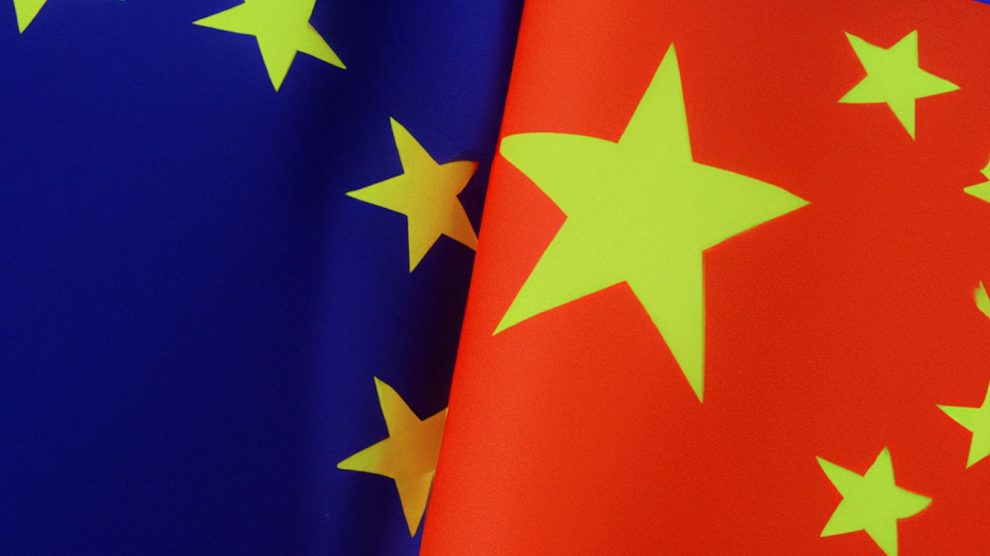
As Europe chases its energy transition, it risks deepening its dependence on Beijing — but economist Carlo Pelanda argues Brussels is showing early signs of a more assertive, if pragmatic, turn.
The most recent signals, he says, suggest Brussels is now searching for a more assertive way to define its interests — or at least intends to.
Why it matters: To illustrate what this means in practice, Pelanda starts from a very concrete case: solar panels. “We keep buying solar panels from China because producing them at home costs us more,” Pelanda says. Beijing offers technology that is “not excellent, but works well enough — and, above all, comes at an unbeatable price”.
- That, he argues, is where dumping becomes the central issue: European manufacturers may match or surpass Chinese technology, but cannot compete on price when exports above a certain technological level are directly or indirectly supported by the Chinese state.
- The pressure extends beyond solar. Pelanda points to Italy’s white-goods industry as an example of manufacturing that can no longer compete — “not because of quality, but because of price” (translated) — while the same challenge is increasingly visible in the auto sector.
Between the lines: That is precisely the dilemma now playing out over Italy’s Transition 5.0 plan. As Decode39 recently reported, pressure is growing to loosen Made in EU requirements and reopen incentives to cheaper Chinese green technologies.
- Pelanda’s solar-panel example captures the trade-off: lowering costs may speed up the transition today, but it can also make it harder for European manufacturing to survive — deepening the dependency policymakers say they want to reduce.
Strategic convergence. One possible answer is what Pelanda calls the “Pax Silica” — a US-led effort, which Italy has joined, to build a critical-minerals extraction and processing chain among compatible democracies, independent of China. He describes it as a form of “selective globalization” that cannot be built in one or two years, but could bear fruit within roughly five years or slightly more.
- A second lever is national investment screening: Italy has already used its Golden Power, as with Pirelli, though Pelanda says Chinese stakes in strategic companies remain significant.
The bigger picture. Rather than American-style tariffs — which he says can inflict significant self-harm — Pelanda favours a negotiated compromise.
- Under such an arrangement, Europe would refrain from erecting US-style barriers while Beijing would give European companies greater access to its market or ease pressure on selected sectors.
- With the EU running a trade deficit with China of roughly €300 billion, Pelanda argues that rebalancing that relationship provides a concrete basis for negotiation.
Political fault lines. The obstacle is cohesion. Germany’s auto-sector positioning, rooted in the early 1990s, is difficult to dismantle, and there is no European consensus for coordinated tariff action.
- Transatlantically, Pelanda sees another gap: Washington is tougher on tariffs but also more willing to trade them away for geopolitical concessions.
- The EU, wary of an outright economic war with China, finds tariffs and barriers more politically difficult to deploy — not primarily for technical reasons, he says, but because Europeans lack the consensus to act cohesively.
What it signals: Pelanda’s prescription is essentially deter, then deal: identify China’s vulnerabilities, act on them to create leverage, then signal a willingness to compromise before confrontation turns into an economic war that would hurt both sides.
- But deterrence requires credibility. Europe must speak “with one voice,” he argues, understand Beijing’s difficulties and at the same time “show that we can hurt them badly” (translated).
- “At the moment, we are not demonstrating that.”