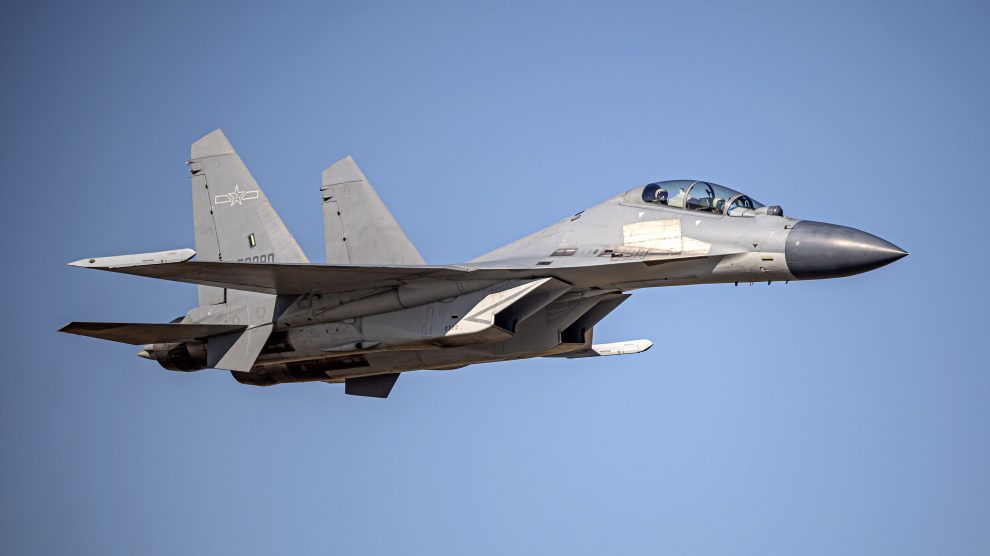
The Chinese formation travelled more than 6,000 kilometres, crossing two continents and four countries in nearly nine hours, to participate in “Eagles of Civilization 2026”, the second joint exercise between the Chinese and Egyptian air forces. The J-16s, initially spotted during a stopover in Karachi, are accompanied by aerial refuelling aircraft, special-mission aircraft and helicopters.
It is the first time the J-16 has reached Mediterranean Africa for the exercise. More significant, however, is the language China is using to describe the deployment.
The PLA Air Force has presented the operation as a test of its “long-range projection”, “agile deployment” and “system-of-systems” operational capabilities. Chinese media have gone further, portraying long-range overseas training as moving from basic capability validation towards greater “maturity and normalization”.
The distinction matters. Flying several advanced fighters to Egypt demonstrates reach.
- Moving an integrated formation there, refuelling combat aircraft en route, using the tanker as an airborne command node and rapidly preparing the force for operations after arrival is intended to demonstrate something more complex: an ability to move, coordinate and sustain tactical air power well beyond China’s traditional military geography.
The J-16 is the messenger. The J-16 inevitably attracts attention. A heavy twin-engine multirole fighter, it is described by Chinese military experts as capable of carrying a larger weapons load and performing a wider range of missions against air, land and maritime targets than the J-10Cs China sent to last year’s exercise.
- The transition from the J-10C to the J-16 therefore gives Beijing a visible marker of the exercise’s evolution. “Eagles of Civilization 2026” is expected to include air combat tactics, air superiority operations, combat search and rescue and force employment drills.
- But focusing too heavily on the fighter risks missing what China appears most interested in demonstrating.
A video released by the PLA Air Force showed a YY-20A tanker refuelling J-16s during the journey to Egypt, including two fighters simultaneously. According to the Chinese account, the tanker also acted as an airborne command node. Once the formation arrived, personnel and equipment were rapidly prepared for flight operations.
- These details occupy a prominent place in Beijing’s narrative because the capability being showcased is not simply the performance of an individual aircraft. It is the ability to connect fighters, logistics, aerial refuelling, command functions and personnel across considerable distances.
- That is what gives the deployment significance beyond a conventional bilateral exercise.
From overseas training to a “strategic air force”. Chinese military commentary explicitly links exercises such as this one to Beijing’s ambition to build what it calls a “strategic air force”. The development of long-range capabilities is also associated with the ability to “safeguard its overseas interests”.
That language helps explain why Egypt matters. China does not need to establish a permanent air presence in the Mediterranean for this deployment to carry strategic significance. The more immediate question is whether the PLA Air Force is developing the operational experience, logistics and integrated procedures that can make operating far from Chinese territory progressively easier.
- The distinction is between presence and the capacity for presence.
Egypt offers an opportunity to exercise the latter. A deployment of roughly 6,000 kilometres forces the PLA Air Force to deal with distance, aerial refuelling, unfamiliar operating environments and the coordinated movement of aircraft and personnel. China’s own narrative stresses the value of exposing frontline aircraft to different geographical, climatic and operational conditions.
- The Indo-Mediterranean dimension — with Egypt serving as a northern gateway towards Europe — consequently takes on particular significance. If Chinese interests extend across increasingly distant regions, and Beijing explicitly links the development of a strategic air force to protecting those interests, the ability to accompany them with some degree of military projection becomes increasingly relevant.
- It would be premature to infer from a single exercise that China is developing a structured military posture across the Indo-Mediterranean. “Eagles of Civilization”, however, allows the PLA Air Force to practise some of the capabilities that would be required to operate across that geographical depth.
Cairo’s calculation. There is a second dimension to the exercise, distinct from China’s ambitions: what Egypt is seeking from increasingly visible military cooperation with Beijing.
- Andrea Ghiselli, Lecturer at the University of Exeter and Head of Research at the ChinaMed Project, sees the deployment as “potentially important”, above all because it demonstrates “more confidence on the Chinese side in bringing their aircraft abroad and allowing them to be seen up close”.
- If the 2026 programme resembles last year’s, Ghiselli said, the exercise should be relatively comprehensive. There could, however, be constraints stemming from agreements between Egypt and the United States. In 2025, he noted, Cairo used MiG aircraft rather than its F-16s for precisely this reason.
That points towards a broader dynamic in Egypt’s military relationships. According to Ghiselli, with the war ongoing, Egypt is likely to be increasingly dissatisfied with restrictions on upgrades to its US-made aircraft — upgrades that Washington has long declined to authorize in order to preserve Israel’s qualitative military edge.
- Since 2024, there has also been speculation over a potential Egyptian purchase of Chinese J-10 fighters and PL-15 missiles. Neither Beijing nor Cairo, Ghiselli stressed, has ever confirmed those reports.
- The possibility that China is using the exercise partly as a commercial showcase should therefore be treated cautiously. Ghiselli does not rule out Beijing pushing for a sale, but said he would not consider such an outcome established until “we see Chinese-made fighters in Egyptian colors”.
- Cairo, meanwhile, has an interest in preserving its contracts with the United States. Military cooperation with China can therefore serve several purposes at once. As with other US partners, Ghiselli said, it cannot be excluded that Egypt is also using its opening towards Beijing to send a signal to Washington.
That ambiguity is part of what makes the exercise significant:
- For China, Egypt offers an environment in which to display and refine long-range power-projection capabilities.
- For Cairo, Beijing may provide additional options without necessarily implying an abandonment of its military relationship with Washington.
The capability matters more than the six fighters. More consequential is the gradual expansion of the PLA Air Force’s operational geography. A military capability generally viewed through an Indo-Pacific lens is demonstrating that it can also reach the Mediterranean with advanced fighters and the supporting assets needed to sustain them.
As CNKY noted, the broader pattern may be more significant. In August alone, the PLA Air Force announced joint activities with Egypt, the United Arab Emirates, Thailand and Belarus.
- What Beijing is demonstrating in Egypt is therefore less the ability to fly far on a single occasion than an ambition to make distance an increasingly routine feature of Chinese air operations. That may ultimately be the most important signal from “Eagles of Civilization 2026”.
The bottom line: Six J-16s do not constitute a new Chinese military presence in the Mediterranean. But operations of this kind can build the experience, procedures and capabilities that make it progressively less exceptional to see Chinese air power operating far beyond China’s borders.
(Photo: Wikipedia)