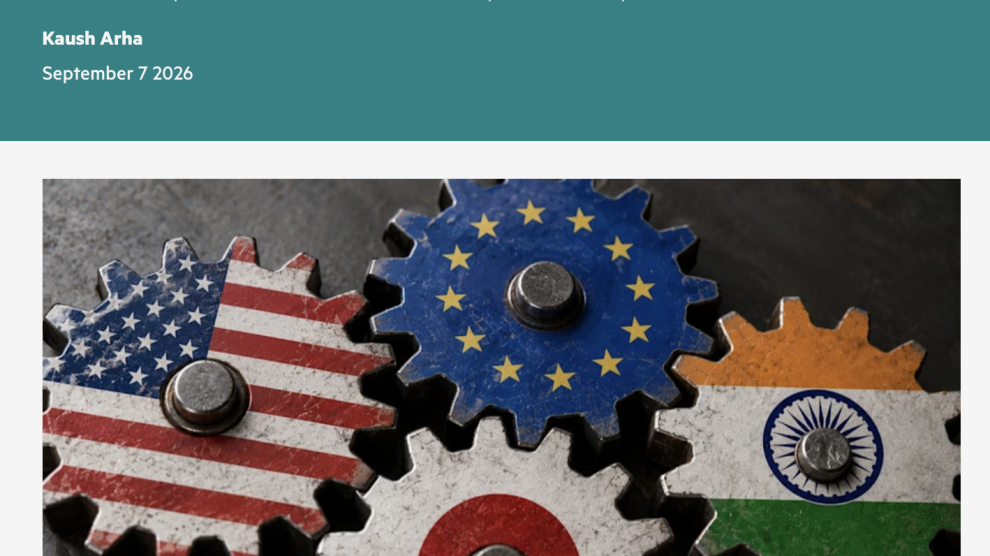
The United States, European Union, Japan and India should create a new forum to coordinate industrial policies, supply-chain security and the development of trusted technologies.
That is the proposal put forward by Kaush Arha, president of the Free and Open Indo-Pacific Forum and former senior adviser to USAID, writing in fDi Intelligence, part of the Financial Times.
Why it matters: Together, the four account for more than half of global GDP. But scale is only part of the argument.
- Arha sees the G4 as a way to manage a shift already under way: from largely unrestricted globalization toward a more stratified economic system, where trust increasingly shapes where countries invest, which technologies they share and which dependencies they seek to reduce.
The big picture: This new economic geography is already taking shape. Washington and its allies are restricting China’s access to the most sensitive technologies, particularly advanced semiconductors, while Beijing has responded by wielding export controls on critical minerals.
- At the same time, much of ordinary trade continues with far fewer constraints.
- This is not decoupling. It is a more selective form of interdependence.
Trusted technology is the glue. Arha’s G4 would help prevent allied industrial policies from becoming duplicative or competing with one another, while coordinating investment, research, intellectual property protection and, crucially, standards for AI and emerging technologies.
- The proposal taps into a concept that is becoming increasingly central to economic security: what is produced matters, but so do who produces it, where it is produced and within which technological ecosystem.
Zoom in: Projetcs, projects, projects! The same logic is reshaping infrastructure. Arha points to IMEC, the Three Seas Initiative, the Middle Corridor and the Lobito Corridor — different projects sharing an effort to diversify routes and supply chains while building more resilient connections among trusted partners.
- IMEC, in particular, connects three of the economic spaces represented in the prospective G4 — India and Europe, through the Gulf and Mediterranean, within a broader strategic architecture strongly backed by the United States.
Zoom out: The Italian angle. Arha’s proposal intersects with the strategic interests of Italy, which finds historic allies in the US, Japan, and India, and its primary international projection in the EU.
- IMEC is one of the main connectivity projects for Italy.
- The Lobito Corridor is one of the main areas of interest and investment where the Mattei Plan, Italy’s strategy for Africa, intersects with international projects such as the Global Gateway and the PGII.
What we are watching: China is the main factor bringing these interests together, but Arha identifies a political prerequisite: Washington must show that it can be not only the group’s leader and convener, but also a “reassuring economic actor.”
- The G4, then, would not be designed to dismantle globalization. It would seek to shape what comes next: an economy that remains interconnected, but is increasingly organized around security, resilience and trust.