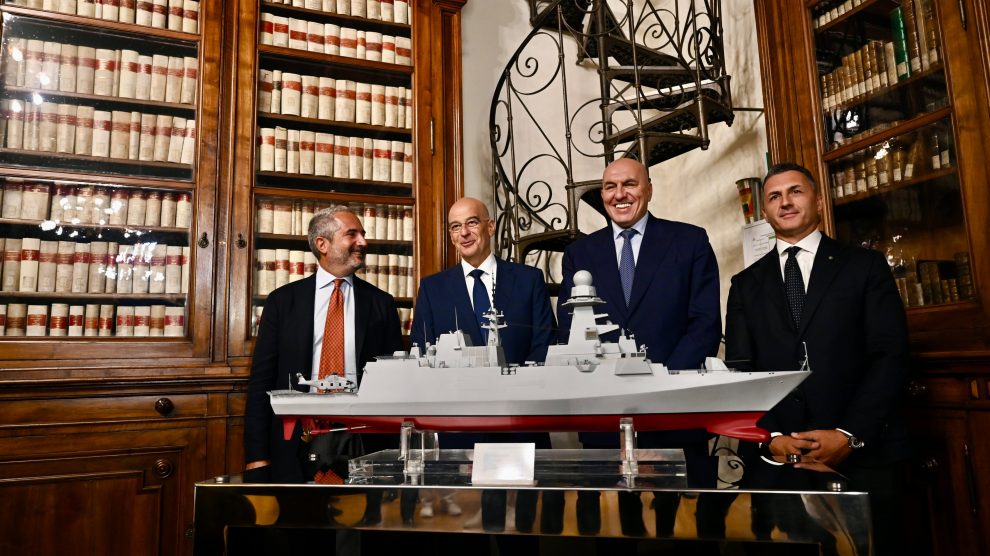
ROME — Italy and Greece signed an implementing agreement Tuesday for the transfer of two Italian FREMM frigates to the Hellenic Navy, turning their growing Mediterranean defense partnership into a major naval and industrial deal.
Why it matters: The signed agreement moves the transfer of the Carlo Bergamini and Virginio Fasan from political commitment to implementation, setting the legal, economic and technical framework for the deal.
- Greece is set to receive the first frigate in the first half of 2028 and the second in the first half of 2029, strengthening its naval capabilities in the eastern Mediterranean.
- Italy will replace the transferred ships with new FREMM Evo units, maintaining the size of its frigate component while renewing its fleet.
- The deal also opens an industrial track involving Greek shipyards, while Athens retains the possibility of acquiring two more Italian FREMMs.
Zoom in: The FREMM deal. Italian Defense Minister Guido Crosetto and his Greek counterpart Nikos Dendias signed the implementing agreement in Rome on Sept. 8 governing the transfer of the Carlo Bergamini and Virginio Fasan to the Hellenic Navy.
- The agreement gives concrete effect to the memorandum of cooperation and declaration of intent signed by the two ministers in La Spezia on Sept. 29, 2025.
- It sets the legal, economic and technical framework for the transfer, as well as initial and subsequent support for the two vessels.
- The operation is estimated at around €460 million.
- The timeline: The Carlo Bergamini, a general-purpose frigate, is expected to be transferred in the first half of 2028. The Virginio Fasan, configured for anti-submarine warfare, would follow in the first half of 2029.
- Both were built by Fincantieri under the FREMM program and entered Italian Navy service in 2013.
- Athens is also keeping open the possibility of acquiring another two Italian FREMM frigates in the future.
Follow the industry. The arrangement goes beyond a ship-to-ship transfer. The agreement also covers Greek industrial participation, including shipyard involvement in maintenance and the integration of new systems.
- For Rome, the sale fits into the renewal of the Italian fleet. The two departing frigates are due to be replaced by new FREMM Evo units, allowing the Italian Navy to maintain the size of its frigate component.
- For Athens, the Italian ships will join new French-built frigates already ordered by Greece, expanding the Hellenic Navy’s capabilities in air defense, surface warfare and anti-submarine operations.
What they’re saying: Dendias said his talks with Crosetto went beyond the transfer of the two frigates, pointing to plans to make bilateral defense cooperation more structured.
“Today at the Italian Ministry of Defense in Rome, in the highly constructive discussion we had, we agreed on the establishment of an institutionalized dialogue between the Ministries of Defense of Greece and Italy regarding our joint path on issues concerning European defense and security, as well as ways to address our common challenges,” Dendias said.
- “We also focused on strengthening the cooperation of our states’ defense ecosystems and discussed the prospect of their joint development of innovative products.”
At sea. The defense relationship is already visible operationally.
- The Greek frigate Kountouriotis and the Italian patrol vessel Raimondo Montecuccoli are operating together as part of NATO’s Standing Maritime Group 2, which is under Greek command, led by Commodore Georgios Kypriotis aboard the Kountouriotis.
- From Sept. 6-9, the two ships are calling together at Oran, Algeria, where the program includes a PASSEX aimed at improving communication and joint maneuvering between crews.
- NATO Maritime Command said the visit was designed to “strengthen maritime cooperation with Algeria,” a NATO Mediterranean Dialogue partner. The Alliance summarized the objective as: “Improve interoperability. Strengthen partnerships.”
Their deployment also places Italian and Greek forces inside the same NATO maritime surveillance effort at a time of increased Russian naval and logistical movements across the Mediterranean.
- NATO Maritime Command has said SNMG2 contributes to monitoring Russian vessels transiting the region, accompanying its message with the unusually direct formulation: “We. Are. Watching.”
- At least two separate Russian groups have recently entered the Mediterranean heading east, according to the information provided. Their final destinations remain unconfirmed.
The FREMM agreement is therefore not developing in isolation. Rome and Athens are strengthening their industrial and naval relationship while their forces already operate within the same Allied maritime architecture.
- The wider Mediterranean picture extends beyond NATO. Italy and Greece are also active through the EU’s Irini operation. At the end of August, Italian Navy personnel aboard the Thaon di Revel boarded the tanker Sun in international waters east of Malta to verify its flag after the vessel was suspected of sailing under a false one.
- EU foreign policy chief Kaja Kallas dated the intervention to Aug. 30. The operation brought the number of such flag checks conducted by European operations in recent months to six.
The NATO and EU activities are separate. But together they illustrate the increasingly dense maritime security environment in which the Italian-Greek partnership is developing: Allied surveillance of Russian movements, European checks on suspicious shipping and a growing emphasis on naval capabilities.
Between the lines: The timing brings the different strands of the relationship together.
- As Crosetto and Dendias institutionalize a deeper defense dialogue in Rome and move ahead with the FREMM transfer, Italian and Greek ships are already operating together within a NATO group under Greek command.
- The result is a partnership developing on three connected levels: naval capabilities, defense industry and operations at sea.
- Dendias’ emphasis on an “institutionalized dialogue” and cooperation between the two countries’ defense ecosystems suggests Rome and Athens want to extend that relationship beyond the transfer of two ships.
What we’re watching: The next steps are the implementation of the economic, technical and support arrangements attached to the two FREMMs and preparations for the transfer of the Carlo Bergamini in 2028.
- Further ahead, the key questions are how Greek industry will be integrated into the program, whether the two countries move toward jointly developing defense products and whether Athens exercises the option to acquire another two Italian frigates.
The bottom line: Rome and Athens are building a defense relationship around ships, industry and operations at sea — linking a major naval transfer to a broader push for closer European defense cooperation in an increasingly contested Mediterranean.