The Russian war in Ukraine is once again exposing a fault line within Italy’s center-left. Giuseppe Conte has drawn a clear line: the Five Star Movement will not sign up to a governing platform that provides for continued arms deliveries to Kyiv. Elly Schlein, by contrast, is standing by the Democratic Party’s position: support for Ukraine combined with diplomatic pressure for a just peace and a stronger European role.
The disagreement goes beyond weapons supplies. It touches on Italy’s international alignment and on whether the center-left can build a viable governing coalition.
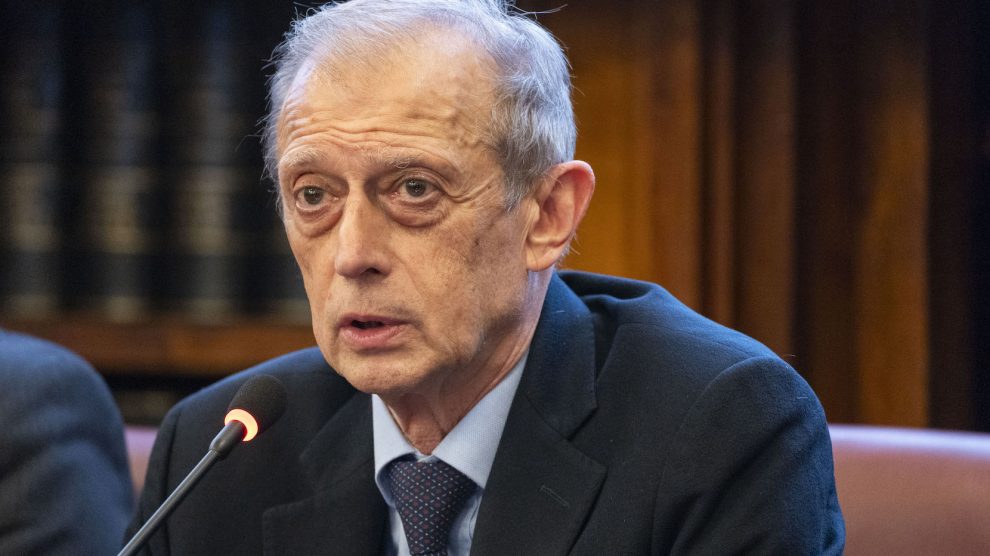
Piero Fassino, vice chair of the Defense Committee in Italy’s Chamber of Deputies, sees the gap between the Democratic Party and the Five Star Movement as a political issue before it is a tactical one. And he argues that calls to halt military aid raise a question Italy’s progressive camp cannot avoid: under what concrete conditions can peace be achieved?
Q: Fassino, Conte says the Five Star Movement will not sign a program that provides for sending weapons to Ukraine. Schlein, by contrast, has reiterated her support for Kyiv. Can that difference be bridged?
A: Elly Schlein has made it clear that the Democratic Party has no intention of abandoning its support for Ukraine. It is legitimate for another political force to take a different position. But it must have the courage to confront the consequences of that position in full. The question is not simply whether to send weapons.
- The question is how to stop a war that began with Russia’s aggression against Ukraine. And today there is one point no one can avoid: Putin continues to make the cession of the Donbas to Russia a non-negotiable condition for an agreement. Can we accept a peace built on the humiliation of the country that was attacked?
Q: Is that the point you believe Conte and the Five Star Movement are avoiding?
A: Yes. Anyone who argues that military support for Ukraine should be reduced or halted must explain what happens next. What would Putin ask of a potential mediator? He has already said it: the Donbas.
- At that point, what would Conte and those who agree with him say? This is a question that cannot be avoided. Because if aid is suspended without addressing this issue, the risk is simply that of facilitating Putin’s aggression, which, moreover, has undergone a continuous and brutal escalation over the past two months.
Q: But Schlein is also calling for a diplomatic shift and for a European negotiator. Couldn’t that help bridge the different positions within the center-left?
A: Certainly. Europe must be a protagonist in the diplomatic initiative. But diplomacy does not mean removing the problem. It means confronting it. Macron and Scholz tried to engage with Putin.
- Scholz even went so far as to assure Putin that Germany would not support Ukraine’s accession to NATO, which, as we know, requires the consent of every member of the Alliance.
- Despite that, a few days later Putin ordered the invasion of Ukraine. Europe needs a stronger voice, but that voice must be credible. And to be credible, it must know which values it intends to defend and under what conditions.
Q: Do you fear that a peace built on ceding the Donbas could create a dangerous precedent?
A: The risk is clear. If the condition for ending a war were to hand the aggressor a piece of the country it attacked, what message would we send? History has already shown us what can happen when people believe they can stop an aggressor by giving up territory.
- In Munich in 1938, Bohemia and Moravia were ceded to Hitler in the belief that this would stop his ambitions. A year later, Germany invaded Poland and unleashed a war that devastated the whole of Europe.
Q: So the point is that peace cannot simply mean the absence of war?
A: Exactly. We need a peace that is also sustainable and that guarantees the future security of Ukraine and Europe. Putin has rejected even a fragile and temporary ceasefire. And what kind of peace emerges is an issue that directly concerns Italy as well.
Q: Let’s turn to the broad center-left coalition. Could foreign policy ultimately become the breaking point between the Democratic Party and the Five Star Movement?
A: It is certainly a decisive issue. A governing coalition must have a recognizable and reliable position on the major international issues. You cannot imagine that on foreign policy, security and defense everyone can maintain their own separate line. Sooner or later, you have to decide what position to take. And that applies to Ukraine just as much as it does to relations with Europe and NATO.
Q: Do you therefore consider a progressive coalition with different positions on Ukraine incompatible?
A: I am saying those positions need to be clarified beforehand. You cannot enter government and discover the next day that there is no common position on Italy’s international alignment.
- Foreign policy is not an ancillary chapter of an election platform. It is one of the elements that define a country’s identity and its role in the world.
Q: There is another issue you often raise: European defense. Why should that be central for a progressive political force?
A: Because the world has changed. If the United States is no longer willing to support NATO as it did in the past, Europe must take on greater responsibility.
- That does not mean building a militaristic Europe. It means having the capacity to defend our citizens, our interests and our values. Today, progressive forces must also confront this issue without hesitation.
Q: So, more defense spending?
A: Yes, and there is no contradiction with progressive values. Look at Sweden’s Social Democrats: they have supported very robust defense programs, with national investment and European projects.
- The left cannot think of security as an issue to be left to the right. Security is a responsibility of the state and, increasingly, of Europe.
Q: Is Meloni doing enough internationally to strengthen Italy’s position?
A: On and off. Sometimes the government is present, at other times it puts on the brakes. Let’s be clear: Meloni and much of her coalition do not believe in a united and strong Europe. They talk about a “Europe of Nations” and a “European Confederation.”
- And on every European policy, the Meloni government’s first instinct is to scale it back or dismantle it. We have seen this with the Coalition of the Willing, in which Meloni participates reluctantly while distancing herself from its more demanding decisions.
- This wavering risks weakening Italy’s international credibility. And we need to be very clear about this: foreign policy is not something to play around with. A country’s credibility is built over time and can be damaged very quickly.
Q: Ultimately, then, will foreign policy be the real test for the broad center-left coalition?
A: It will be one of the decisive tests. It is not enough to bring together political forces that want to defeat the right. You need to know what kind of Italy you want to govern and what role you want it to play in the world.
- On Ukraine, that means supporting the pursuit of peace without confusing peace with surrender. And it means fighting for a Europe capable of speaking with one voice. Only then can the progressive camp be credible.