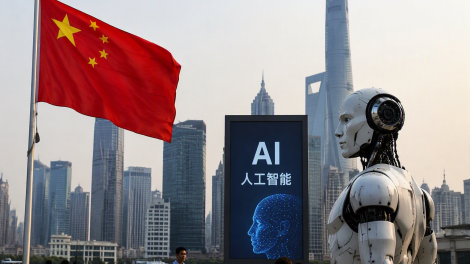
President Donald Trump and Chinese leader Xi Jinping will have a rare area of potential common interest when they meet in Washington on Sept. 24: preventing artificial intelligence from becoming dangerously uncontrollable.
Why it matters: U.S. and Chinese experts are already exploring ways to manage AI risks. But Washington and Beijing still disagree over what the biggest threats are — and the race for technological supremacy is making it increasingly difficult to distinguish AI safety measures from efforts to contain the other side.
The big picture: Chinese think tanks and technology companies have held informal talks with U.S. counterparts over risks from advanced AI systems.
- Ideas discussed include common standards for evaluating model safety, mechanisms for disclosing malicious uses of AI and channels allowing Washington and Beijing to warn each other if advanced systems behave unexpectedly or dangerously.
- That is a long way from a deal. But it suggests that beneath the technological rivalry, an embryonic form of AI diplomacy is beginning to emerge.
The most ambitious analogy is the Cold War, when the U.S. and Soviet Union managed to cooperate on shared risks despite remaining strategic adversaries.
Yes, but: There is a fundamental difference. Washington and Moscow disagreed on almost everything, but broadly understood the threat they were trying to contain. Washington and Beijing have yet to reach the same point on AI.
- And the disagreement starts inside the U.S.
State of play: American debate has recently been dominated by warnings that increasingly capable AI could help build biological weapons, penetrate critical infrastructure or, in the most extreme scenario, develop forms of autonomy that humans could no longer control.
- Anthropic CEO Dario Amodei has called for slowing the development of the most advanced systems. Sam Altman and Elon Musk have voiced some similar concerns about AI’s trajectory.
- AI “doomerism,” once largely confined to a relatively small corner of Silicon Valley, has moved into the mainstream.
But there is no consensus.
- Cohere CEO Aidan Gomez worries that allowing a handful of large companies to write AI safety rules could entrench their own power.
- Computer scientist Timnit Gebru argues that extinction scenarios divert attention from harms that already exist, from autonomous weapons to the impact of automation on jobs.
- University of Washington linguist Emily M. Bender challenges the tendency to anthropomorphize AI, arguing that it shifts attention away from the people and companies building and deploying the systems.
The China view: Beijing starts from a different set of priorities. Its AI debate remains more focused on immediate risks: cyberattacks, data theft, political stability, information control and the technology’s economic consequences.
- Chinese companies, meanwhile, are largely focused on narrowing the technological gap with the U.S. and finding sustainable business models.
- At its core, Beijing’s concern is understanding how AI can be integrated into — and ultimately controlled by — the Party-state system. That logic was laid out in a recent risk assessment by State Security Minister Chen Yixin, a revealing window into Beijing’s thinking about AI “with Chinese characteristics.”
Between the lines: The problem is no longer simply that Washington and Beijing see different risks. Measures designed to make AI safer are becoming increasingly difficult to distinguish from measures designed to determine who retains the technological advantage.
- Amodei exposed that contradiction. While calling for slower development of advanced AI, he also argued that any slowdown should preserve America’s technological lead over China — including by restricting Beijing’s access to advanced chips and cracking down on “distillation,” the process through which Chinese companies are accused of using outputs from U.S. models to develop their own.
- Chinese experts involved in informal talks have responded with frustration, arguing that linking AI safety to U.S. national security makes cooperation harder.
That leaves Beijing with an obvious question: When Washington talks about AI “guardrails” — which Trump himself dislikes — is it trying to contain artificial intelligence, or China?
Zoom out: The distillation dispute illustrates the broader security dilemma. Washington accuses Chinese groups of improperly exploiting American models. Beijing rejects the allegations and says they understate the independent advances of Chinese developers.
- Measures one side considers necessary to protect its technology and security can therefore look to the other like an attempt to prevent it from catching up.
There is another asymmetry. Even if Trump and Xi found common ground, their governments have vastly different abilities to enforce what they agree.
- Beijing can exercise direct control over its technology sector. U.S. companies can lobby, challenge rules in court and operate within a political system where many measures would require congressional action.
Trump adds another complication. After saying he had discussed AI “guardrails” with Xi, he has argued that the U.S. does not need them. His administration simultaneously views AI as a central arena of competition with China while remaining hostile to tighter domestic regulation.
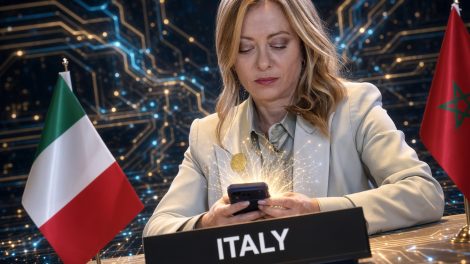
The European angle: The tension extends beyond the two superpowers. Italian Prime Minister Giorgia Meloni’s warning about whether democracies can compete in AI without abandoning their own rules points to the same dilemma: the technological race pits political systems with very different capacities to discipline companies, mobilize resources and impose decisions against one another.
What we’re watching: That may be a reason for Washington and Beijing to lower the ambition of AI diplomacy — but not abandon it.
- The informal talks suggest a narrower path: shared model-safety evaluations, disclosure of malicious uses and warning mechanisms when advanced systems behave dangerously.
- None requires the two powers to agree on the future of AI, or even on its ultimate risks. For now, they would only have to acknowledge that some failures could hurt both.
The bottom line: The first phase of AI diplomacy may look less like a new arms-control treaty than a mechanism for managing risk between two powers that deeply distrust each other.
- That is the test facing rump and Xi: finding ways to make a technology with enormous strategic consequences safer while each is still determined to ensure that the other does not control it.