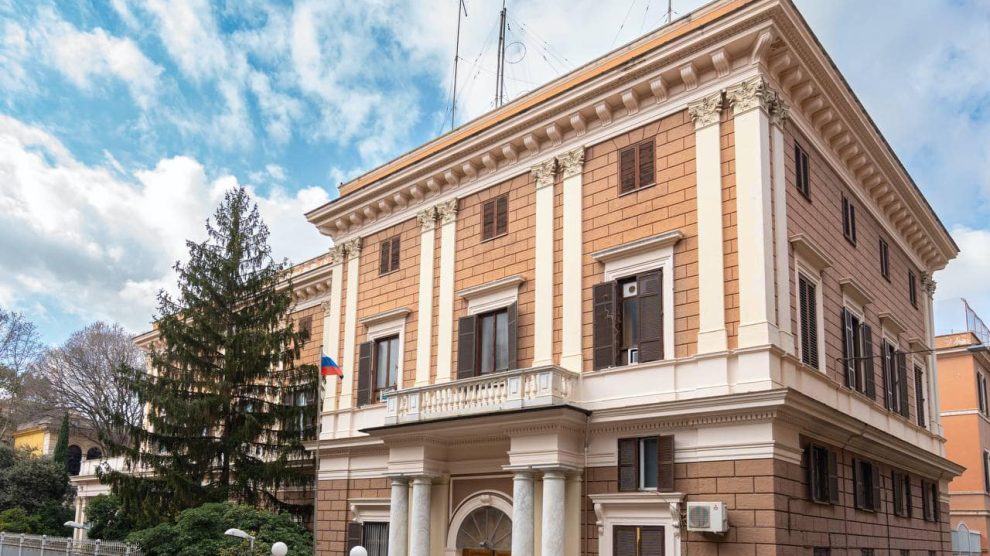
The newspaper’s findings map what it describes as a Russian intelligence presence operating under diplomatic cover in Rome, identifying several officials allegedly connected to Moscow’s main security services.
The reporting, led by journalist Massimiliano Coccia in collaboration with a pool of researchers and journalists including the Kyiv Independent, starts from a documented case: Ivan Petrovich Gorbachev and Mikhail Vasilyevich Astakhov, respectively a military attaché and deputy military attaché at the Russian embassy in Rome. Both men, whom the investigation links to Russia’s military intelligence service, the GRU, were expelled from Italy on July 9 following an investigation by prosecutors in Rome into the transfer of classified information to Russia.
- From those two officials, Il Riformista broadens its investigation to other members of Russia’s diplomatic presence in Italy.
The FSB connection: The report identifies embassy counsellors Igor Alexeyevich Anikeyev and Igor Albertovich Ovechkin as allegedly connected to Russia’s Federal Security Service, the FSB.
- According to the investigation, their work focused in particular on collecting information about Italian systems and equipment, including military devices and technologies linked to NATO.
- Coccia writes that understanding those technologies, the infrastructure supporting them and the companies involved in their supply could provide information about how part of Italy’s security apparatus functions and where vulnerabilities may exist.
Beyond military intelligence: The investigation also identifies Anton Andreyevich Demin and Dmitry Yuryevich Morozenkov, respectively second and third secretaries at the Russian embassy, as allegedly linked to the SVR and GRU.
- Their reported activities, according to Il Riformista, extend beyond the strictly military sphere into political, economic and civil-society environments.
- The investigation points in particular to contacts involving Russian cultural associations, Italian entrepreneurs active in Russia and other interlocutors who could provide access to information and networks.
- The report stresses that contact with such organisations or individuals does not itself constitute evidence of intelligence activity. Rather, it argues that maintaining relationships over time can provide access to information and potentially identify vulnerabilities or opportunities for influence.
The Vatican angle: A separate part of the investigation focuses on Konstantin Alexeyevich Nemudrov, an attaché at the Russian embassy accredited to the Holy See.
- Il Riformista describes the Vatican as a particularly sensitive diplomatic environment because of its international contacts, humanitarian role and involvement in questions including Ukrainian children transferred to Russia.
- The investigation also notes that Nemudrov’s father, Alexey Nemudrov, was expelled from Italy in 2021 in connection with the Biot espionage case. A source cited by the newspaper claims that the son subsequently continued at least part of his father’s network of contacts with the Holy See.
The big picture: Coccia’s investigation ultimately describes different roles within what it presents as a broader Russian intelligence architecture in Italy: military intelligence associated with Gorbachev and Astakhov; analysis of technological capabilities and vulnerabilities associated with Anikeyev and Ovechkin; and relationships spanning culture, economics, politics and journalism associated with Demin and Morozenkov.
- The report also discusses alleged attempts to recruit Belarusian and other Eastern European citizens for sabotage operations and the collection of information on digital infrastructure vulnerabilities, placing those activities within the broader landscape of hybrid operations confronting European countries.
- Its central argument is that traditional espionage and newer forms of hybrid activity increasingly overlap — and that diplomatic status can provide both access and mobility for intelligence gathering.
The bottom line: For Il Riformista, Rome therefore offers a particularly revealing window into how that system may operate: not through a single network or activity, but through a combination of military, technological, economic, cultural and diplomatic channels