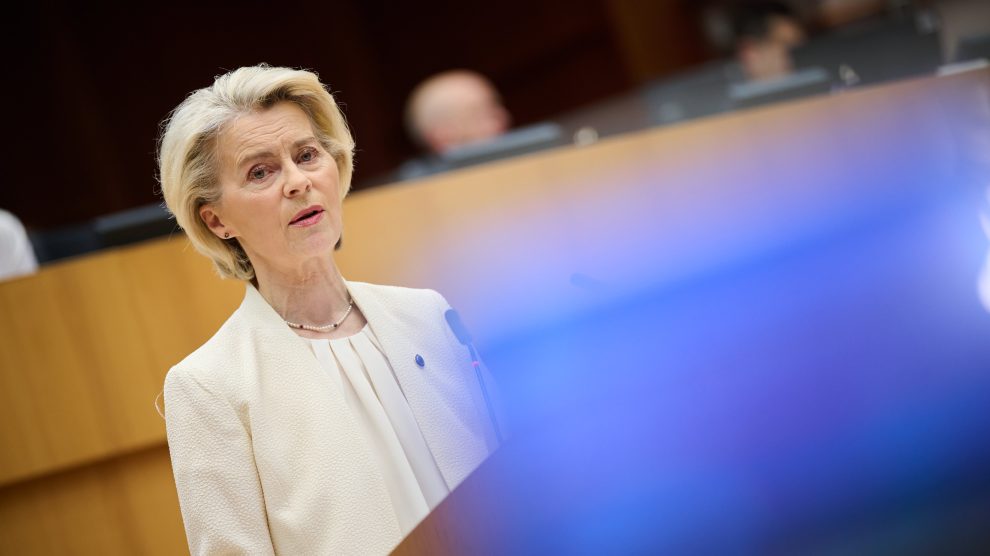
In her very first State of the Union address in 2020, European Commission President Ursula von der Leyen insisted that European leadership was “not about Europe first.” Six years later, the message has hardened: “the fate of Europe must remain in the hands of Europeans.” Invoking Charles Dickens’s “best of times, worst of times,” describing the French Revolution, von der Leyen captured Brussels’s reading of the current age of disruption: pandemic, war in Ukraine, energy crisis, competition with China, technological upheaval, cognitive warfare, and relationships no longer taken for granted.
A courageous speech in its ambition, vision and political clarity. Von der Leyen cast the European Commission as an increasingly proactive actor, advancing imaginative proposals while skirting some of the harder trade-offs. The strategic message was clear: in a more fragile and competitive world, European integration is becoming the foundation of European sovereignty.
Much of this was predictable. Mario Draghi, Enrico Letta, the Competitiveness Compass, the EU’s defense agenda, the diagnosis was already written. The question was not whether the EU understood its problems. It was whether it could finally act on them: from diagnosis to delivery.
The speech offered a catalogue of priorities. Three stand out, none of them a surprise.
- First, competitiveness as the foundation of European power. Von der Leyen called it the “number one priority.” Challenges are familiar: weak productivity, high energy costs, thin investment, regulatory complexity and, above all, fragmentation. Her prescription closely follows Draghi and Letta: complete the Single Market, accelerate permitting, cut bureaucracy and “gold-plating,” mobilize European savings and capital, and reduce energy costs. What has changed is the framing, which is increasingly geopolitical. The real challenge, however, is execution. By July 2026, only 15.7% of Draghi’s 383 recommendations had been fully implemented. Competitiveness remains little more than a slogan unless it delivers growth, jobs and technological relevance. On climate and energy, she embraced nuclear power, renewables, and lower electricity costs, never once using the words “Green Deal,” a choice made to sidestep any controversies.
- Second, security and defense. Ukraine’s sovereignty remains central, with the emphasis shifting from spending more to building European capabilities together. There was no softening of language toward Moscow’s nationalism, its strategy of terror, or Vladimir Putin’s interference and disinformation, aimed at European unity. Where last year’s address dwelt on the need for more defense spending, this year’s focused on how that spending is done. Von der Leyen proposed an equivalent to NATO Article 4-style consultation mechanism, an “Emergency Security Protocol,” a possible European Security Council, and a European Instrument for Strategic Enablers covering missile defense, strategic transport, space and cyber. The strategic logic was clear: not just national defense budgets padded in isolation, but a European pillar built to stand alongside NATO.
- Third, technology and AI. The EU has recognized that technological and economic dependencies can become strategic vulnerabilities. AI, semiconductors, critical minerals, energy and supply chains are now part of the same security equation. The shift is from regulating emerging technologies to financing, scaling and deploying them, especially AI, and turning industrial capacity into productivity and technological power. On artificial intelligence, the ambition is to move AI beyond the screen and into industry and society, while ensuring that is properly governed. The digital agenda also extended on the proposed EU KIDS Act, which would impose age-based restrictions on minors’ access to social media. Europe does not lack strategies. What it lacks is speed, scale and execution.
Three novelties stood out.
- First: the shift from strategic autonomy to capacity. Independence becomes the organizing language across energy, technology, capital, defense, minerals, borders, democracy. Yet independence, in her words, is not isolation, as she pointed to several partnerships (Mercosur, India, Indonesia, Mexico, Canada) with trusted partners, making it clear that control over one’s own fate is built as much though alliances as through self-reliance. Since she first spoke of a “geopolitical Commission,” this is the first time that language has been matched by an actual capability agenda.
- Second, the fusion of economics and security, including cognitive warfare. Energy, technology, minerals, capital and trade: all now treated as security policy, alongside disinformation and foreign interference. China is the clearest case in point. A trade deficit approaching €1 billion a day, heavy dependence on Chinese critical minerals and rare earths, these are framed not as economic imbalances but as strategic vulnerabilities, long overdue for alarm. Hence the much harder language, invoking the EU to use “all the tools at disposal, ” to correct what she termed the excessive and unacceptable distortions in commercial competition.
- Third, the symbolism was carefully staged. Canadian Prime Minister Mark Carney attended as the special guest while von der Leyen floated the idea of Canada becoming the EU’s first “associate member,” a status that would itself require political and legal definition. The other guest were chosen just as carefully: two young founders of a successful start-up, a brave Ukrainian gymnast who lost a leg in a Russian attack, and the message of the mother of a fourteen-year-old Belgian girl who died by suicide after cyberbullying. Together, they personified the speech’s main themes: innovation, security, resilience and the social costs of the digital age.
Three gaps remain between the ambition and the means.
- First, who pays. Defense, AI infrastructure, energy grids, critical-mineral reserves, and industrial transformation, all demand investment at a scale fragmented capital markets and uneven national fiscal capacity cannot yet deliver. The EU budget remains limited and joint financing remains politically sensitive. There is no serious sovereignty without serious answers on financing it.
- Second, political will. Europe increasingly knows what it wants. The question is whether it can decide at geopolitical speed. Completing the Single Market means governments giving up national barriers. A real European defense market means confronting national industrial interests. Enlargement, Ukraine, Moldova, the Western Balkans, belongs in this same frame: not just geopolitical obligation, but an investment in Europe’s own markets, industrial capacity and strategic weight. All these issues will force institutional and budgetary choices Europe has so far avoided.
- Third, the transatlantic silence. The speech had no mentioning of the United States or transatlantic relations, even as it remains Europe’s most consequential partnership, on both security and the economy. The omission, while other partners were distinctively mentioned, likely reflects a delicate moment rather than a shift in priority, but it leaves an important question unaddressed at a speech otherwise built on naming things plainly.
The bottom line: The speech’s strategic core was European independence, not just a slogan, but a new doctrine. The underlying shift is profound: from a model built on US security, cheap Russian energy, expanding trade with China and rules-based globalization toward stronger European defense, energy independence, economic security, technological sovereignty, diversified partnerships and a more integrated Single Market. The strategic narrative is there. What comes next is harder: turning ambition into power.