Italy will soon submit its bid to host the first strategic critical raw materials stockpiling site under a European Commission call, Industry Minister Adolfo Urso said on Monday, as Rome seeks to position itself as a European hub for recycling, processing and supply-chain security.
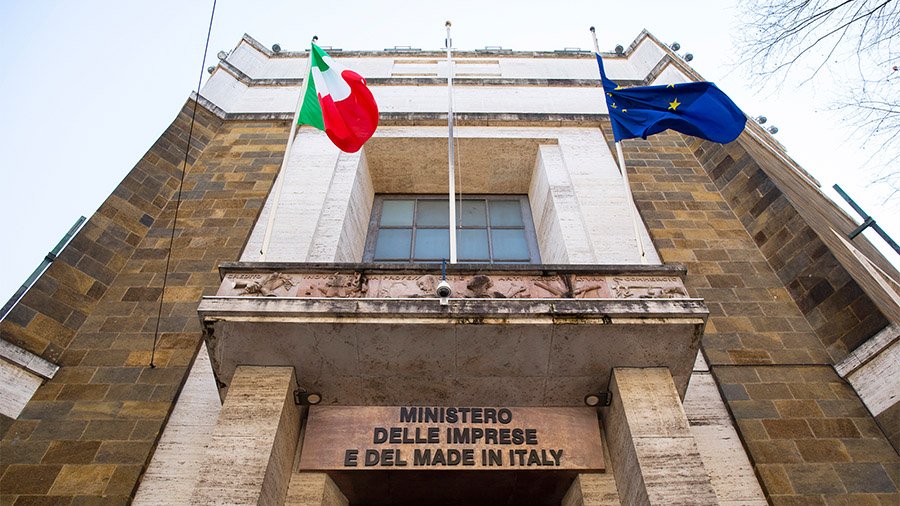
Speaking at the third National Symposium of the Italian Observatory on Critical Raw Materials for Energy (OIMCE) at the Ministry of Enterprises and Made in Italy (MIMIT), Urso identified Porto Marghera, in Veneto, as Italy’s candidate.
- “We are convinced that Veneto, with Porto Marghera, can represent a natural gateway to European markets and a strategic hub for security of supply,” Urso said.
Why it matters: The project is part of a broader Italian strategy that goes beyond stockpiling. Rome wants to build an integrated system combining ports, logistics, industrial processing, recycling and domestic mineral resources — while using international partnerships to diversify supply chains.
- Urso said the proposed network could involve the Quadrante Europa freight terminal, the ports of Trieste (the Italian IMEC hub) and Ravenna and the Tassullo mine in Val di Non, alongside Porto Marghera.
- The objective is to create an integrated system connecting “ports, logistics, industry and mineral resources,” while attracting new investment in critical raw materials recycling and processing.
The ambition: Make Italy Europe’s leading hub for critical raw materials recycling.
- Urso said the government intends to pursue the strategy through the remainder of the legislature, including through the Imprese decree and, more comprehensively, the next Budget Law.
- Italy, he argued, has companies capable of meeting that challenge.
The bigger picture. Rome sees the strategy as part of Europe’s effort to reduce external dependencies and strengthen strategic autonomy.
- Italy is not historically rich in raw materials, making the resilience of supply chains particularly important for a manufacturing economy. But the Italian approach emerging from Monday’s symposium is not based solely on securing additional foreign supplies.
- It encompasses resources, processing, technology, skills, recovery and recycling.
- That whole-of-value-chain approach was stressed by Francesca Zarri, president of Assorisorse, one of the two organisations behind OIMCE alongside WEC Italia. “OIMCE allows us to look at critical raw materials not as a single supply issue, but as a challenge involving the entire value chain,” she said, pointing to resources, processing, technologies, skills, recovery and recycling.
The goal, Zarri said, is implementation. Italy now needs to turn knowledge into concrete industrial capacity, develop more resilient value chains and leverage the role it can play within both the European and Mediterranean systems.
Three dimensions. WEC Italia President Marco Margheri framed the Italian challenge around three priorities.
- First, building a national strategic vision together with MIMIT, the Environment and Energy Security Ministry (MASE), the Foreign Ministry and other government departments. For a country with limited domestic raw materials, this is closely tied to protecting the value chains underpinning Italy’s manufacturing capacity.
- Second, treating critical minerals as an integral part of energy strategy. “We must avoid one dependency turning into another, generating new bottlenecks,” Margheri said, linking critical minerals to a broader approach based on energy multiplicity and addition.
- Third, international partnerships.
Zoom out: Pax Silica and global affairs. Margheri pointed to opportunities for Italy to deepen cooperation with the United States, Canada, the United Kingdom and Québec, while expanding its engagement with Latin America and Africa, including through the government’s Mattei Plan.
- He also highlighted Italy’s participation in Pax Silica, alongside the United States and a broader network of countries, as an important development in efforts to create alternatives to existing value chains and reduce the risk that excessive concentration can become a geopolitical lever.
- OIMCE’s approach, Margheri said, is intended to remain grounded in data, industrial realities and skills development, while following the World Energy Council’s multi-stakeholder and multi-energy model.
International partners were in the room. Monday’s discussion, moderated by WEC Italia Secretary General Michele Vitiello, brought together representatives from MIMIT and MASE, as well as CDP and the embassies of the United States, United Kingdom and Canada.
- Participants included Francesco Tenuta for MIMIT, Nunzia Bernardo for MASE and Roberto Ferrante for CDP, alongside Stephen Anderson from the U.S. Embassy, Clare James from the British Embassy, Marie Gagné from the Canadian Embassy and Laurence Fouquette-L’Anglais from the Québec delegation in Italy.
- Their participation put international cooperation alongside domestic industrial policy as one of the central elements of Italy’s critical-minerals strategy.
What Italy still needs to solve. The symposium also presented the findings of OIMCE’s working groups, coordinated by Giuseppe Montesano, WEC Italia Professional Fellow and coordinator of the Observatory.
- Their work focuses on several pressure points across the supply chain:
- Italy’s projected critical raw materials requirements for 2030-2040;
- skills and training;
- recovery and recycling;
- increasing resource availability;
- processing complex matrices and exploiting sites that are closed or in decline;
- the potential of secondary resources, mining sites and strategic supply chains for Italian industry.
- The roundtable presenting the findings included Mariachiara Zanetti of Politecnico di Torino, Fernanda Panvini of Enel Foundation, Irene Pellucchi and Carlo Carincola of Erion, Francesco Vegliò of the University of L’Aquila/AIDIC and Filippo Del Grosso of FEEM/Assorisorse.
- The wider OIMCE network discussion was opened by Alberto Pasanisi of Edison, Omar Perego of RSE and Luca Farina of VSF.
What they found. Montesano said the working groups had focused on three core elements of critical raw materials strategies for energy: determining future demand, developing skills and increasing resource availability.
- The approach, he said, was deliberately pragmatic, producing recommendations and concrete proposals aimed at improving Italy’s security of supply.
- New challenges require new approaches, Montesano added — starting with skills development, moving through the selection and refinement of industrial processes, and extending to incentive-based regulation and streamlined permitting.
The bottom line. The strategy discussed in Rome on Monday connects several pieces that are often treated separately: securing foreign supplies, building international partnerships, developing skills, recovering secondary resources, processing materials domestically and scaling up recycling.
- OIMCE — the permanent critical raw materials initiative promoted by WEC Italia and Assorisorse, with the symposium supported by Edison and Enel Foundation — aims to provide institutions with concrete proposals to strengthen security of supply, supply-chain resilience and the competitiveness of Italian industry.
- Porto Marghera could now become a physical expression of that strategy: a European stockpiling gateway surrounded by a wider Italian network of ports, logistics, industrial capacity, recycling and mineral resources.
(Photo: @Mimit_gov)