
This is a real turning point: the attempted attack on the American base at Fairford, in the United Kingdom, is an act of war, with precedents only in the Cold War. It changes every political dynamic, including in Italy. Can Parliament continue to pretend that this does not concern us? And what should be said, and how should we prepare?
Those behind it, in theory, could have two origins: Russia or Iran. Russia and Iran are the two countries that could benefit from such an act of destabilisation. They could also have reached Fairford by relying on third parties.
It is difficult to believe that China organised something like this precisely as President Xi Jinping was concluding an almost triumphal visit to Washington. It is possible, indeed, that Russia and Iran, China’s half-friends, organised the attack with the thought of causing trouble for Beijing as well.
In particular, if one assumes the worst, the Russian strategy seems to be moving on four fronts.
- The first is the war in Ukraine, where things are going from bad to worse.
- The second is support for Iran in its war and through its proxies. Here things are going better, but there are no medium- or long-term prospects, because the Iranian economy — the engine of the regional conflict — is in pieces.
- The third consists of military actions: attacks, whether successful or unsuccessful, genuine or suspected, and drone incursions that keep NATO’s security apparatus on alert.
- The fourth, and most delicate, is ideological support, but perhaps logistical support as well, for pro-Russian forces or forces that are out of alignment with traditional American interests in Europe, or even in America. This is the most sensitive terrain because genuine, real and legitimate opinions — opinions that in a democracy must be allowed expression — become mixed up with murkier intentions.
This in fact undermines democratic resilience because it places institutions at the centre of two wrenching pressures: either to allow every opinion free expression, including anti-democratic ones; or to forcefully restrict access to the democratic agora and, in doing so, restrict the overall freedom of the institutions themselves. Simply placing democratic institutions before this alternative is already a victory for Russian President Vladimir Putin.
The different fronts are connected. The open war in Ukraine, even if it is being lost, justifies and sustains the threats on the other three fronts.
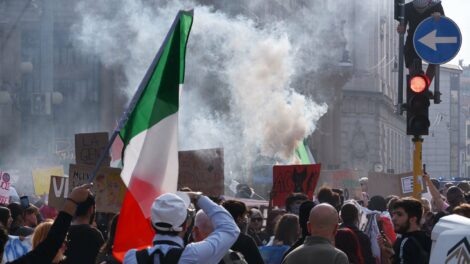
- This raises questions about Europe’s overall defence, and particularly Italy’s, where there are no fewer than three parties with Russian sympathies. They do not have enough votes to govern alone, but they are divided between right and left. Thus, within the bipolar system adopted by the country after the end of the Cold War, they are able to condition every governing majority.
- In this sense, Italy’s original Constitution, designed through provisions both explicit and otherwise, could perhaps have a second life. It was conceived to concentrate power in the centre and exclude anti-democratic and anti-American factions, on both the right and the left, from government, while still leaving them room for expression in political debate.
Today, this is precisely what would be needed. Many pieces are missing before Italy could fully return to that history. Without stirring through everything that is there or everything that is missing, what is absent in Italy is a sense of alarm about the dark spiral into which the world is descending.
It is right not to be alarmist. But believing that the issue of expensive oil is due to some act of God, and that it can be dealt with by asking oil companies for a contribution, is misleading. Oil is expensive, and it will remain expensive, because there is a hybrid war unleashed by Russia and Iran.
- Without trying to see and understand, and therefore, with all due caution, to address the main problem, we are simply pounding water in a mortar.
Hence electoral reform. What is it for? What should it be for?
- It cannot be there to give power to Italy’s Prime Minister Giorgia Meloni, or to take it away from her, with all due respect to the prime minister or to the opposition. It must serve the country.
- What is the country’s problem today? The challenge to democracy posed by pro-Russian forces on the right and the left. There is a Constitution designed for precisely this purpose, so what would be needed is simply a return to the origins.
- Naturally, this also means there must be figures such as De Gasperi or Togliatti, as there were in their time, willing to take the bull by the horns while thinking about the country.
The bottom line: Perhaps this is precisely Russia’s wager: that the short circuit between a bipolar electoral system grafted onto a Constitution designed to neutralise the extremes, combined with a weak political class, can create the conditions for a success that would cover up the failures in Ukraine or Iran.