Mykhailo Fedorov, Ukraine’s former defence minister and the mind behind its drone revolution, now advises Italy’s Defence Ministry. His latest plan, humanoid robots at the front within six months, may be a stretch, but the know-how he brings to Rome is not.
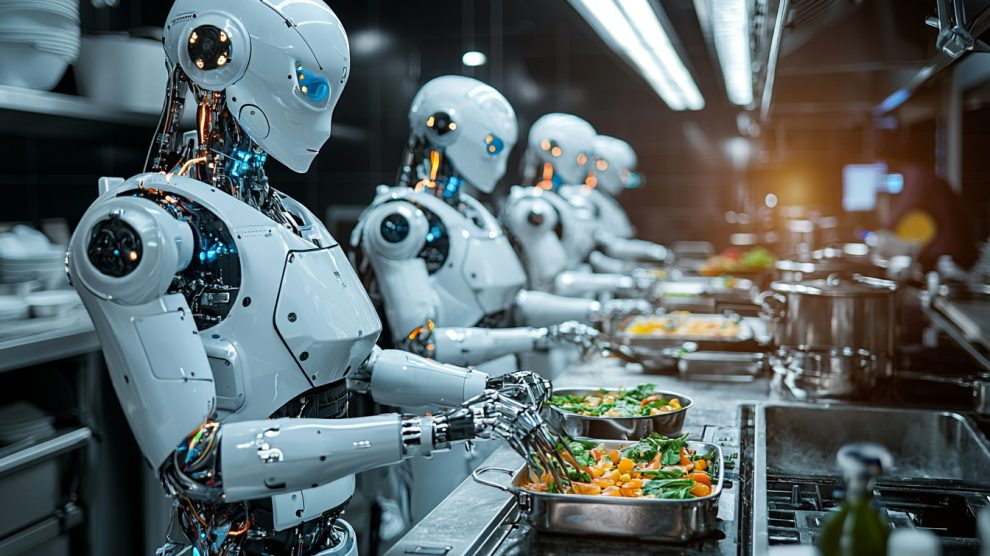
The move: In Lviv, Mykhailo Fedorov, removed by President Volodymyr Zelensky in July, unveiled a project to replace much of Ukraine’s frontline manpower with robotic systems, humanoids included. The targets:
- a first humanoid deployed at the front within six months;
- within a year, an offensive in which robots autonomously carry out the deadliest phases of the mission.
Why it matters: The driver is manpower. According to National Guard commander Oleksandr Pivnenko, Russian forces outnumber Ukrainian troops six to one in some sectors. Unmanned ground vehicles and AI-guided anti-drone turrets are already in use, but not at scale.
Racing for the rules: Speaking to The Washington Post, Fedorov dismissed the debate on AI risks as a luxury Kyiv cannot afford: the priority is to “survive and preserve independence.”
- Once robots are deployed, he argues, the process becomes “inevitable and irreversible”, and whoever arrives first sets the rules. He calls for a new Manhattan Project with Western industry, including his own defence-tech firm, whose first investor is Palantir CEO Alex Karp.
The feasibility gap: No humanoid has ever fought in combat. Ukraine’s drone success rested on cheap, easily mass-produced platforms. A biped is the opposite:
- less stable, costlier and more complex than wheeled or tracked vehicles;
- dependent on a supply chain that does not exist at industrial scale;
- vulnerable to electronic warfare, with doctrine still lagging behind.
- The six-month deadline looks more political than realistic.
Rome’s opportunity: For Italy, the humanoids are a sideshow; Fedorov himself is the asset. As an adviser to the DefenceMinistry, he brings rare experience in building an ecosystem that develops, tests and produces unmanned systems at wartime speed. Rome could draw on that model to:
- accelerate procurement cycles that remain slow by Ukrainian standards;
- strengthen the dialogue between the armed forces, start-ups and major industrial groups;
- position itself among Europe’s front-runners in military robotics.
What it signals: As Europe races to close its defence-technology gap, battlefield-tested lessons are scarce and valuable. By bringing Fedorov in, Italy has secured direct access to them.
- The question is whether Rome’s institutions can absorb a method built on speed, risk-taking and constant iteration.