

The big picture: Ahead of the European Council, Meloni warned that geopolitical tensions are affecting supply chains, energy costs and Europe’s industrial competitiveness.
- Addressing the Italian Senate, she argued that Europe must strengthen its ability to respond collectively to external shocks while preserving its industrial base.
- Her broader approach to strategic economic dependencies, including critical raw materials and rare earths, emphasises diversified suppliers, stronger commercial partnerships and more secure industrial value chains.
Why it matters: Critical minerals and semiconductors are different industries, but their vulnerabilities expose a common geopolitical problem: concentrated production, strategic dependencies and the growing possibility that access to essential technologies becomes an instrument of political pressure.
- The European Council’s October 15–16 agenda addresses competitiveness, industrial renewal, energy prices and the resilience of the Single Market.
- The challenge is particularly acute as competition between Washington and Beijing increasingly shapes access to advanced technologies, industrial investment and strategic resources.
The diplomatic angle: Ambassador Armando Varricchio, Italy’s Special Envoy for Innovation and New Technologies, recently highlighted the risks of allowing semiconductors to become another arena of global confrontation.
- Speaking at the Guarini Institute for Public Affairs at John Cabot University during the event Diplomacy of Semiconductors: Power, Innovation, and Strategic Competition, Varricchio warned that the industry must not become the battlefield of a new global conflict.
- He stressed the importance of diplomacy in managing US-China technological competition, identifying three essential principles: technology, interdependence and trust.
- His argument challenges the assumption that strategic autonomy necessarily requires technological independence. No country can maintain leadership across the entire semiconductor ecosystem alone.
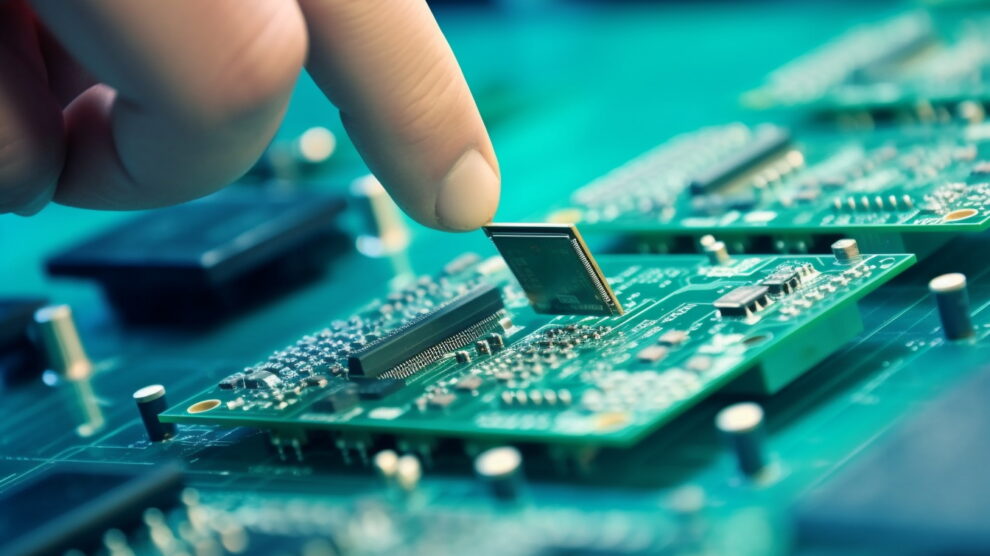
By the numbers: Europe’s semiconductor position illustrates the scale of its industrial challenge.
- The EU accounts for approximately 8% of global semiconductor production, compared with around 18% of end-user demand, according to figures presented by European Commission official Pierre Chastanet.
- Semiconductor shortages cost Europe’s automotive industry more than €100 billion in 2022–2023, exposing the consequences of disrupted supply chains.
- AI-related components could account for more than 70% of the semiconductor market by 2030, making advanced computing capabilities increasingly central to industrial competitiveness.
The Brussels response: Chastanet, Head of Unit for Microelectronics and Photonics at the European Commission’s DG CNECT, argued that Europe must combine industrial investment with stronger international partnerships.
- Speaking at the same John Cabot discussion, he emphasised the need to make the EU more attractive to foreign investment while strengthening its domestic semiconductor capabilities.
- As reported by Adnkronos, his message was that Europe must create conditions for investment and develop international partnerships, because bilateral agreements alone are insufficient.
- The emerging Chips Act 2.0 agenda reflects this approach, extending Europe’s ambitions beyond fabrication plants to advanced packaging, chip design, research, skills and demand-side industrial policies.
Zoom out: The semiconductor debate connects directly with Europe’s wider effort to reduce economic exposure to geopolitical shocks.
- The Commission’s recent selection of 46 additional strategic critical raw-material projects illustrates the parallel push to diversify essential supply chains. Meanwhile, cooperation with partners such as Japan, South Korea, Taiwan, India and the United States remains crucial to Europe’s technological capabilities.
The strategic dilemma: Europe must reduce excessive dependencies without undermining the international networks that make advanced technological production possible.
- Industrial capacity requires reliable energy, investment, specialised expertise and access to global markets.
- Diplomatic partnerships must therefore complement industrial policy, particularly as geopolitical tensions threaten maritime routes, energy supplies and advanced manufacturing networks.
The bottom line: Meloni’s emphasis on economic security and the arguments advanced by Varricchio and Chastanet point towards the same strategic conclusion: Europe’s technological sovereignty will depend on its ability to manage interdependence.
- As EU leaders discuss competitiveness in Brussels, the semiconductor industry demonstrates why strategic resilience requires more than domestic production. It demands industrial capabilities supported by trusted international partnerships and an economic environment capable of sustaining innovation.