
The United States sees Italy as a strategic partner in its effort to reorganize global technology supply chains around trusted economies. And Washington wants the new US-Italy Trusted Tech Accelerator to help turn that vision into industrial partnerships.
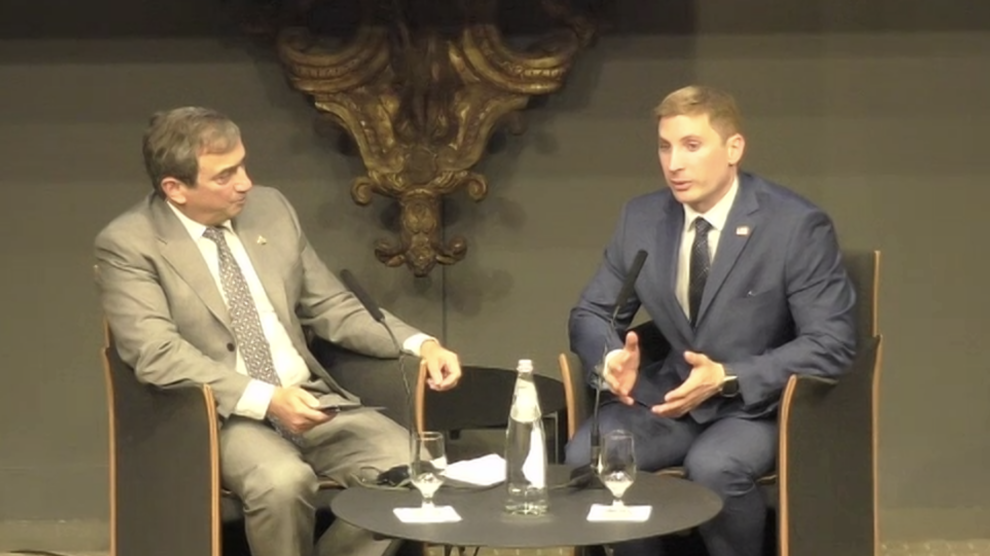
That was the message delivered by Jacob Helberg, US Under Secretary of State for Economic Affairs, during a fireside chat with Italian Ambassador Marco Peronaci at the third US-Italy Dialogue on Trusted Technologies for Democracies, held in Washington on October 15–16.
Helberg linked the administration’s Pax Silica initiative – of which he is the “architect” – to a broader transformation of the global economy, arguing that artificial intelligence will reshape not only productivity and economic growth but also the international distribution of wealth and power.
Why it matters: Washington increasingly views technological leadership as inseparable from economic security. For the Trump administration, building resilient supply chains among politically aligned countries is becoming a central instrument of strategic competition.
- Helberg described Pax Silica as a platform bringing together countries with complementary technological and industrial capabilities to secure the infrastructure underpinning the AI economy.
- Its scope extends beyond semiconductors and computing infrastructure to the wider manufacturing ecosystem, where different industries often depend on the same production facilities and critical inputs.
- The initiative seeks to address excessive geographical concentration, vulnerable production nodes and dependencies that could expose Western economies to geopolitical coercion.
The big picture: Helberg placed this strategy within what he sees as a historical economic turning point. He argued that AI-driven productivity gains could significantly accelerate economic growth, potentially altering the balance of economic power within a generation. Countries able to capture those gains would enjoy advantages extending well beyond the technology sector.
- In his account, the Western tradition of scientific discovery provides a foundation for responding to that transformation. He explicitly connected this tradition to Italy’s Renaissance, describing the country’s intellectual history as part of the broader Western commitment to scientific progress and human reason.
- The geopolitical implication is that the United States cannot secure its technological future alone. It needs partners with industrial capabilities, scientific expertise and shared strategic interests.
The Italy connection: Peronaci invited Helberg to share insights on how trusted partners can develop competitive alternatives to existing suppliers, particularly when diversifying supply chains may involve higher short-term costs.
- The ambassador also raised the potential to extend cooperation across Asia, Africa and the Mediterranean, drawing a parallel with the challenges NATO faces in coordinating defense-industrial production across decentralized Western economies.
- Helberg’s response placed Italy firmly within the emerging American strategy.
- Rome joined the Pax Silica Declaration in July, followed by a bilateral memorandum on critical minerals signed in September on the sidelines of the United Nations General Assembly.
The new accelerator represents a further step, intended to connect diplomatic alignment with investment, research and industrial cooperation.
- Asked directly whether the initiative could count on his support, Helberg replied: “You can absolutely count on my support.”
- “We view Italy as a very, very important partner,” he added, expressing appreciation for the Meloni government’s approach to technological innovation.
- Helberg also welcomed the accelerator’s practical structure, particularly its ability to bring private-sector participants into discussions and generate new partnerships. He expressed hope that the accelerator could serve as a model for bringing governments and businesses together to develop new partnerships under Pax Silica.
Inside Pax Silica: Helberg outlined an approach combining economic security with opportunities for industrial expansion. “It’s not just meant to be a defensive mechanism, it’s also meant to be a way to seize the opportunities,” he said.
- The initiative is designed to accommodate both government-to-government and government-to-business cooperation, reflecting the structure of Western economies, where strategic supply chains are largely operated by private companies.
- Helberg identified information asymmetries as a central challenge. Governments do not necessarily know where their industries depend on vulnerable suppliers, while companies need greater visibility into regulatory developments, policy priorities and geopolitical risks.
- Pax Silica, in this reading, can help map critical supply-chain nodes, identify vulnerabilities and create the conditions for new partnerships.
On superintelligence: The conversation also addressed the administration’s approach to advanced AI regulation. Responding to Peronaci’s questions about AI consciousness, human dignity and the appropriate regulatory framework, Helberg rejected the idea that artificial intelligence should be treated as sentient.
- On regulation, he favored applying existing legal frameworks to specific uses of AI rather than introducing a comprehensive regulatory regime covering the technology as a whole.
- He argued that autonomous vehicles, medical applications and aviation present different risks, making sector-specific rules and established liability principles more appropriate. The administration, he said, is examining existing legislation to identify possible gaps.
The China factor: The Under Secretary delivered a particularly sharp warning about the international consequences of Chinese industrial overcapacity and subsidized exports. Helberg argued that a potential second China shock, “or the China squeeze,” threatens manufacturing industries across multiple markets, particularly in advanced electronics, telecommunications equipment and electric vehicles.
- While US tariffs have, in his assessment, provided some protection to the American market, he expressed concern that other economies remain exposed to Chinese competitive pressure. “We don’t want to be an island surrounded by Chinese-dominated markets,” he said.
- The statement reveals an important dimension of Washington’s thinking: American economic security depends partly on the resilience of allied markets and industries. A protected US domestic market would offer limited strategic reassurance if its partners became increasingly dependent on Chinese production.
What we’re watching: The next test for Pax Silica will be whether its growing network of diplomatic commitments can produce measurable changes in investment, manufacturing and supply-chain resilience.
The bottom line: For Italy, the Accelerator offers a possible route to translate its scientific and industrial capabilities into partnerships with American companies and investors. For Washington, the bilateral initiative could demonstrate how trusted technology cooperation works beyond government declarations.
- The strategic objective emerging from the Peronaci-Helberg conversation is broader still: to build an international technology ecosystem capable of sustaining Western economic competitiveness as AI transforms the global balance of power.