

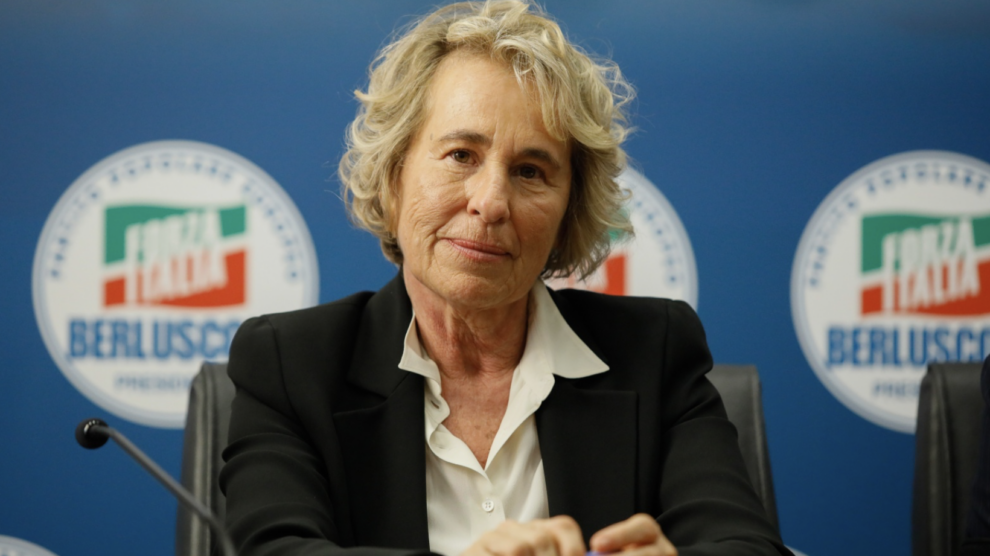
The Republican setback in the US midterm elections reflects growing voter frustration over the Iran war, rising living costs and Donald Trump’s unfulfilled promises. But Stefania Craxi, leader of Forza Italia in the Italian Senate, cautions against drawing premature conclusions about America’s political future or applying its electoral dynamics to Europe.
In an interview with Decode39, she argues that the EU must seize the moment to strengthen its geopolitical role, deepen its strategic autonomy and pursue a more ambitious agenda for growth, investment and common defense.
Why it matters: For Italy, she insists, pragmatic Atlanticism and a stronger Europe remain complementary priorities, regardless of who occupies the White House.
Q: What was the biggest mistake Trump made?
A: Let us start with one fact. If 62 percent of Americans consider the decision to go to war with Iran to have been wrong, it seems quite clear to me, regardless of the assessment of the decision itself, that this was the main reason for his defeat.
- Trump had won with the slogan “no more distant wars”, underestimating the fact that, in today’s world, distant wars do not exist, especially for a power that, by history and ambition, claims a leading role on the global stage and is engaged in a competition with China that goes well beyond the Indo-Pacific region.
- This decision had economic consequences, from rising inflation to higher fuel prices, contradicting Trump’s second major promise: to guarantee greater prosperity for the middle class, despite indicators such as GDP and unemployment remaining positive.
- Added to this was the loss of support among Hispanic voters, because of the harshness with which the issue of immigration was addressed, and among rural voters, affected by the consequences of the trade war, particularly with Canada, which penalized agricultural states. These are, to a large extent, the same social groups that had brought him victory and have now turned their backs on him.
Q: Is there a risk, however, that the intensity of anti-Trump sentiment could fuel the far left? And how should Republicans respond?
A: In American history, only three presidents have not lost at least one chamber of Congress in midterm elections, so we are not facing an unprecedented event. Moreover, midterm elections do not automatically determine the outcome of the race for the White House: Clinton, Obama and Reagan demonstrated that a midterm defeat does not preclude a subsequent presidential victory.
- The real point is to understand how the Republican Party will react, how strong the influence of the MAGA movement will remain, and whether it will be able to interpret the changes taking place in the country by finding a credible candidate for 2028. The defeat has opened up the question of succession and the redefinition of Republican leadership.
- As for the Democrats, I would be careful about considering the contest already settled. Today they are celebrating, but their victory highlights two different wings that are not necessarily reconcilable: on the one hand, the centrism of James Talarico, capable of speaking to conservative and religious voters, including on the issues of values and the reduction of inequality; on the other, the progressivism represented by Abdul El-Sayed, the first Muslim senator elected in Michigan.
- For this reason, the contest remains completely open. Personally, I am not cheering for either side, and I frankly find ridiculous the attitude of the Italian broad left-wing coalition, which once again is celebrating other people’s victories.
Q: What lesson does this hold for the European right, for example for those parties that, as opinion polls tell us, are preparing to govern in France and Spain?
A: First of all, Europe’s right-wing parties are the product of profoundly different histories, political cultures and national contexts; for this reason, making automatic comparisons is always very risky. I believe, however, that two lessons emerge from this vote.
- The first is that credible candidates are needed, capable of interpreting their own times.
- The second is that no macroeconomic figure can replace citizens’ concrete perceptions: the American economy, overall, is not doing badly, but voters do not vote for GDP.
- They look at the cost of filling up their cars, their bills and their groceries. If prosperity does not reach their pockets, growth remains a statistic and does not translate into electoral support.
Q: So does the positive model in Europe remain the Italian one, which has been able to combine conservatism, Atlanticism and Europeanism in an approach aimed not at dismantling Europe but at building it, as the Meloni government is doing?
A: The Italian centre-right is a coalition that has existed for 30 years. It is not an improvised grouping formed against a common enemy: it is made up of forces driven by different political sensibilities but held together by a common spirit, motivated above all by pragmatism and the desire to provide concrete answers.
- It has given the country stability, both political and financial, and has cultivated a rational Atlanticism, without hesitation but also without subservience, whatever the left may say.
- I recall that Deputy Prime Minister Tajani did not go to Washington after the disparaging remarks that President Trump made about Meloni. So much for going cap in hand!
- It is therefore a pragmatic Atlanticism, without ever forgetting that the transatlantic relationship is the foundation of our security and is an irreplaceable relationship that does not depend on whoever happens to occupy the White House.
- Moreover, Europeanism is another of the guiding principles that the government has rightly established, and the government has rightly stayed the course. We are very much aware that the Europe we need does not yet exist.
Q: Can you articolate on it?
A: We need a political Europe, capable of finally becoming a geopolitical actor and speaking with one voice, strong and authoritative. That is why, on Ukraine, we are calling for a European Union special envoy who speaks on behalf of everyone, without yielding to the logic of small groups of countries that privilege the interests of a few over those of the many.
- I find it tiresome that the left today opportunistically denounces Italy’s irrelevance, calls for more Europe, endorses power politics and three-way agreements, yet does not demand a Community-based approach.
- Incidentally, it is the same contradiction-ridden left that, when it comes to the test, would leave Kyiv to its fate and says no to every investment in defence: one cannot expect to sit at the table where decisions on European security are made and then refuse to contribute to it.
- All the more so in a context such as the one we are experiencing these days, with hybrid attacks, a veritable war, ranging from the skies to refrigerators, including French healthcare facilities where blood is stored.
The bottom line: “That is why I say we need the Europe that does not exist yet,” Senator Craxi said.
- And above all, we need a Europe of growth, a pact for investment and development, to support industries and businesses, including through common debt instruments. A Europe in which flexibility is the logical consequence of extraordinary circumstances and not a concession.
- Because if the Union continues to respond with the recipes of austerity, which have already proved so unsuccessful, it will not be up to the exceptional moment we are experiencing.