
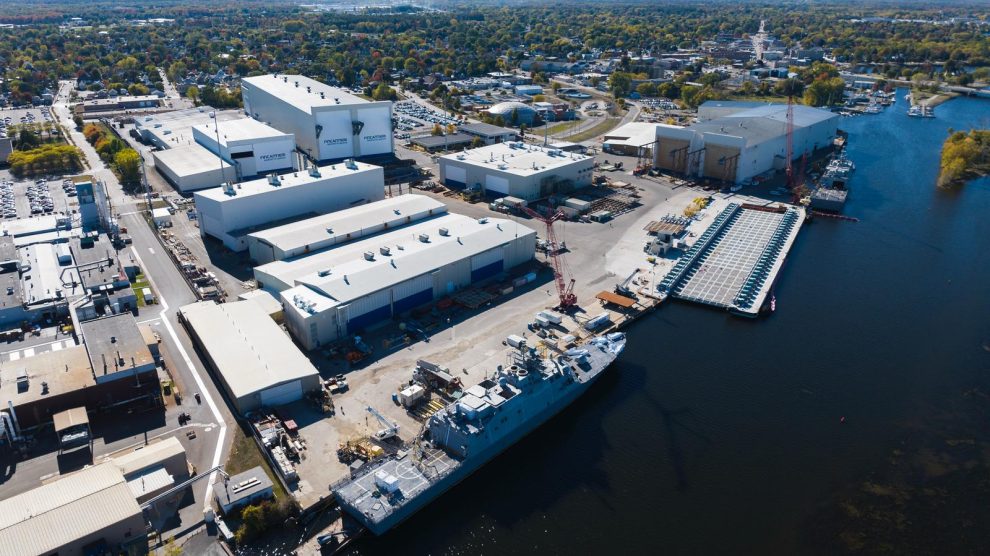
Decoding the news. Fincantieri’s Marinette shipyard in Wisconsin has become a focal point for both political and industrial interests.
- Upgraded with $400 million in investments, it is now considered a leading example in the US shipbuilding revival—a critical issue in Washington’s long-term competition with China.
- US Navy Secretary John Phelan’s recent visit confirmed that strategic dimension.
What Phelan said. During a Congressional hearing on June 10, Phelan publicly praised the work being done at Marinette.
- “I was very impressed by their investments in their shipyard and think they’ve attempted to modernise,” he said. “And I think there are some things that some of the other shipyards can actually take and potentially adapt,” he added.
- He acknowledged delays in the Constellation-class frigate program stem from shared responsibility between the Navy and industry, partly due to outdated contracting mechanisms.
- Still, he stressed: “I do think that the shipbuilder there has done a great job,” and emphasised the need to sustain and expand the yard’s contribution.
The context. Fincantieri has operated in the US since 2009, with over $800 million invested nationwide.
- Roughly $400 million was spent modernising the Marinette site, which is now one of the most advanced shipyards in the country. It is dedicated to producing the US Navy’s new Constellation-class frigates.
- The group also operates in Sturgeon Bay (civilian ships and maintenance) and Jacksonville (repairs), expanding its footprint as a relevant industrial player for the American naval base.
- Fincantieri is expanding its capacity for ship repair and post-construction testing in Florida, focusing on next-gen systems and subsystems for commercial and military applications.
Industrial value. Fincantieri brings proven expertise in building complex ships, including military, cruise, and offshore vessels.
- Through its Norwegian subsidiary VARD, the group can also support the construction of icebreakers, which the United States urgently needs to strengthen its strategic presence in the Arctic.
- Operational designs are already available for 50–110 meter units currently in service with navies and operators in Northern Europe.
- A proposal is under development that includes collaboration with local US shipyards.
- According to a Wall Street Journal timeline, China builds a new frigate in about 5 years, France in 6, and Italy — using Fincantieri’s design — in 3,5. The U.S., despite adopting the Italian design to accelerate delivery, is now expected to take nearly 10 years due to extensive design changes.
China as a driver. According to a Congressional report released in April, China’s Navy is now the largest in the world, with over 370 combat platforms projected to reach 435 by 2030.
- As of September 2024, the US Navy operated 296 battleforce ships, a figure expected to decline to 294 by the end of the decade.
- The genuine concern among US analysts and officials is China’s production capacity—fast, scalable, and potentially convertible to military use. This asymmetry demands a robust American industrial response.
The US response. On April 9, US President Donald Trump signed an Executive Order to revitalise military and civilian shipbuilding in the United States.
- The goal is to build approximately 100 new ships and bring the US battle force fleet to 381 units over the next thirty years.
- President Trump’s pick for the next chief of naval operations, Admiral Daryl Caudle — according to Politico, “a longtime admiral who has demanded accountability from America’s ailing shipbuilding industry” — demonstrates the Trump administration’s focus on revitalising the US shipbuilding sector.
- With proven facilities already operating on American soil, Fincantieri is positioned as a key industrial ally to help narrow the capability gap with China and rebuild a resilient US production base.
What we’re watching. Marinette is more than a shipyard—it is a test case for America’s maritime revival.
- The Department of Defence states that the Chinese navy “is the largest in the world, with a battle force of over 370 ships, including major surface combatants, submarines, ocean-going amphibious ships, mine warfare ships, aircraft carriers, and fleet auxiliaries.”
- This estimate does not include some 60 Houbei-class missile-armed patrol craft.
- Thanks to its expertise and on-the-ground presence, Fincantieri stands out as a strategic partner in the global naval competition—something Secretary Phelan has now confirmed.