The facility would likely be located in northern Italy, close to major transport and logistics infrastructure. It would serve as a cornerstone of Europe’s effort to secure access to critical raw materials and rare earths.
Why it matters: Minster Adolfo Urso’s announcement comes as the issue of critical minerals moves to the centre of the transatlantic agenda.
- On the same day, the U.S. State Department is hosting allies, partners and like‑minded countries for the first Critical Minerals Summit, underlining Washington’s effort to build a coordinated supply‑chain system.
- Italy is represented by Foreign Minister Antonio Tajani, who is working to position Rome as a central node in the emerging U.S.‑led architecture, while reinforcing the EU’s broader push for strategic autonomy amid wars, trade tensions, and growing global supply‑chain vulnerabilities.
What’s happening: Italy is on the short list to host one of Europe’s first two strategic storage hubs for critical raw materials, according to Industry Minister Adolfo Urso.
- The facility would likely be located in northern Italy, close to major transport and logistics infrastructure.
- The objective is to ensure secure and reliable access to critical raw materials and rare earths for European industry.
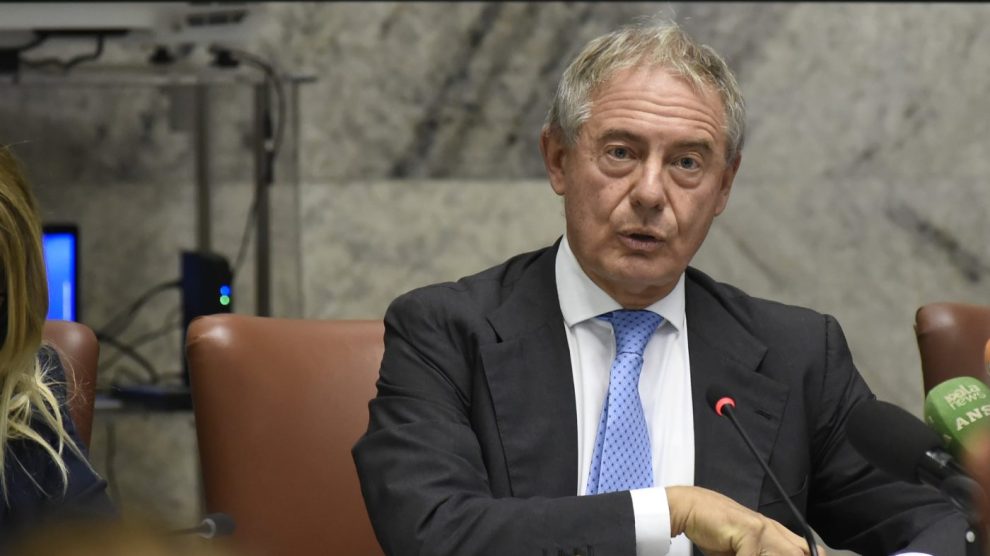
Driving the news: Speaking at a Legambiente event focused on clean industrial policy, Urso framed the initiative as a response to Europe’s deteriorating security environment.
- Europe, he warned, is increasingly surrounded by conflicts, making strategic autonomy a necessity rather than a choice.
- In this context, strategic stockpiling of critical raw materials becomes a security and resilience tool rather than just an industrial policy measure.
Big picture: Urso linked the storage hub to broader EU debates on supply-chain resilience, competitiveness, and decarbonization.
- He said the issue was recently discussed with EU commissioners at the Competitiveness Council, highlighting the need to safeguard access to raw materials and rare earths.
- The risks cited include armed conflicts, trade wars, and intensifying global competition.
Between the lines: Italy is also advocating limits on EU exports of ferrous scrap, arguing that retaining materials within Europe is essential to:
-
- Support steelmakers—particularly Italian firms—transitioning to electric arc furnaces.
- Enable the development of a genuine circular economy aligned with decarbonization goals.
- The move mirrors parallel steps in Washington. Just a day earlier, U.S. President Donald Trump launched Project Vault, a $12 billion initiative to build a strategic stockpile of critical minerals and rare earths, designed to shield supply chains from geopolitical shocks and reduce dependence on China.
What he’s saying: Urso argued that recycling offers a faster and more realistic path to strategic autonomy than opening new mines.
- Building a recycling industry, he said, is easier and quicker than developing mining projects.
- Time, he added, is a critical constraint if Europe wants to secure its strategic independence.
Zoom out: The proposal fits squarely within the EU’s broader effort to strengthen its critical raw materials strategy, reduce external dependencies, and adapt industrial policy to an increasingly fragmented and competitive global order.