The news: According to Italian daily Il Messaggero, which first reported the initiative, a directive signed in October places the Department of Information for Security (DIS), the body that coordinates Italy’s intelligence agencies, at the center of a new “cabina di regia” — a central crisis coordination unit — a crisis command structure designed to manage systemic threats ranging from cyberattacks and sabotage to military escalation and pandemics.
The move reflects mounting concern in Rome that overlapping bureaucracies could slow decision-making in a “black swan” scenario affecting critical infrastructure or national resilience. Italian officials have in recent months assessed risks including cyber operations capable of disabling the national network, drone incursions, attacks on strategic assets and renewed public-health emergencies.
- Officials privately acknowledge that the fragmentation exposed during the Covid-19 pandemic — when overlapping chains of command slowed decision-making — remains a defining lesson behind the reform.
- The new architecture is designed to prevent a repeat of that institutional paralysis in future whole-of-system emergencies.
Zoom in: from CISR to National Security Strategy. Under the plan, the coordination hub would operate under the authority of the prime minister and the Interministerial Committee for the Security of the Republic (CISR), bringing together intelligence, civil protection, defence and interior ministry authorities.
- The directive effectively sidelines older coordination bodies created during past crises, replacing them with a streamlined command structure directly anchored to Palazzo Chigi in order to eliminate bureaucratic overlap in high-intensity emergencies.
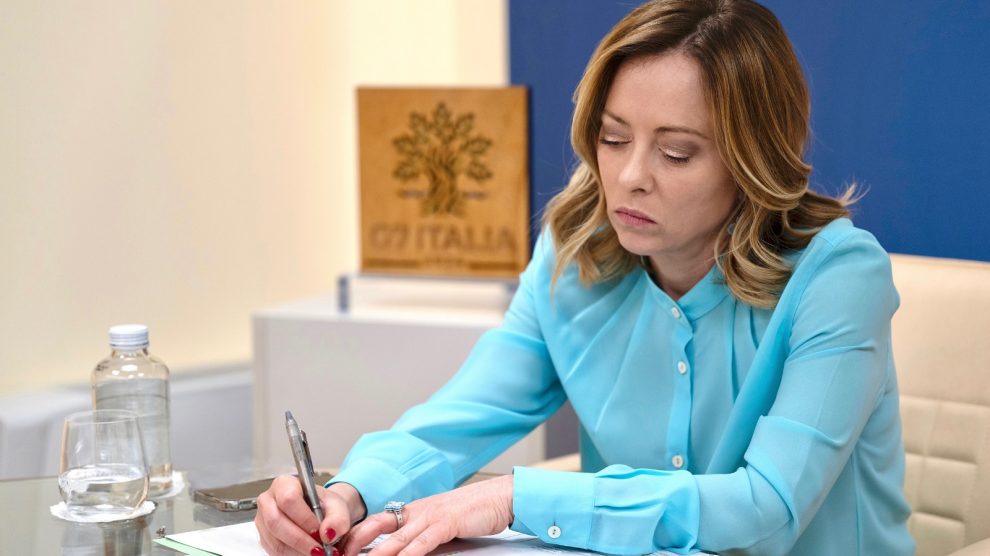
- Meloni has also asked the CISR to draft a formal national security strategy to be updated annually — a significant shift for Italy, the only G7 country that has never adopted a comprehensive document equivalent to the U.S. National Security Strategy.
- Such a blueprint would define priorities, alliances and resource allocation across military, economic and technological domains.
- Significantly, the concept of a formal strategy has circulated across Italy’s political spectrum for years, including proposals advanced by former defence minister Lorenzo Guerini, suggesting a rare bipartisan convergence on the need for stronger crisis governance beyond electoral cycles.
-
Guerini is the current President of COPASIR (Comitato Parlamentare per la Sicurezza della Repubblica), the Italian parliamentary committee that oversees the national intelligence agencies
-
A wider climate of instability. The initiative comes amid heightened geopolitical tension on Europe’s periphery, including Russia’s war in Ukraine, instability in the Middle East and concerns within NATO about hybrid threats targeting member states. Italian officials have warned that infrastructure such as ports, airports, rail hubs and hospitals could become focal points in a crisis, prompting work on classified contingency plans to protect them.
- Defense Minister Guido Crosetto has previously indicated that measures are being developed to secure the country against “hybrid threats,” including cyber operations.
- Similar planning frameworks have been adopted by NATO allies, reflecting a broader shift toward resilience and civil-military integration.
- During the Milan-Cortina 2026 Winter Olympics, Italy protected itself against various forms of hybrid cyber and physical attacks.
The bottom line: For PM Meloni, the project underscores a governing philosophy that places crisis preparedness and strategic autonomy at the center of Italy’s role within NATO and the European Union.
- For international observers, it signals that Rome — traditionally cautious about centralizing power in security matters — is adapting to an era defined by hybrid warfare, technological disruption and systemic risk.
What we’re watching: Whether the framework will speed decision-making in a real emergency remains to be tested. But the message from Rome is clear: Italy intends to be better prepared for the next shock, whatever form it takes.