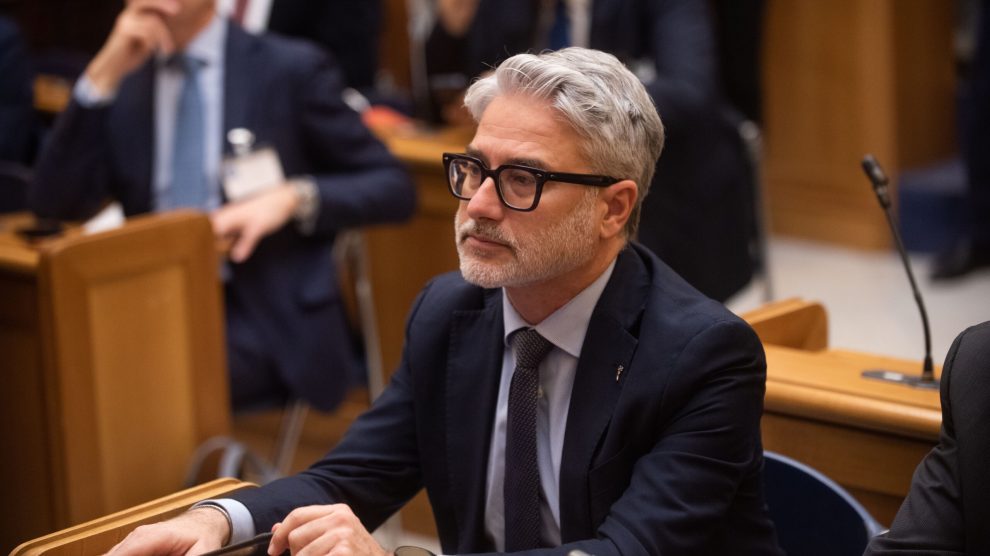
Italy’s readiness to contribute naval assets to a potential European mission in the Strait of Hormuz reflects a deeper evolution in its strategic posture, according to Emanuele Loperfido, a member of parliament from Fratelli d’Italia and secretary of the Foreign Affairs Committee in the Chamber of Deputies.
Speaking to Decode39, Loperfido points to the country’s rapid reduction in dependence on Russian gas and its parallel effort to build a diversified energy system spanning the Mediterranean, the Caucasus and the Gulf. “Italy has drastically reduced its reliance on Russian gas,” he says, framing the shift as both an economic and geopolitical adjustment.
Q: Italy is ready to send two naval vessels to Hormuz, within a European initiative to be activated after a cessation of hostilities. What signal does this send?
A: It is a signal of responsibility and strategic awareness. Maritime security and energy security increasingly overlap, and Italy’s presence serves both a national and a European interest. The Strait of Hormuz is a critical chokepoint for global energy flows, and freedom of navigation is a direct interest for Italy and Europe.
- Italy’s availability is part of a multilateral framework and presupposes minimum security conditions, starting with a cessation of hostilities, as indicated by Defence Minister Guido Crosetto.
- This choice is consistent with the path taken in recent years: Italy has drastically reduced its dependence on Russian gas, building a system based on diversified supplies from the Mediterranean, the Caucasus and the Gulf.
Q: While multinational missions are important, there is also a need to reform the EU and speed up its processes. How do conservatives intend to do this?
A: The issue is not to transfer additional competences to the European level, but to improve the Union’s decision-making capacity. European conservatives, and Fratelli d’Italia in particular, believe that democratic legitimacy remains with the member states.
- The priority is therefore to strengthen political coordination among governments, make processes more efficient and reduce decision-making times, without altering institutional balances. The recent energy crisis is indicative: faced with urgency, some countries — including Italy — acted quickly, diversifying supplies and reducing dependence on Russia.
- The meeting in Paris among Europe’s major economies is a stimulus for the EU to ensure that Europeans are in a position to safeguard their own political and energy interests.
Q: How can the European Council in Cyprus demonstrate to allies that freedom of navigation in Hormuz is a central issue?
A: Bringing Hormuz to the centre of the summit means recognising that energy security is now a strategic European priority that can no longer be postponed.
- After drastically reducing dependence on Russia, Europe has built a new energy balance that passes through these regions. This explains the interest in de-escalation and stabilisation in that area.
Q: Is Cyprus’s accession to NATO back on the agenda?
A: Any reflection on NATO membership must be approached with balance, taking into account regional dynamics and the need to preserve cohesion among allies.
- That said, recent news that the United States is contributing to the expansion and upgrading of certain bases on Cypriot soil shows that Cyprus is a reliable partner, with whom we share values, alliances and challenges.
Q: Algeria, the Gulf, and soon Azerbaijan: how does the prime minister’s international activism align with Italy’s gas supply needs?
A: In recent years, Italy has pursued a very clear strategy: reducing dependence on Russia and building a more secure and diversified energy system.
- The numbers help explain the scale of this shift. In 2021, more than 40 per cent of Italy’s gas imports came from Russia; today that share has fallen to residual levels, around 1–2 per cent.
- This reduction has been offset through strong diversification: Algeria, now the leading supplier, accounts for roughly 30–35 per cent of imports; Azerbaijan has grown to around 15–17%; and liquefied natural gas now covers about a third of national demand, particularly from the United States and Qatar.
- This also shows that, at the height of the energy crisis, the prime minister did not remain passive but travelled personally to key supplier countries. It is a strategy pursued in the national interest.