The example of the Cuban regime shows that this model has failed, and now it is time for conservatives to build the alternative.
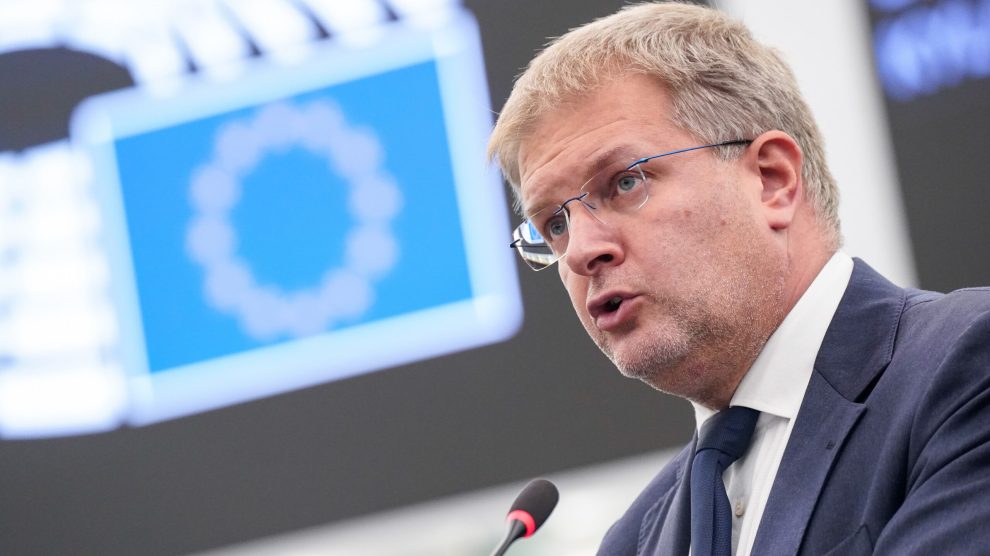
Speaking to Decode39 from Mexico City, Carlo Fidanza, Head of the Brothers of Italy delegation in the European Parliament, Vice President of the EuroLat Parliamentary Assembly, and Vice President of the ECR party, reflects on the latest EuroLat gathering, the special forum that for twenty years has fostered relations with the southern side of the Atlantic.
The occasion also provides an opportunity to assess the political landscape in Latin America, where conservative parties are advancing across the region, and to examine the state of agreements such as Mercosur.
Q: Twenty years of EuroLat: what assessment can be made, particularly in light of the cooperation between ECR and Latin America, and the frequent visits of Latin American leaders to Palazzo Chigi?
A: Latin America is going through a historic phase of profound political change. The disastrous era dominated by the so-called São Paulo Forum is drawing to a close. Created by Lula together with left-wing and far-left parties and movements, it shaped governments across much of Latin America through a mix of welfare populism, links to drug trafficking, anti-Western rhetoric, and restrictions on democratic dissent, eventually giving rise to murderous regimes such as those of Maduro in Venezuela, the Castro brothers and Díaz-Canel in Cuba, and Ortega and Murillo in Nicaragua.
- The interparliamentary assembly, which brings together members of the European Parliament and Latin American legislatures, remains a valuable platform for reaffirming the historic bond between the two continents. However, it must adapt to the new political reality and overcome the blockages and delays of the past.
Q: Conservative parties are advancing throughout Latin America. What does this signal?
A: It signals that the governments and regimes linked to the São Paulo Forum experience have reached the end of the road. The remarkable rise of Javier Milei in Argentina, the recent victory of José Antonio Kast in Chile, that of Rodrigo Paz in Bolivia, as well as Maduro’s removal from power and the imminent collapse of the Cuban regime, demonstrate that this model has failed and that it is now time for conservatives to build the alternative.
- We look with hope to the second round of Peru’s presidential election, where Keiko Fujimori is leading the left-wing candidate; to the upcoming presidential election in Colombia, where outsider Abelardo de la Espriella is running; and to Brazil’s elections later this year, where, despite unprecedented judicial persecution, the conservative opposition led by Flavio Bolsonaro may finally bring Lula’s era to an end.
- Added to this are the leadership of President Peña in Paraguay, Noboa in Ecuador, and the recent successes of centre-right forces in Costa Rica and Honduras. Nor should we overlook the controversial president of El Salvador, Nayib Bukele, who, through his zero-tolerance policies, transformed what was once considered the most dangerous country in the world into a place where people can walk safely in the streets.
- In short, the wind has clearly shifted and is blowing to the right. We want to strengthen our network of relations with conservative parties across the continent because we face common challenges and share deep cultural roots, as well as strong ties through the many Italians living there.
Q: At what stage is Venezuela’s transition, and how can a democratic process leading to free elections be ensured?
A: The interim government of Delcy Rodríguez continues to operate in a state of constant ambiguity. On the one hand, it fuels anti-American and anti-Western narratives to appease the most radical factions left behind by Maduro. On the other, it has sent signals of openness toward U.S. demands. Yet progress toward democratic transition remains far too slow.
- Consider that the amnesty law introduced by Rodríguez at the end of February was abruptly revoked, and only now has a new wave of political prisoner releases been announced. We do not intend to abandon the goal of a transition based on free elections. We were among the promoters of the European Parliament’s Sakharov Prize being awarded to María Corina Machado and President-elect Edmundo González, and we have no intention of accepting watered-down solutions.
- It will still take time, but the path has been set.
Q: How should the recent trade agreements between the EU and Latin American countries be viewed in terms of future prospects?
A: As we know, global trade tensions are forcing the European Union to seek new commercial outlets. Italy is a major exporting nation and can find promising new markets, particularly in a continent where Italy enjoys a degree of admiration that we often underestimate ourselves.
- At the same time, free trade must also be fair trade. That is why we insist on the concrete application of the principle of reciprocity in these agreements. Products made using substances that have long been banned for European producers should not be allowed into Europe.
- In practical terms, this means defending our agriculture, negotiating effectively, and improving enforcement. We achieved this only partially with the EU-Mercosur agreement. The renewed agreement with Mexico moves in the same direction and presents similar challenges, albeit with a much smaller potential impact. The announced protection of an increasing number of geographical indications is welcome, but reciprocity must now be applied fully and consistently.
Q: Energy and critical raw materials: how can the relationship between the EU and Latin America reduce strategic dependencies and counter China’s economic penetration in both regions?
A: Latin America is extraordinarily rich in minerals and critical raw materials that we have negligently left open to Chinese penetration. For us, however, it is essential to build value chains with friendly nations if we are to meet the challenge of Europe’s twin transitions.
- In this respect, the new trade agreement with Mexico—a country rich in lithium and copper—opens up a new opportunity. Yet it must now be implemented effectively to ensure that it does not become another unfinished project.