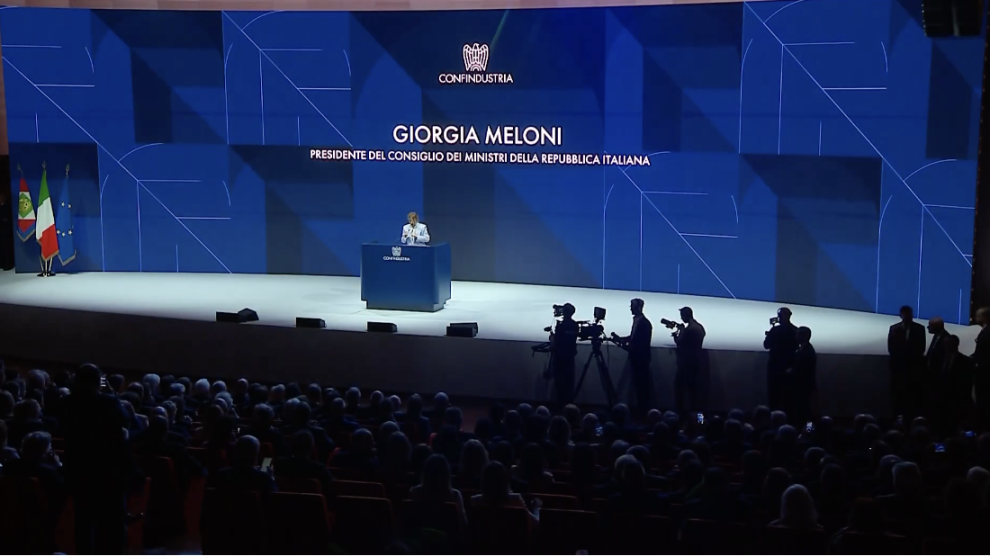
ROME — Italy’s annual Confindustria assembly — hosted by the country’s main business organization — turned into a joint call from business and government for a tougher European industrial strategy, as Prime Minister Giorgia Meloni and industrial leaders linked energy costs, geopolitical instability and manufacturing competitiveness in unusually direct terms.
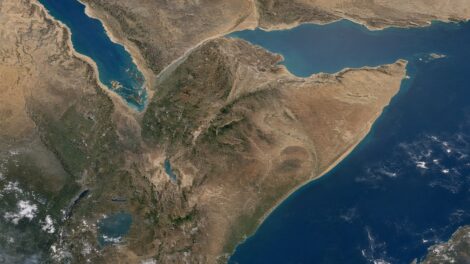
The backdrop was the escalating Middle East crisis and fears over the Strait of Hormuz, a critical route for global energy flows that Italian industry sees as a direct threat to production costs and economic stability.
The industry message. Confindustria President Emanuele Orsini warned that European industry risks sliding toward “industrial desertification” unless Brussels moves quickly on energy, trade and industrial protection.
- PM Meloni, speaking before President Sergio Mattarella and Italy’s business elite at Rome’s La Nuvola convention center, used the occasion to defend a broader strategy combining support for defense spending with emergency economic flexibility for households and companies.
Why it matters: Rome is increasingly framing industrial competitiveness as a national security issue.
- Italy is pushing the EU to widen fiscal flexibility beyond defense spending to include energy-related support measures.
- Confindustria is escalating pressure on Brussels over Chinese industrial overcapacity and EU climate regulation.
- The government is using the energy crisis to relaunch its nuclear agenda and attack parts of the EU’s green regulatory framework.
Zoom in: Industry’s warning energy… Orsini delivered one of the sharpest warnings yet from Italian industry on the state of European manufacturing.
- “We do not want to relocate our industries and deindustrialize our continent,” he said, pointing to rising energy costs and uncertainty linked to the Middle East crisis. Referring to the debate over the Strait of Hormuz, he added: “We keep hearing statements — open it, close it, close it, open it. We hope a solution can be found for the Strait of Hormuz, because the issue of energy costs is now a priority.”
… and China. The Confindustria president argued that Europe is struggling to respond to China’s industrial scale and export strategy. “China is colonizing our markets,” Orsini said. “If the European Union does not immediately support our production systems, we will be forced into an industrial desert.”
- He described China as “the only real industrial superpower,” noting that it now accounts for 35% of global manufacturing output — “more than the other eight leading industrial countries combined.”
- Yes but… the issue, Orsini argued, is not only scale. “China plays with distorted rules and exports its own imbalances to the rest of the world — deflation and weak domestic demand,” he said. “It is shifting an enormous volume of goods toward European markets. Not only low-cost products, but also advanced technologies, sectors where China has overcapacity while Europe struggles and falls behind.”
- The message from Italian industry was clear: Europe’s competitiveness debate is no longer only about productivity or innovation, but increasingly about strategic protection of industrial capacity.
Between the lines: Meloni and business align. Meloni used the assembly to underline a growing convergence between her government and Italian industry.
- “We have shown that even when we start from different positions, at a certain point we can discover that we are a team if the objective is the same,” she said, referring to the goal of putting “the nation in the best possible condition to face the difficult challenges of this time with its head held high.”
- The speech mixed national resilience, economic pressure and geopolitical uncertainty, with Meloni repeatedly arguing that Italy cannot separate industrial policy from broader strategic autonomy.
- “The government is here and does not intend to retreat by a single millimeter,” she said. “We are not afraid of the weight of responsibility, nor afraid of proving ourselves equal to the task.”
At the same time, Meloni acknowledged the pressure on companies and households from the energy shock and broader instability. “No one underestimates the harshness of the time we are living through,” she said.
Energy first. Energy emerged as the central issue tying together the entire assembly. Meloni thanked Orsini for recognizing what she described as the government’s effort to change Italy’s energy approach, particularly by increasing supply and strengthening tools aimed at ensuring “stability, continuity and more predictable prices.”
- She also directly linked the crisis involving Iran and the Strait of Hormuz to Italy’s push for more EU fiscal flexibility.
- “These are circumstances that escape the control of EU member states and fully justify extending the flexibility already granted for security and defense spending to the investments needed to address the energy crisis,” Meloni said.
- Rome has formally asked the European Commission to expand the scope of the EU’s “National escape clause” to allow support measures for families and companies affected by the energy shock.
- “It is not about being authorized to create new national debt,” Meloni argued. “It is about allocating better what already exists. Pure common sense.”
The broader Italian argument is that energy security should now be treated as part of Europe’s strategic resilience framework, alongside defense.
Defense and economic survival. Meloni also sought to balance support for higher defense spending with domestic economic concerns — a politically sensitive issue in Italy.
- “I have not changed my position on defense spending, even though I know very well that the issue is unpopular in Italy,” she said. “A serious leader must tell the truth. The truth is that if you cannot defend yourself, if you ask someone else to guarantee your security, you will pay for it in terms of autonomy and your ability to defend your national interests.”
- But she added that economic strain carries its own strategic risks. “If today we do not help families and businesses overcome the impact of a significant crisis, tomorrow there may be nothing left to defend in this country,” Meloni said. “We must create a balance between two necessities.”
The formulation reflects a broader attempt by Rome to connect NATO-related defense commitments with industrial and social stabilization measures.
The EU target. Another recurring target was the EU’s emissions trading system. Meloni described the ETS as a “paradoxical tax” that risks creating “further disparities,” arguing that Europe continues to defend “ideological totems” instead of adapting to the economic pressures facing industry.
- “This is not the right path,” she said. “It is the right path only if we want to surrender ourselves to decline.”
- The criticism places Italy within a growing European push to revisit parts of the Green Deal framework amid concerns over industrial competitiveness and energy costs.
- Meloni also criticized excessive regulatory constraints more broadly, arguing that Europe should move toward a principle where “everything that is not explicitly forbidden for a higher protected interest should be allowed, without cages and constraints whose only consequence is suffocating economic initiative.”
Nuclear comeback. Meloni used the assembly to reaffirm the government’s commitment to bringing nuclear power back to Italy.
- “We want to move quickly on the path toward the return of nuclear energy in Italy, starting with the most innovative technologies and modular reactors,” she said.
- According to the prime minister, a framework law delegating powers to the government should be approved by the summer, followed by implementing decrees. “I have no doubt that restarting nuclear production is within our reach and important for our competitiveness,” she said. “I am very determined on this.”
The bottom line: The Confindustria assembly highlighted a growing alignment between Italy’s government and industrial sector around a common message: Europe’s energy vulnerability, industrial competitiveness and geopolitical security can no longer be treated as separate issues.