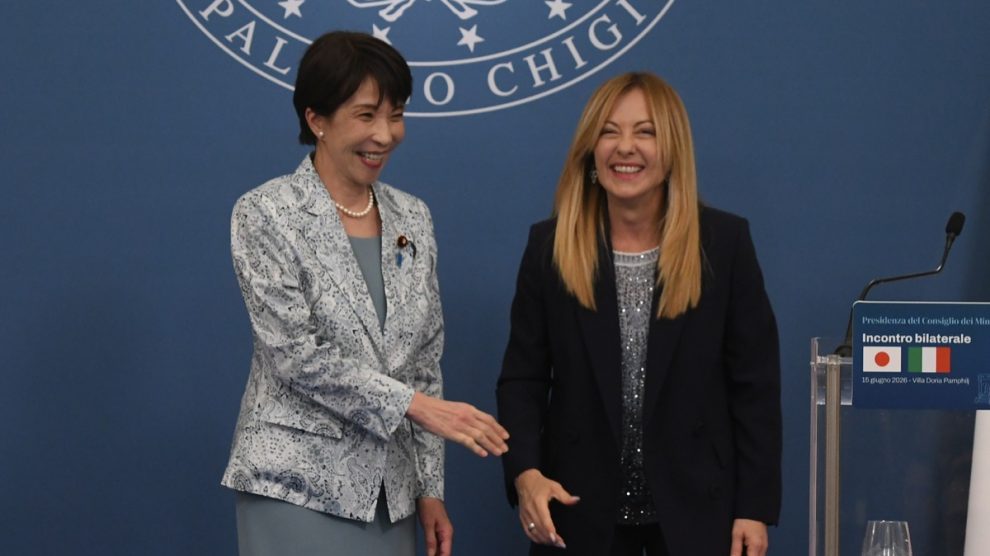
Italy and Japan used Monday’s meeting in Rome between Prime Minister Giorgia Meloni and Japanese Prime Minister Sanae Takaichi to reinforce a strategic partnership that is increasingly centered on defense, space, economic security and critical technologies ahead of the G7 summit in Evian.
The big picture: The summit gave both governments an opportunity to review progress on the agreements reached during Meloni’s visit to Tokyo in January and align positions on major international issues, from Ukraine and the Middle East to Indo-Pacific security.
- Speaking to reporters after the meeting, Meloni emphasized both her personal rapport with Takaichi and the strategic nature of the relationship between the two countries.
- “I am very, very pleased to have the opportunity to meet again, because it is clearly a chance to exchange views once more with a friend, but also because I have had the opportunity to engage with a pragmatic, concrete and determined leader, with whom I share a particular political affinity,” Meloni said.
- “Like me, she is convinced that Italy and Japan are naturally strategic allies, destined to work together because they know that together they can shape both the present and the future.”
The meeting came five months after Italy and Japan upgraded bilateral ties to a Special Strategic Partnership, a move that has accelerated cooperation across multiple areas. In May, Nagoya hosted a new meeting of the Italy-Japan Business Group, while Tokyo held the first session of a new bilateral economic security dialogue and the inaugural meeting of a new intergovernmental space dialogue.
- According to Italian sources, Rome and Tokyo share the goal of turning the political framework established in January into tangible results, using 2026 — the 160th anniversary of diplomatic relations between the two countries — as a key milestone.
- Both governments also pledged to deepen cooperation on critical raw materials, an increasingly important issue in the broader economic security agenda.
- Beyond defense and supply chains, both governments identified artificial intelligence, biotechnology, advanced manufacturing and next-generation civil nuclear energy as priority areas for future cooperation.
Space takes center stage. One of the most significant outcomes of the Rome summit concerns space, a sector that both governments increasingly view as a pillar of the bilateral relationship.
- In a joint declaration signed alongside the meeting, Meloni and Takaichi acknowledged the growing importance of space “in all fields, from scientific research to security and the space economy,” and agreed on the need to deepen cooperation by building on existing partnerships, including the long-standing relationship between the Italian Space Agency (ASI) and the Japan Aerospace Exploration Agency (JAXA).
- The agreement aims to strengthen scientific and technological cooperation while expanding industrial ties between the two countries’ space sectors. Rome and Tokyo also committed to facilitating reciprocal access to their space industries, promoting commercial cooperation between companies and supporting the development of new technologies and expertise.
- Particular attention will be devoted to small and medium-sized enterprises and startups, which both governments intend to support through their respective funding mechanisms in order to encourage new industrial partnerships.
Defense and economic security. Defense remains another cornerstone of the relationship. Meloni highlighted the Global Combat Air Programme (GCAP), developed jointly with the United Kingdom, as one of the central pillars of bilateral cooperation.
- “Defense is another crucial sector of Italy-Japan cooperation,” she said. “We have continued to work side by side on a highly strategic program, the Global Combat Air Programme, which brings us together with the United Kingdom in the development of a sixth-generation fighter aircraft. Here too, we have finally entered the operational phase.”
- Alongside defense, economic security is becoming increasingly prominent in the bilateral agenda. The launch of a dedicated dialogue reflects shared concerns over supply-chain resilience, critical technologies and reducing vulnerabilities linked to strategic raw materials.
- On the economic front, both governments reaffirmed their interest in further strengthening trade and investment ties. Bilateral trade reached €12.3 billion in 2025, generating a €4.4 billion surplus for Italy. Trade totaled roughly €3 billion in the first quarter of 2026.
The Africa angle. Africa has also emerged as a new area of cooperation.
- Meloni announced plans to launch a structured dialogue between Italy’s Mattei Plan and Japan’s Tokyo International Conference on African Development (TICAD).
- “Italy and Japan share the same outlook toward the African continent, and it is our intention to launch a structured bilateral dialogue to build synergies between our Mattei Plan and Japan’s TICAD initiative,” she said.
Aligning before the G7. International crises dominated much of the strategic discussion.
- Meloni and Takaichi welcomed the memorandum between the United States and Iran and stressed the importance of the transit through the Strait of Hormuz, one of the world’s most critical energy corridors. “We held an in-depth discussion on the international crises,” Meloni said, expressing “satisfaction” with the memorandum and reiterating the importance of the “reopening of the Strait of Hormuz.”
- Takaichi echoed that position: “We welcome the U.S.-Iran memorandum and hope it can lead rapidly to an agreement ensuring free and secure navigation through Hormuz,” the Japanese prime minister said.
- The two leaders also coordinated positions ahead of the G7 summit, with Ukraine occupying a central place in the conversation.
- Meloni described Russia’s aggression as “unacceptable” and said support for Kyiv would remain one of the key themes of discussions among G7 leaders. “In the face of Russia’s brutal attacks, we cannot look the other way. Solidarity is essential,” she said, adding that support for Ukraine and efforts to achieve peace would remain “a central element” of the summit agenda.
Between the lines: The growing convergence between Rome and Tokyo reflects a broader strategic trend.
- In recent years, Japan has progressively expanded the scope of its Free and Open Indo-Pacific strategy beyond traditional security issues to include economic security, energy, emerging technologies and supply-chain resilience.
- Many of the issues now driving Italy-Japan cooperation — from economic security and critical technologies to strategic supply chains and industrial partnerships — fit squarely within that broader framework and reflect a narrowing gap between European and Asian strategic priorities.
The bottom line: Rather than unveiling a series of new standalone initiatives, the Rome summit demonstrated that the Special Strategic Partnership launched in January is moving into an operational phase, with economic security and geopolitical coordination emerging as the central pillars of the Italy-Japan relationship.
- Meloni framed the relationship as a partnership increasingly focused on implementation. She noted that initiatives announced during the January summit — including the economic security dialogue and the space dialogue — have already been launched, with both governments now preparing additional projects ahead of the G20.