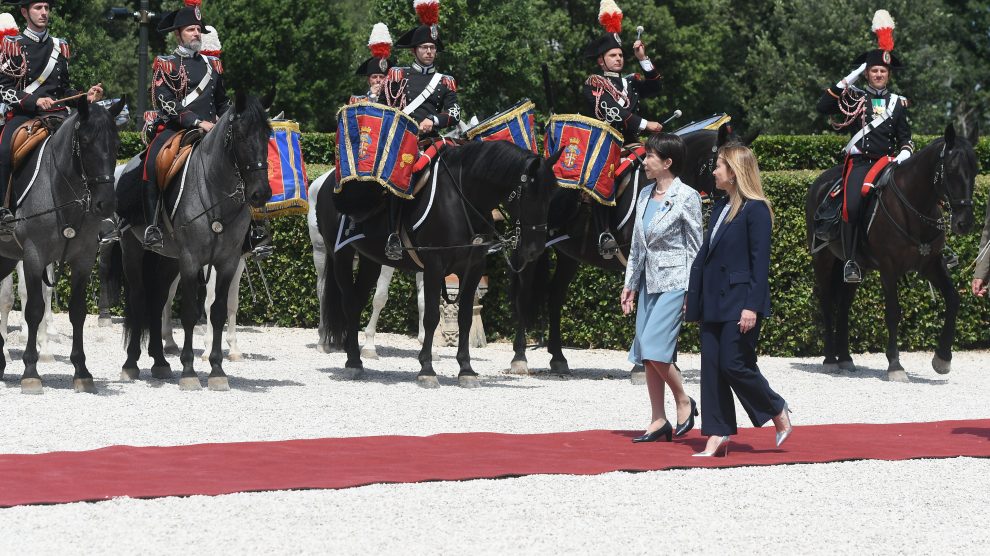
Beyond diplomacy, the meeting between Italian Prime Minister Giorgia Meloni and Japanese Prime Minister Sanae Takaichi delivered a clearer picture of where Rome and Tokyo want to deepen industrial cooperation under the “special strategic partnership” launched in January.
Supply chains move to the top of the agenda. Italy and Japan signed an intergovernmental memorandum aimed at strengthening supply chain resilience.
- Takaichi described economic security — including energy security — as a fundamental issue for both countries and welcomed the agreement as a tool to reinforce critical supply chains.
- Both economies are heavily integrated into global manufacturing networks and remain exposed to disruptions affecting strategic goods and technologies. The agreement signals a push for closer coordination between governments and industry on supply-chain security.
Energy security remains a shared priority. The two leaders discussed energy resilience, including possible actions within the G7 framework.
- The talks also built on discussions held in January on mutual assistance in liquefied natural gas (LNG) supplies during emergencies.
- Energy remains a strategic concern for both countries. Closer coordination could create additional opportunities for industrial cooperation across energy infrastructure, supply security and related technologies.
Semiconductors gain strategic importance. Meloni and Takaichi pointed to what they described as concrete progress in semiconductor cooperation between institutions and companies from both countries.
- Chips have become a core element of economic security strategies worldwide. The emphasis on linking public institutions and private-sector actors suggests that Rome and Tokyo are looking beyond political dialogue toward industrial partnerships.
Advanced nuclear cooperation enters the agenda. The two governments said they intend to deepen cooperation on next-generation civil nuclear technologies and combine Italian and Japanese engineering expertise.
- Italy is pursuing plans to reintroduce advanced nuclear technologies, while Japan has decades of experience in the sector. The area could become a new channel for industrial, engineering and research collaboration.
Space is becoming a business sector. Italy and Japan agreed to expand cooperation in space, building on existing partnerships between the Italian Space Agency (ASI) and the Japan Aerospace Exploration Agency (JAXA).
- The two countries welcomed the results of bilateral space consultations held in Tokyo in May and pledged to facilitate reciprocal access to space, promote commercial cooperation and support small and medium-sized enterprises and startups.
- The language adopted by Rome and Tokyo goes beyond scientific cooperation. The emphasis on commercial partnerships, financing mechanisms and industrial ecosystems points to a growing business dimension in the bilateral space relationship.
The lunar economy angle. Italy and Japan also committed to strengthening cooperation under the Artemis framework, including work related to the Lunar Multi-Purpose Habitation Module and the Pressurized Rover developed in coordination with NASA.
- They also pledged continued collaboration on low-Earth orbit activities, the International Space Station and future space stations.
- The commitments place both countries within emerging lunar and orbital supply chains that could generate opportunities for aerospace manufacturers, technology firms and research organizations.
The bottom line: The Rome summit suggests that the Italy-Japan relationship is evolving beyond traditional diplomacy and defense cooperation. For businesses, the clearest signals came in sectors tied to economic security and critical technologies: energy, semiconductors, advanced nuclear and space.