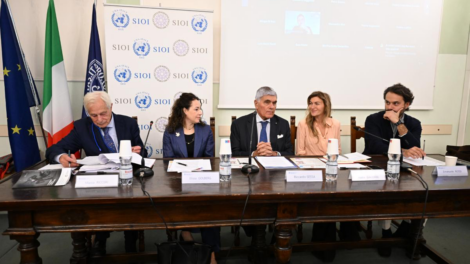
Decoding the news. Antonio Missiroli, former director of the European Union Institute for Security Studies and former NATO deputy secretary general for emerging security challenges, argues that the weeks leading up to the Ankara summit will bring an escalation of the debate over European defence spending.
- On the Iran deal, he sees no defeat for Tehran: “There are criticisms within the United States, Congress and the Republican Party itself, which probably help explain why JD Vance postponed his trip to Switzerland to continue the negotiations.”
Q: How do you assess the EU leaders’ request for the European Commission to develop stronger tools to address China’s economic power?
A: It is a kind of compromise between two different approaches: one that wanted to be more aggressive and begin using the existing instruments against China immediately, and another that preferred to buy time and adopt a more pragmatic model.
- Many probably also had Donald Trump’s own experience in mind. When he imposed additional tariffs on China, he received an immediate response that forced him to backtrack and adopt a much lighter approach toward Beijing. And we should not forget that Trump is considered a hawk in relations with China.
- The approach, therefore, is to buy time, explore which instruments can be used appropriately, and make a possible decision at a later stage. We are still at a preliminary stage. This is not a decision that signals an intention to impose tariffs on China, precisely because there are different approaches within the European Union.
Q: Military defense is not the only priority. Trade defense also emerged from the EU Council. Is that part of the backdrop to Donald Trump’s unusual remarks?
A: I think it is part of Trump’s personality and way of operating. He even mocks his own allies and presents himself as a bully, especially at a moment of obvious weakness following the Iran deal and the criticism he has received both over the war itself and the agreement that followed.
- There is, therefore, a desire to restore the image of a strong and powerful man to whom everyone turns for something. I do not think this is directly connected to trade disputes.
Q: Does the deal appear weak to you, all things considered?
A: Based on what has emerged in the international press, compared with the positions Trump expressed in recent weeks, it looks almost like a victory for Iran. On the nuclear program, there is simply a postponement of the decision by at least two months, and we know how difficult the Iranians are in this kind of negotiation.
- There is a commitment – one Iran had already made several times in the past – not to develop a nuclear weapon. But this is not a concession Iran is making to the United States now. There is also a commitment to progressively lift the economic sanctions imposed by the United States on Iran, as well as the idea of creating a fund – presumably not with American money, but with funds from Gulf countries – for Iran’s reconstruction.
- If this is an agreement that signals Iran’s defeat, I think we would all be surprised. From this perspective, there are also criticisms within the United States, Congress and the Republican Party itself, which probably help explain why JD Vance decided to postpone his trip to Switzerland in order to continue the negotiations.
Q: Why, in your view, is Trump targeting Italy, to which Giorgia Meloni responded forcefully? Does the approaching Ankara summit also play a role?
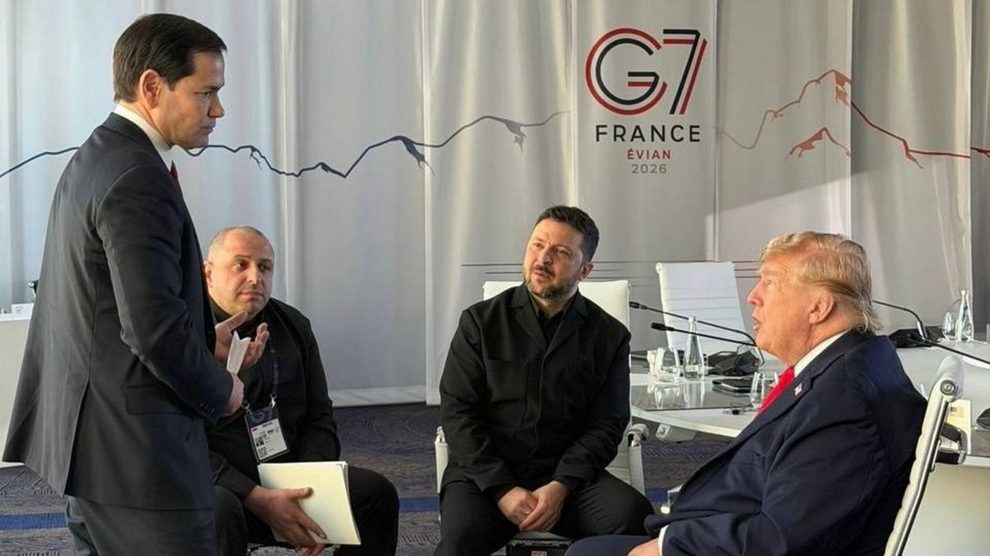
A: From this perspective, the G7 summit was seen as positive, in the sense that the feared skirmishes and disputes did not materialise. There had even been expectations that Trump would not attend, or that the United States would not sign the joint document ultimately adopted.
- I would point to Defense Secretary Pete Hegseth’s speech at NATO headquarters, which was particularly aggressive toward allies. It is clear that, in the weeks leading up to the Ankara summit, there will be a kind of escalation in the debate over defense spending by European countries.
- There are certainly some countries, including Italy, that are considered not to be meeting the commitments made only a year ago at the Hague summit. The Pentagon and the Trump administration will therefore exert pressure on all allies, particularly those that have so far been seen as more reluctant to increase defense spending.
- But this is not specifically directed at Italy. Other countries are also in a difficult position from this standpoint. It is also part of building leverage to obtain possible concessions in the final document that could be approved in Ankara.
Q: America’s distancing from the Atlantic alliance did not begin today. Given the wars underway, how can NATO be reformed in a way that strengthens rather than fragments it?
A: In the event of a gradual – and hopefully negotiated – American disengagement from the Atlantic Alliance, including the withdrawal of forces and at least part of its equipment from Europe, it would clearly be difficult to imagine a NATO stronger than it was a few years ago.
- However, it is entirely conceivable that, if this partial American disengagement is carried out gradually and in cooperation with allies, Europeans could mitigate the possible negative consequences.
- For Europe, this remains a highly demanding challenge. It is not only a matter of at least partially replacing American capabilities that may be deployed elsewhere, but also of developing a greater capacity to act independently from the United States in terms of command management.
- Some transfers of responsibility have already taken place in recent months, including in the provision of specific military capabilities to the alliance. Europeans have probably understood both the challenge and the reality. The major difficulty now is putting it into practice and determining how, within the Atlantic Alliance, the idea of a European pillar – or at least greater European responsibility – can be translated into operational terms.