The Indo-Pacific is delving deeper into the conversation at NATO’s Ankara summit through a series of meetings and initiatives that showed how deeply the two strategic theaters have become interconnected. NATO expansion eastward is not on the table: what is growing instead is a network of cooperation built around shared interests, industrial capabilities and common vulnerabilities.
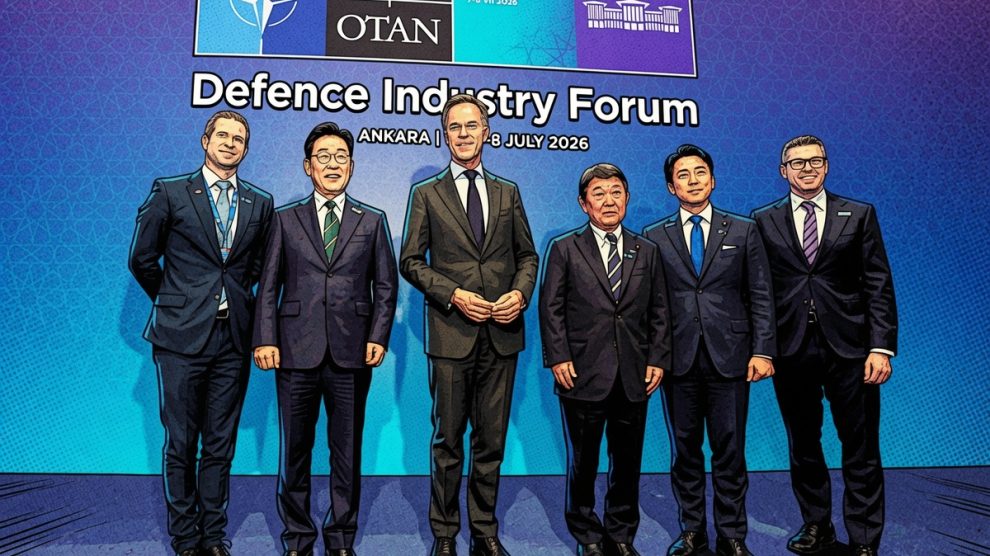
The IP4 meeting. On July 7, NATO Secretary General Mark Rutte met with representatives of the Alliance’s four Indo-Pacific partners — Japan, South Korea, Australia and New Zealand, collectively known as the IP4.
- The discussion covered Ukraine, China, North Korea and Iran before turning to areas where cooperation can become more concrete: the defense industry, cyber and technology.
The Asian view. Interest in this relationship appears to be growing on the Asian side just as Washington is asking its allies to assume greater responsibility for their own security.
- South Korean President Lee Jae-myung has described cooperation with NATO as a tool for addressing challenges that increasingly cut across regional boundaries, from supply chain security to military cooperation between Russia and North Korea.
- Tokyo has emphasized the same interdependence. According to Japanese Foreign Minister Toshimitsu Motegi, developments in the Euro-Atlantic and Indo-Pacific regions are now part of a single strategic picture.
- The convergence is driven by concrete interests, with a holistic approach to economic security emerging as the most immediate area for cooperation.
Zoom in: The Italy link. Italy is part of these discussions.
- President Lee was in Rome in mid-June, just days before Japanese Prime Minister Sanae Takaichi, who involved Italian Prime Minister Giorgia Meloni in the European launch of the FOIP review.
- On the sidelines of the NATO summit, Meloni also met Japanese Defense Minister Shinjiro Koizumi together with Deputy Prime Minister and Foreign Minister Antonio Tajani and Defense Minister Guido Crosetto.
- What they said: “We discussed issues of common interest in depth, with particular attention to the Indo-Pacific region and the delicate situation in the Middle East,” Crosetto said.
- He added that the meeting also provided an opportunity to take stock of the GCAP program, which he described as “fundamental to ensuring innovative operational capabilities and securing a competitive and technological advantage in the aerospace sector.”
The GCAP lens: GCAP offers a useful lens through which to understand what is happening. Italy, the United Kingdom and Japan are building a partnership that will integrate industrial expertise and advanced technologies for decades, spanning sensors, artificial intelligence, electronic warfare and data management.
- Ankara showed how this kind of relationship is becoming an increasingly important component of the broader connection between Europe and the Indo-Pacific.
The nuclear layer. In the same hours, the United States, Japan and South Korea signed a memorandum aimed at accelerating the deployment of small modular reactors (SMR) in third countries, with an initial focus on the Indo-Pacific.
- The document addresses economies of scale, project de-risking, private investment, licensing processes and supply chains.
- Strategic cooperation also depends on the ability to offer competitive technologies, infrastructure and standards to countries that will need to meet growing energy demand over the coming decades.
The paradox. This is where the summit’s most interesting dynamic emerges. The Trump administration would like to return NATO to its “factory settings,” with Europeans assuming greater responsibility for the security of their continent.
- At the same time, the capabilities underpinning Western deterrence increasingly follow a much broader geography. Security remains organized around theaters. Industry, technology and supply chains continuously cross them.
The wider lens: Beyond the IP4. The same dynamic extends to countries outside the IP4 format. Rachel Rizzo, a senior fellow at the Observer Research Foundation, points to India as one of the actors to watch.
- In her analysis, rising European defense spending and the search for additional production capacity could create more space for New Delhi within the Euro-Atlantic defense industrial ecosystem.
- India’s recently established Security and Defence Partnership with the European Union, its expanding manufacturing base and its vast domestic market strengthen its bargaining position with European partners.
The bottom line: Ankara offered a relatively clear picture of the trajectory now taking shape.
- NATO is deepening cooperation with its Indo-Pacific partners as Europe and Asia build increasingly dense industrial and technological relationships.
- GCAP, SMR, cyber and supply chains belong to different policy areas, yet they converge around a decisive question: the capacity to produce, control and share the technologies on which security will depend in the coming decades.
- NATO’s geographical perimeter remains the one defined by the Treaty. The network of political and practical cooperation supporting Euro-Atlantic security now extends far beyond it.