

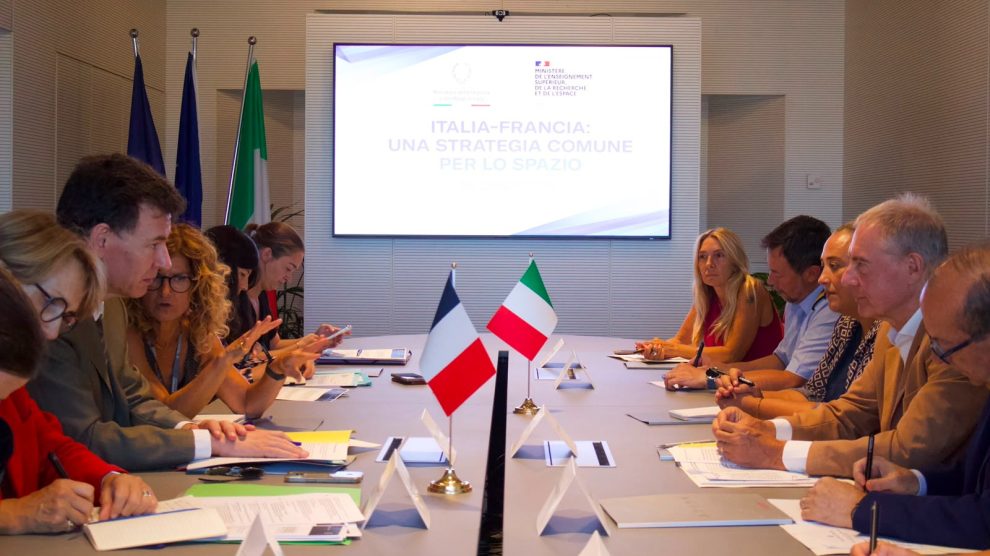
Italy is increasingly treating Europe as the natural framework for its space ambitions. The visit of Industry Minister Adolfo Urso and French Space Minister Philippe Baptiste to the Fucino Space Centre reinforced a political line that links industrial consolidation, secure communications and autonomous access to orbit.
The move: The visit followed a series of steps that have deepened cooperation between Rome and Paris, including a joint declaration on the space economy and the bilateral summit between Giorgia Meloni and Emmanuel Macron in Antibes.
- Fucino provided the latest setting for that convergence. The centre is operated by Telespazio, the joint venture between Leonardo and Thales, and is expected to play a role in Europe’s future secure satellite communications architecture.
- The broader message was clear. Italy wants to build strategic space capabilities alongside France and Germany rather than rely primarily on technologies and services developed outside Europe.
Why it matters: The shift does not imply a break with Washington, but it does suggest a change in emphasis.
- Italy has maintained dialogue with the United States on space and strategic technologies, yet recent political momentum has been concentrated on European initiatives.
- That is particularly visible after months of debate over the possible use of Starlink for secure communications. The focus has now moved toward European-controlled systems and industrial capacity.
Strategic convergence. The clearest expression of this approach is Bromo, the planned alliance between Leonardo, Airbus and Thales to create a stronger European satellite group.
- Its significance is not only commercial. Bromo is intended to address one of Europe’s main structural weaknesses in space, the fragmentation of national industries and programmes.
- “Italy and France together must show the way toward European champions,” Urso said, arguing that competition is no longer mainly within Europe but increasingly with actors outside it.
- Baptiste echoed the same logic, presenting space as a core element of European sovereignty across defence, security, research and industry.
The bigger picture: The same strategy underpins Iris², Europe’s future secure communications constellation. Fucino is expected to serve as one of its control hubs, complementing Toulouse.
- With more than 170 antennas, the site offers Italy a way to place existing operational capabilities inside a broader European architecture. Bromo would perform a similar function on the industrial side.
- Together, the two projects reflect a wider objective: ensuring that Europe can control satellites, data, services and communications infrastructure.
What comes next: Launch capability remains the other key pillar. Without autonomous access to space, European constellations and secure services would remain exposed to external dependencies.
- Urso therefore linked the broader strategy to Vega-C and to deeper cooperation on launchers.
- The Paris summit on September 9-10 and the interim European Space Agency ministerial meeting in Italy in December will test whether this political alignment can be translated into programmes, resources and industrial capacity.
- The direction, however, is already visible. Italy wants to build its future in space through Europe, not simply purchase it elsewhere.